Still-Hunting After a Wisconsin Snow
There’s nothing quite like that first blanket of fresh snow in Wisconsin, transforming familiar woods into a crisp, quiet wonderland. But for deer hunters, it’s more than just a pretty picture; it's an undeniable advantage, turning what can be a frustrating guessing game into a solvable puzzle. If you've ever trudged through dry leaves, spooking deer before you even knew they were there, you know the struggle. This guide is all about embracing the snow, showing you how to still-hunt effectively and turn those silent, white woods into your best ally for filling a tag.
The Magic of Fresh Snow and Deer Movement
That first significant snowfall isn't just a change in scenery; it's a game-changer for deer hunting tactics, especially for the still-hunter. The world quiets down, deer behavior shifts, and suddenly, the woods reveal their secrets in a way they never do during other seasons.
Why Snow Changes Everything
Imagine trying to walk through a dry fall woods – every step is a crackle, a crunch, a tell-tale sign of your presence. Now picture that same woods under six inches of fresh powder. Each step, if taken carefully, is muffled. This reduction in noise pollution is perhaps the most immediate and profound benefit for the still-hunter. Deer, constantly on alert, rely heavily on their sense of hearing. When your footsteps are softened by snow, you drastically increase your chances of getting within shooting range before they detect you. It's like turning down the volume on the entire forest, allowing you to move with unprecedented stealth.
Beyond the sound, snow paints a clear picture of deer activity. It's a fresh canvas that records every step, every browse, every scrape. You can instantly tell how recently deer have been in an area, their direction of travel, and even their approximate size by the tracks they leave. This eliminates much of the guesswork inherent in hunting bare ground. Instead of wondering if a rub line is old or new, or if a bedding area is currently in use, the snow provides indisputable evidence. A line of fresh tracks leading into a thicket isn't just a sign; it's an invitation to follow. It simplifies the scouting process, allowing you to focus on truly active areas and adapt your plan in real-time.
Understanding Winter Deer Behavior
As soon as that cold snap hits and snow starts to accumulate, a deer's priorities shift dramatically. Their primary focus becomes energy conservation and finding reliable food sources. This means their daily routines often become more predictable, revolving around bedding down in thermal cover and moving to feed. During the early season, deer might roam more broadly, but once winter truly sets in, they become more deliberate. You'll find them concentrating in areas that offer both shelter from the elements and accessible food. This might be a dense conifer stand offering protection from biting winds and heavy snow, or a south-facing slope that gets more sunlight and melts snow faster.
Knowing this, a still-hunter can anticipate where deer are likely to be throughout the day. Instead of wandering aimlessly, you can target specific types of habitat. For instance, after a brutal cold front, deer will gravitate towards thick cover like cedar swamps or pine plantations to escape the wind and retain body heat. This is prime territory for still-hunting, as deer will often be bedded down tight, allowing you to approach slowly and carefully. They won't be as apt to move unnecessarily, which can be both a blessing and a curse. You might get closer, but they'll be watching and listening intently. Targeting these thermal sanctuaries, especially later in the morning or mid-day, can be incredibly productive. You can learn more about Hunting the Wisconsin Rut in November as well as understanding how deer adapt to different times of year.
Essential Gear for Still-Hunting in Snow
Still-hunting in the snow demands a specific approach to gear. It’s not just about staying warm; it’s about staying quiet, dry, and being able to navigate effectively in potentially challenging conditions. Your equipment should enhance your stealth and endurance, not hinder it.
Clothing and Layering for Cold and Quiet
The core principle for still-hunting clothing in Wisconsin snow is layering. You need to be able to regulate your body temperature as you transition from slow, deliberate walking to periods of standing or sitting perfectly still. Start with a moisture-wicking base layer – synthetics or merino wool are excellent choices that pull sweat away from your skin, preventing that chilling effect when you stop moving. Over that, add an insulating mid-layer, like a fleece jacket or a down vest. This is your core warmth.
For your outer layer, quietness is paramount. Stiff, noisy fabrics like many waterproof shells can betray your presence long before you see a deer. Look for brushed fleece, softshell materials, or even traditional wool that is both warm and exceptionally quiet, even when brushing against branches. Brands like Sitka, Kuiu, or even budget-friendly options that prioritize quiet fabrics will make a huge difference. You'll also need a warm, quiet hat and gloves. Many still-hunters prefer thin gloves for better feel on the rifle or bow, with a thicker pair to slip on during static periods. Remember that Wisconsin's Blaze Orange and Pink Options apply during gun seasons, so incorporate those quiet, visible layers into your system. Think about how much quieter a soft wool jacket is compared to a crunchy rain shell when you're slowly raising your binoculars.
Footwear for Silent Movement
Your feet are your primary contact with the snow, and the right footwear can make or break a still-hunt. The ideal boot for still-hunting in snow is waterproof, insulated, provides good ankle support, and has a sole pattern that offers grip without picking up excessive snow. Scent is also a factor, so consider rubber boots or scent-controlling options. However, even the best boots won't guarantee silence without proper technique.
The real trick is learning to "feel" the ground beneath the snow. You're looking for firm spots, old logs, or packed snow that won't crunch or compress loudly. Take short, deliberate steps, rolling from heel to toe, distributing your weight carefully. This technique is often described as feeling like you're stepping on eggshells – slow and intentional. Avoid boots with overly aggressive, stiff lugs that can make noise when scraping against hidden ice or hard ground. For deeper snow, gaiters are invaluable for keeping snow out of your boots and preventing your pant legs from getting soaked, which quickly leads to cold feet and discomfort. For more on keeping your feet warm, check out our guide on Insulated Boots for All-Day Sits.
Optics and Navigation in a Snowy World
In a landscape blanketed in white, contrast and detail can be tricky. Quality optics become even more critical for picking out a deer against a snowy backdrop or identifying subtle movements in a thicket. A good pair of 8x or 10x binoculars with excellent low-light performance will be your best friend. They allow you to scan ahead, scrutinize dark shadows, and confirm what your eyes are seeing without making unnecessary movements.
A rangefinder is also vital, as snow can play tricks on depth perception, making distances appear shorter or longer than they truly are. Knowing the exact yardage to that stump or patch of brush can save you from an ethical shot dilemma. For navigation, especially on public land, a GPS unit or a reliable hunting app like GoHunt on your smartphone is essential. A snowy landscape can make familiar terrain look entirely different, and losing your way is a real possibility. Pre-load maps, mark potential bedding areas, and understand how to use your device to track your progress and avoid trespassing. Even better, bring a portable power bank for your phone, as cold weather can drain batteries quickly. Remember, the quiet efficiency of your movement is paramount, and minimizing fumbling with gear is part of that. Knowing your route allows you to keep your head up, observing.
Reading the Landscape and Deer Sign
The snow doesn't just muffle your steps; it tells a story, revealing the intimate details of deer life that are often invisible on bare ground. Learning to read these clues is the very heart of successful still-hunting in winter.
Deciphering Tracks and Trails
A fresh snowfall is nature's newspaper, and deer tracks are the headlines. The first thing you're looking for is freshness. Sharp, crisp edges on a track indicate recent activity, sometimes within hours. If the edges are rounded or filled with fine powder, the track is older. Size and depth can give you clues about the deer's age and weight – deeper, wider tracks usually belong to bigger, heavier animals. A good still-hunter doesn't just follow tracks blindly; they interpret them. Are the tracks walking casually, or are they spread out, indicating a running deer? A casual walk is what you want; it means the deer isn't alarmed.
Pay close attention to where the tracks lead. Do they funnel into a thick brushy area, suggesting a bedding location? Do they parallel a ridge line or cross a saddle, indicating a travel corridor? Understanding Reading a Ridge Point for Deer Movement can be invaluable here. Often, you'll find multiple tracks converging into a "deer highway" leading from bedding to feeding areas. These are excellent places to still-hunt slowly, as you're on a direct path to where deer want to be. When you find fresh tracks leading into dense cover, slow down even further. This is where the encounter is most likely to happen. Take your time, look ahead, and prepare for a shot.
Finding Winter Food and Cover
With snow on the ground, deer are even more concentrated around reliable food sources. Green browse, leftover agricultural fields, and certain woody browse become prime targets. Still-hunting isn't just about finding tracks; it's about anticipating where deer will be spending their time. On public land, this often means scouting for areas with white oak acorns, which persist under the snow, or identifying clear-cuts and areas with young saplings that offer accessible browse. In farmland, standing cornfields or fields with leftover bean stubble are magnets. If you're in an area where baiting is banned, understanding Late-Season Food Sources for Whitetails becomes even more critical for success.
Simultaneously, deer seek out thermal cover to escape the bitter cold and wind. This includes dense conifer stands like cedar swamps, pine plantations, or even thick stands of young hardwoods. These areas block the wind and hold heat better than open timber. When still-hunting, you'll often find deer bedded down on south-facing slopes, catching what little sun is available, or tucked into the leeward side of a ridge out of the wind. Using an app like GoHunt allows you to overlay aerial imagery with topographic maps, helping you identify these key habitat features from home. By combining fresh track sign with knowledge of where deer find food and shelter, you can paint a clear picture of their daily movements and strategize your approach.
Using Wind and Thermals to Your Advantage
Wind direction is always crucial in deer hunting, but it takes on an even greater significance when still-hunting in the snow. Deer rely heavily on their nose, and still-hunting involves getting close. Always position yourself so the wind is blowing from the deer to you. This might mean making a wide loop to approach a bedding area or food source from a downwind direction. Never still-hunt with the wind at your back, as your scent will travel ahead of you, alerting deer long before you see them. If the wind shifts, you may need to adjust your entire route or even pause your hunt.
Thermals, the rising and falling air currents, also play a role, especially in hilly or broken terrain like Wisconsin's Driftless Area. In the morning, as the sun warms the earth, thermals rise, carrying scent uphill. In the evening, as the air cools, thermals fall, carrying scent downhill. This means if you're still-hunting uphill in the morning, your scent will be carried ahead of you. If you're still-hunting downhill in the evening, your scent will once again be carried ahead. The ideal is often to still-hunt across the slope, or to time your movements to align with the thermal direction. For instance, in a coulee, you might want to start your still-hunt from the top in the morning, slowly working your way down, allowing your scent to rise behind you. Always be mindful of both the prevailing wind and the local thermals; they are your silent partners in the hunt, or your worst enemies if ignored. Understanding Wind and Thermals in a Coulee is a fundamental skill that takes time and practice to master.
Tactics for a Successful Still-Hunt
Still-hunting is often described as "hunting at the pace of a squirrel," and that adage holds especially true in snowy conditions. It's a method that demands patience, keen observation, and the ability to move with incredible stealth.
The Art of the Slow Stalk
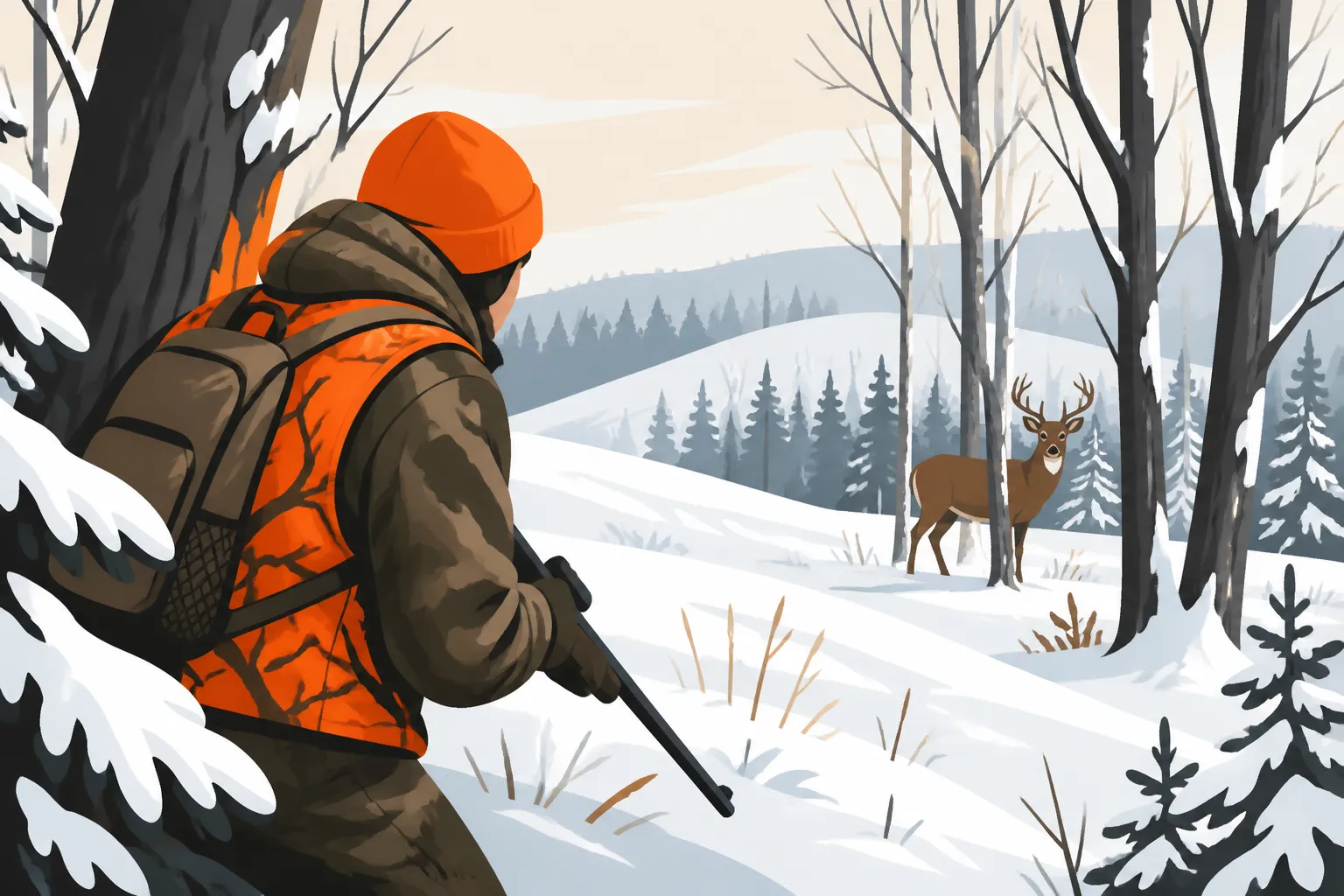
The cardinal rule of still-hunting is to move slowly. We're talking agonizingly slow, often taking minutes to cover just a few yards. Your pace should be dictated by what you can see ahead of you. Take a few steps, then stop, scan every inch of the cover in front of you, and repeat. Your eyes should be searching for horizontal lines (a deer's back), patches of solid color (a hide), or the subtle flick of an ear or tail against the vertical lines of trees. Often, you won't see an entire deer; you'll catch a small, out-of-place detail that gives it away.
Focus your scanning on areas where deer are likely to be bedded or feeding – thickets, brush piles, the edges of clearings. Use your binoculars constantly to pick apart distant cover. This stop-and-go method allows you to process information and spot deer before they spot you. It also gives you time to react, to bring your rifle or bow up, or to adjust your position for a better shot. Don't be afraid to sit down for 10-15 minutes in a promising spot, just watching and listening. Often, deer that were slightly out of sight or were initially spooked by your distant approach will relax and reveal themselves if you stay put and remain still. If you’re truly committed to still-hunting, practice moving in a straight line for a short distance, then slowly pivot your head to scan left and right, then behind you, before taking another slow step.
Picking Apart the Cover
Deer, especially pressured deer, become masters of concealment. In a snowy landscape, they might stand perfectly still, relying on their natural camouflage, or tuck themselves into the densest cover imaginable. Your job as a still-hunter is to methodically "pick apart" these hiding spots. Don't just look at the woods; look into them. Focus on the shadows, the dark spots, the transitions where one type of cover meets another. These edges are often where deer feel safest.
Imagine you're looking at a painting, and you need to find a hidden image. That's essentially what you're doing. Look for broken silhouettes, the gleam of an eye, the white of an antler against a dark trunk. A helpful technique is to use the GoHunt mapping app to identify dense cover, such as cedar swamps or brushy clear-cuts, and then plan your still-hunt route to slowly move through or along the edges of these areas. Pay extra attention to blowdowns, small depressions, and any irregular features where a deer might choose to bed down. Remember that deer often bed with their back to a tree or other obstruction, allowing them to watch their back trail. This is particularly true if you are hunting in a zone that has high pressure, and our article on Hunting Pressure on Wisconsin Public Land has more tips.
Shot Opportunities and Ethical Considerations
When you finally spot a deer while still-hunting, the real challenge begins. Often, it won't be a perfectly broadside shot in an open field. More likely, it will be a fleeting glimpse, a partially obscured deer, or a tight window through thick timber. The key is to remain calm, assess the situation quickly, and only take a shot if you have a clear, ethical shot opportunity. This means having a clear path to the vital organs, ensuring no obstructions will deflect your projectile.
Before you even step into the woods, practice shooting from various positions – kneeling, sitting, even awkward standing shots – that mimic what you might encounter while still-hunting. When the moment comes, move slowly and deliberately to get into position. If the deer is unaware, take your time. If it's looking your way, freeze until it looks away, then finish your movement. For rifle hunters, use shooting sticks or a convenient tree trunk for stability. Bowhunters need to ensure they have enough clearance for their limbs. If the shot isn't perfect, or if you can't get into a stable position, don't take it. Patience is a virtue, and an ethical shot is always paramount. In the event of a less-than-ideal shot, remember that Tracking a Deer in Wisconsin Snow can be made easier with fresh snow, but prevention is always better than recovery.
Table of Snow Conditions and Still-Hunting Impact
Here’s a quick overview of how different snow conditions might influence your still-hunting approach in Wisconsin:
| Snow Condition | Characteristics | Still-Hunting Impact & Strategy |
|---|---|---|
| Fresh Powder (1-6 inches) | Light, fluffy, falls silently, good visibility. | High Impact: Excellent for silent movement. Tracks are pristine and easy to read. Deer are often active, feeding, or moving to cover. Strategy: Focus on subtle movements, follow fresh tracks into bedding areas, utilize the quiet to your advantage for close approaches. |
| Packed/Crusted Snow | Snow has frozen or melted and refrozen, creating a crust. Can be noisy. | Medium to Low Impact: Can be extremely noisy underfoot, making stealth challenging. Tracks might be less distinct or difficult to read if older. Deer may be less active or more wary. Strategy: Hunt during warmer parts of the day when the crust softens. Target thick cover like Still-Hunting Wisconsin Cedar Swamps where crust might be less prevalent. Emphasize observation over movement. |
| Deep Snow (6+ inches) | Heavy accumulation, slow going for both hunters and deer. | High Impact: Movement is difficult for both hunter and deer, causing deer to conserve energy and stick to established trails. Tracks are very clear and deep. Strategy: Focus on travel corridors and obvious food sources. Deer will yard up in thick thermal cover. Hunters might consider snowshoes to reduce exertion and noise, but slow down even more. |
| Melting/Wet Snow | Warm temperatures causing snow to melt, can be slushy. | Medium Impact: Can be very quiet if soft, but also wet and uncomfortable. Tracks may wash out or become less distinct over time. Strategy: Excellent for quiet stalking, but be prepared for wet gear. Deer activity might increase with melting, making them more visible. Focus on areas where melting exposes new browse. |
| Light Dusting | Very thin layer, often patchy. | Low Impact: Offers some visual tracking aid but minimal noise reduction. Can be misleading with patchy areas of bare ground. Strategy: Use as a visual aid for fresh sign, but don't rely on it for stealth. Focus on traditional hunting methods, using wind and cover, but now with the added benefit of seeing recent movement. |
Disclaimer
Hunting is an inherently risky activity. Always prioritize safety, follow all Wisconsin Department of Natural Resources regulations, and obtain appropriate licenses and tags before heading into the field. This guide provides general information and recommendations; specific conditions and individual skill levels may vary.