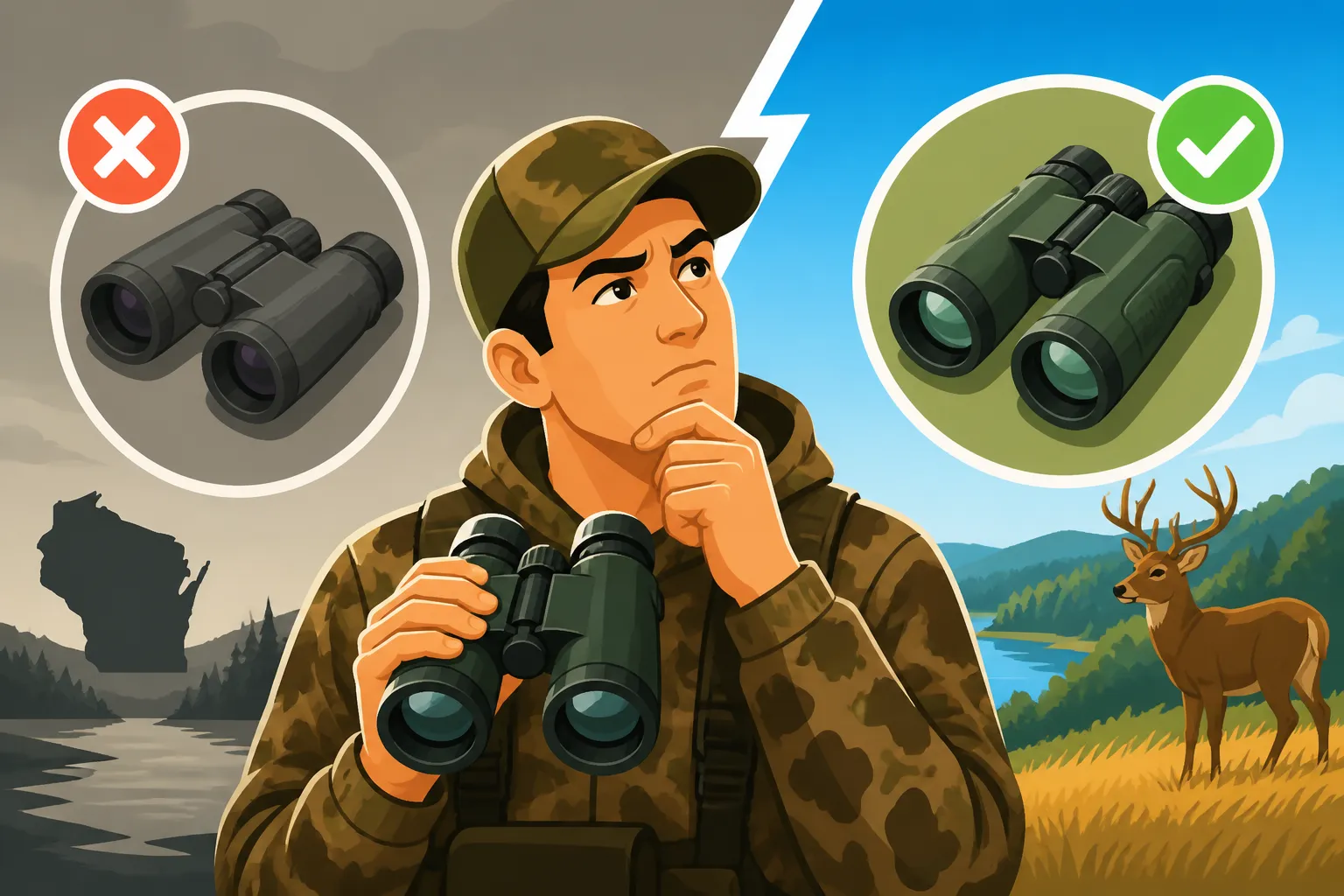
Are Cheap Binoculars Good Enough?
You're standing on your favorite ridge in the Chequamegon-Nicolet National Forest as dawn breaks, or perhaps tucked into a cattail marsh, waiting for the geese to fly. That moment of truth arrives, and you need to see clearly, often through dim light or across a long distance. For many hunters, the thought of dropping hundreds, even thousands, on a pair of binoculars is enough to make their wallet weep. This guide is going to dig deep into that common dilemma: are those inexpensive binoculars you see online or at the big box store truly "good enough" for hunting here in Wisconsin, or are you setting yourself up for frustration in the deer woods and waterfowl blinds?
The Allure and Reality of Budget Binoculars
Let's be honest, hunting can be an expensive endeavor. Between licenses, tags, firearms or bows, clothing, and all the other bits and bobs, the costs add up fast. It's completely natural to look for areas where you can save a few bucks, and optics often seem like a prime candidate. After all, a pair of binoculars is a pair of binoculars, right? They all magnify, they all fit in your pack, and they all let you see things farther away. Why spend a week's grocery budget on something that looks pretty similar to a model a tenth of the price?
The Initial Sticker Shock of Quality Optics
I remember the first time I started seriously looking into quality hunting optics. I'd grown up with a hand-me-down pair that was foggy, heavy, and barely functioned in low light, but it was "good enough." When I started seeing price tags north of $500, $1000, or even $2000 for top-tier binoculars, my jaw practically hit the floor. It feels like an exclusive club, a luxury item that only a select few can afford. This feeling of being priced out of "the best" makes the more affordable options incredibly appealing. You just want something that works, something to help you spot that deer browsing along the edge of a Hunting a Standing Cornfield in Farm Country or that distant gobbler strutting in a field. The marketing for budget binoculars often plays into this, promising "HD clarity" and "rugged construction" at a fraction of the cost, making it tough to resist.
It's a common thought process to think, "Well, I'm only going to use them a few times a year. Do I really need to invest that much?" For many of us, especially those starting out or those who hunt only during the Wisconsin's Nine-Day Gun Deer Season, this logic holds considerable weight. You might be perfectly happy with binoculars that get you by during broad daylight when conditions are ideal. The real test, however, comes when conditions are far from ideal, which, let's face it, is a pretty common occurrence in Wisconsin. That's when the compromises made in budget optics start to show their true colors, often at the most critical moments.
What "Cheap" Often Means in Optics
When you see a pair of binoculars for under, say, $150 or even $200, it's important to understand where the manufacturers are cutting corners. These aren't necessarily "bad" binoculars for every single use case, but they are built to a price point, and that inevitably involves trade-offs. The most significant savings often come from the materials used, particularly the glass itself and the coatings applied to it. Cheaper glass might have inclusions or imperfections that reduce clarity and brightness. The coatings, if they exist at all beyond a basic anti-reflective layer, are usually minimal, leading to poor light transmission and color fidelity.
Beyond the optical components, the mechanical construction also takes a hit. Budget binoculars often feature plastic housings, less precise focus mechanisms, and minimal, if any, robust weather sealing. This means they might feel flimsy, develop play in the focus wheel over time, or, most critically for hunters, fail miserably when exposed to the damp, cold, or snowy conditions common during a Wisconsin Gun Deer Season Structure. Imagine trying to adjust your focus with numb fingers on a sticky dial, or having your lenses fog up internally because a sudden temperature drop overwhelmed the inadequate O-rings. These small frustrations add up quickly when you're trying to stay focused and alert in the field.
Key Performance Factors That Cost More
So, what exactly are you paying for when you step up from a bargain-basement binocular to something in the mid-range or even high-end? It boils down to a few critical performance factors that directly impact your ability to hunt effectively and comfortably in a wide variety of Wisconsin's diverse environments, from the dense northern forests to the sprawling farmlands. These elements are often invisible to the naked eye but become strikingly apparent in the field.
Glass Quality and Coatings
This is, without a doubt, the single biggest differentiator. Higher-quality binoculars use superior glass, often labeled as ED (Extra-low Dispersion) or HD (High Definition), which does a much better job of correcting chromatic aberration—that annoying colored fringing you sometimes see around high-contrast objects. This translates to a sharper, truer-to-life image. But it's not just the glass itself; it's the coatings. Premium binoculars boast multiple layers of anti-reflective coatings on all air-to-glass surfaces (fully multi-coated), which dramatically increase light transmission. This is crucial for Rifle Scopes for Low-Light Timber and binoculars, allowing more light to reach your eyes, resulting in brighter, clearer images in challenging conditions.
Think about trying to pick out a deer against the dark timber just before legal shooting hours, or identifying a subtle antler tine through the dense foliage of a cedar swamp. With cheap binoculars, that same deer might appear as a murky silhouette, or the details will be washed out, making it impossible to confidently identify if it's a legal buck or just a doe. Good coatings also improve contrast and color fidelity, which is vital for distinguishing game from its surroundings. You want to see the subtle shades of brown and gray that make up a deer's coat, not a muddy, indistinct blob. This superior light gathering and image resolution often means you can stay out longer, spotting game that others might miss as the light fades.
Durability and Weather Sealing
Wisconsin weather is notoriously unpredictable. One day it's mild and sunny for Bowhunting Wisconsin's Long Archery Season, the next it's sleeting sideways during the rut, or even a bone-chilling cold for Muzzleloader Deer Hunting in Wisconsin. Your binoculars need to be able to withstand these conditions, and that's where durability and weather sealing come into play. Quality binoculars are typically built with robust chassis materials like magnesium alloy, which are lighter and stronger than the plastics often found in cheaper models. They're also purged with inert gases like nitrogen or argon and then O-ring sealed. This process prevents internal fogging by eliminating moisture and ensures that dust, dirt, and water cannot penetrate the optical system.
Imagine being caught in a sudden downpour while Hunting the Wisconsin Rut in November or trying to glass a field on a foggy morning. With cheap binoculars, you risk internal fogging, which renders them useless, or worse, water intrusion that can permanently damage the optics. A quality pair, however, will shrug off the elements, allowing you to continue scanning for game without missing a beat. This reliability is not just about convenience; it's about not having your hunt prematurely ended or your chances ruined by failing gear. The comfort of knowing your optics will perform when you need them most, regardless of what Mother Nature throws at you, is truly priceless.
Ergonomics and User Experience
While not directly impacting image quality, how a binocular feels and functions in your hands profoundly affects your hunting experience. Better binoculars are designed with thoughtful ergonomics: textured rubber armor for a secure grip, even when wet or cold; a smooth, precise, and fluid focus wheel that allows for fine adjustments; and properly set diopter adjustment to compensate for differences between your eyes. They often have better eye relief, which is the distance your eye can be from the eyepiece and still see the full field of view, a huge benefit for eyeglass wearers.
Cheap binoculars, on the other hand, often feel clunky, plasticky, and might have stiff or gritty focus wheels. The eye cups might be uncomfortable or flimsy, and the overall balance can be off, leading to user fatigue during prolonged glassing sessions. For example, trying to follow a deer's movement through thick brush with a clunky focus wheel can be incredibly frustrating. The subtle differences in feel and function make a huge impact over the course of a long day in the field, especially if you're Still-Hunting Wisconsin Cedar Swamps where quick, precise glassing is essential. A binocular that feels good in your hands and operates flawlessly becomes an extension of your senses, not a hindrance.
Specific Scenarios: When "Good Enough" Might Just Work (or Not)
The truth is, there isn't a one-size-fits-all answer to whether cheap binoculars are "good enough." It really depends on how and where you hunt in Wisconsin. Some hunting styles and environments are more forgiving of optical shortcomings than others. Let's explore a few common scenarios.
Daylight Still-Hunting in Thick Cover
If your primary hunting method is still-hunting through dense pine plantations or thick alder thickets for grouse, or perhaps slowly stalking deer in the heavy cover of the Northern Forest Deer Density in Wisconsin, then a basic pair of binoculars might actually suffice. In these situations, you're rarely making long-range observations. Most shots are relatively close, and you're more focused on spotting movement or distinguishing forms in short bursts. The abundant daylight means light-gathering capabilities aren't as critical, and the short viewing distances minimize the impact of chromatic aberration or lack of edge-to-edge clarity.
In these close-quarters scenarios, a simple 8×32 or even an 8×42 pair of budget binoculars could get the job done for basic identification. You're mostly looking for quick confirmations of movement or antler points, and extreme optical precision isn't paramount. They serve as an aid to confirm what your naked eye already suspects at 50 yards, rather than spotting a distant buck on a far ridgeline. However, even here, a slightly better pair will offer a wider field of view and a more comfortable experience, reducing eye strain and allowing you to survey the dense cover more effectively without feeling like you're peering through a keyhole.
Long-Range Glassing in Open Country or Coulees
Now, let's talk about the Wisconsin Driftless Area, with its deep coulees, expansive ridge tops, and scattered farmlands. Or perhaps you're Field Hunting Geese in Southern Wisconsin where spotting distant birds and identifying species is key. In these more open environments, where spotting game at hundreds of yards is common, cheap binoculars will almost certainly fall short. Trying to pick apart a distant hillside for a bedded deer with low-quality glass is an exercise in frustration. The image will be fuzzy, colors will be muted, and identifying small details like antler tines or the flick of an ear will be nearly impossible. This is where Optics for Wisconsin Timber and Coulees really shine.
This is especially true if you're trying to determine if a deer has legal antlers from afar. You need crisp resolution and excellent contrast to count points, and that's precisely what budget optics lack. The same goes for waterfowl identification on large marshes or open water; distinguishing between different duck species at a distance requires clarity that cheap binoculars simply cannot provide. In these situations, your optics are not just an aid; they are a primary tool for scouting, locating game, and making informed decisions. Relying on cheap binoculars here is akin to trying to drive nails with a rubber mallet – you might eventually get the job done, but it's going to be a lot harder and less effective. This is where tools like GoHunt's gear comparison guides become invaluable, helping you understand the real differences in performance.
Early Morning or Late Evening Stands
This is perhaps the most critical scenario where cheap binoculars really show their weaknesses. Deer and many other game animals are most active during the low-light periods of dawn and dusk. You're sitting in your treestand, perhaps on the edge of an Hunting a Funnel Between Two Swamps, and the woods are just starting to wake up, or beginning to fade into darkness. A mature buck might step out into an opening, but the light is barely enough for your naked eye to make out details. This is precisely when quality optics earn their keep.
Good binoculars, with their superior glass and coatings, excel at gathering and transmitting available light. This means they can effectively "add" minutes of usable viewing time to both ends of the day. A deer that appears as a dark blob through cheap binoculars will reveal its form, and perhaps even its antlers, through a quality pair. The difference can be stark – seeing enough to make a shot decision versus having to pass because you couldn't confidently identify the animal. For Hunting the Peak Rut Week in Wisconsin or during the early When Wisconsin's Archery Season Opens, when those prime hunting hours are often dictated by dim light, investing in better low-light performance is one of the smartest decisions a hunter can make.
Making an Informed Decision: Balancing Cost and Performance
So, how do you navigate this optical minefield without emptying your bank account or ending up with a piece of junk? It's all about understanding your specific needs, setting a realistic budget, and recognizing that there's a sweet spot where increased cost delivers significantly increased performance. You don't always need the absolute top-tier, but avoiding the bottom of the barrel will save you a lot of heartache.
Prioritizing Your Hunting Style and Budget
Before you even start looking at brands or models, take an honest assessment of your hunting style, the environments you hunt in, and how often you'll truly use your binoculars.
- Are you a fair-weather hunter who sticks to broad daylight, thick timber, and short distances? A more budget-friendly option (say, $150-$300) might indeed be "good enough," especially if you’re focusing on general scouting for a Wisconsin Youth Deer Hunt Rules or simply looking to confirm basic animal presence.
- Do you frequently hunt open country, long distances, or during those crucial low-light periods? Then you absolutely need to prioritize better glass and coatings. This means looking at binoculars in the $400-$800 range, where you start to see significant jumps in performance, durability, and ergonomic refinement.
- Is this an investment for decades of hardcore hunting across all conditions? Then the higher-end models (over $1000) might be justified for their ultimate performance and bomb-proof construction.
Consider how much you rely on your binoculars. If you are regularly glassing for extended periods while Hunting Wisconsin Coulees and Ridge Tops, or using them to aid in Shed Hunting on Wisconsin Public Land, then comfort and optical quality become paramount. Think about what a missed opportunity due to poor optics would cost you in terms of time, effort, and emotional investment.
Here's a quick comparison of what to expect:
| Feature/Performance | Entry-Level (<$150) | Mid-Range ($300-$800) | High-End (>$1000) |
|---|---|---|---|
| Glass Quality | Basic, often standard glass | ED (Extra-low Dispersion) | ED/HD, Fluorite, Premium Glass |
| Lens Coatings | Basic anti-reflective, few layers | Fully Multi-Coated, Phase Correction | Advanced Multi-Coatings, Dielectric |
| Light Transmission | Fair, struggles in low light | Good, bright image | Excellent, exceptional low light |
| Clarity/Sharpness | Center acceptable, edges soft | Very good, sharp to edges | Outstanding, razor-sharp |
| Color Fidelity | Decent, can be muted | Accurate, vibrant | True-to-life, natural colors |
| Durability | Primarily plastic, basic sealing | Robust chassis, O-ring sealed, Nitrogen purged | Armored, fully sealed, Magnesium chassis |
| Ergonomics | Often clunky, stiff focus | Comfortable, smooth focus | Superb, precise, long eye relief |
| Low-Light Performance | Poor to fair | Good | Excellent |
| Field Use | Ok for bright daylight, close range | Great for most hunting scenarios | Uncompromised performance, any condition |
The Value of Mid-Range Options
For many Wisconsin hunters, the real sweet spot lies in the mid-range category, roughly between $300 and $800. This is where you get a significant leap in performance, durability, and user experience without reaching the stratospheric prices of the alpha optics. In this bracket, you'll find binoculars that feature ED glass, full multi-coatings, and robust, O-ring sealed, nitrogen-purged housings. Brands that focus on value often excel here, providing features that were once exclusive to high-end models.
These mid-range binoculars will typically offer much better low-light performance, clearer images, and superior durability compared to their cheaper counterparts. They can handle the damp, cold, and rough treatment that hunting in Wisconsin often entails. They'll also feel better in your hands, with smoother focus wheels and more comfortable eyecups, which makes a big difference when you're glassing for extended periods or wearing gloves. You're not just paying for a label; you're paying for engineering and materials that genuinely enhance your ability to spot game and enjoy your time in the woods. When researching, sites like GoHunt often review optics across different price points, which can be helpful for comparing features and real-world performance.
Trying Before You Buy (If Possible)
Regardless of your budget, the absolute best thing you can do is get your hands on a few different pairs before making a decision. Visit a reputable outdoor retailer or a local pro shop that carries a range of optics. Don't just look through them inside the store. Ask if you can take them outside and look at objects at varying distances, in different lighting conditions. How do they feel in your hands? Is the focus smooth? Can you easily adjust the diopter? Do they fog up when you breathe on the lenses after being in a warm store?
Compare an inexpensive pair directly against a mid-range or even a high-end pair. The difference might not be immediately obvious if you've never used good glass before, but a direct comparison will illuminate the subtle yet critical improvements in brightness, clarity, and color rendition. This hands-on experience is invaluable and will help you understand what you're truly gaining or sacrificing at different price points. After all, your binoculars are a critical piece of gear for locating game, identifying animals, and enhancing your overall hunting experience, whether you're trying Rattling and Grunting in Wisconsin or simply enjoying the view from a ridge point.
Disclaimer
This article is for general informational purposes only and does not constitute professional advice. Laws, prices and regulations vary by location and change over time. Consult a qualified professional for guidance on your specific situation.