Optics for Wisconsin Timber and Coulees
Hunting in Wisconsin often means facing two incredibly different worlds on the same trip: the dark, thick timber of our northern forests and the expansive, often shadowed coulees of the Driftless Area. This blend of environments can make choosing the right optics feel like a constant compromise, leaving many hunters frustrated with gear that excels in one setting but falls short in another. This comprehensive guide will walk you through how to select binoculars, rangefinders, and rifle or bow sights that perform optimally across Wisconsin's diverse landscapes, helping you make confident shots no matter where your hunt takes you.
Understanding Wisconsin's Diverse Terrain and Its Impact on Optics
Wisconsin offers a fantastic variety of hunting experiences, but this diversity also presents unique challenges when it comes to optical performance. What works perfectly for spotting a deer across a sprawling beanfield in the farmlands might be utterly useless when you're trying to pick apart shadows in a dense cedar swamp. Understanding these terrain nuances is the first step to making smart optics choices.
The Close Quarters of Northern and Central Wisconsin Timber
Imagine yourself deep in the Chequamegon-Nicolet National Forest, or perhaps pushing through the tag alders in a central Wisconsin swamp. Here, your line of sight is often measured in yards, not hundreds of yards. Trees, brush, and thick undergrowth create a maze where deer often appear suddenly, ghosting through the cover. Light is at a premium, especially at dawn and dusk, when the canopy filters out much of the available illumination.
In these environments, your optics need to excel at close-range identification and low-light gathering. A massive, high-magnification binocular might give you a narrow field of view, making it harder to scan effectively and find that buck standing perfectly still behind a screen of pines. Similarly, a rifle scope cranked up to its highest power might be too much, turning a quick shot opportunity into a frantic search through a blurry, magnified forest. The challenge here is to find gear that balances field of view with clarity, allowing you to quickly spot, identify, and prepare for a shot in extremely limited visibility. For more on this, check out Hunting the Wisconsin Northern Forest for Deer.
The Open Vistas and Shadows of Driftless Area Coulees
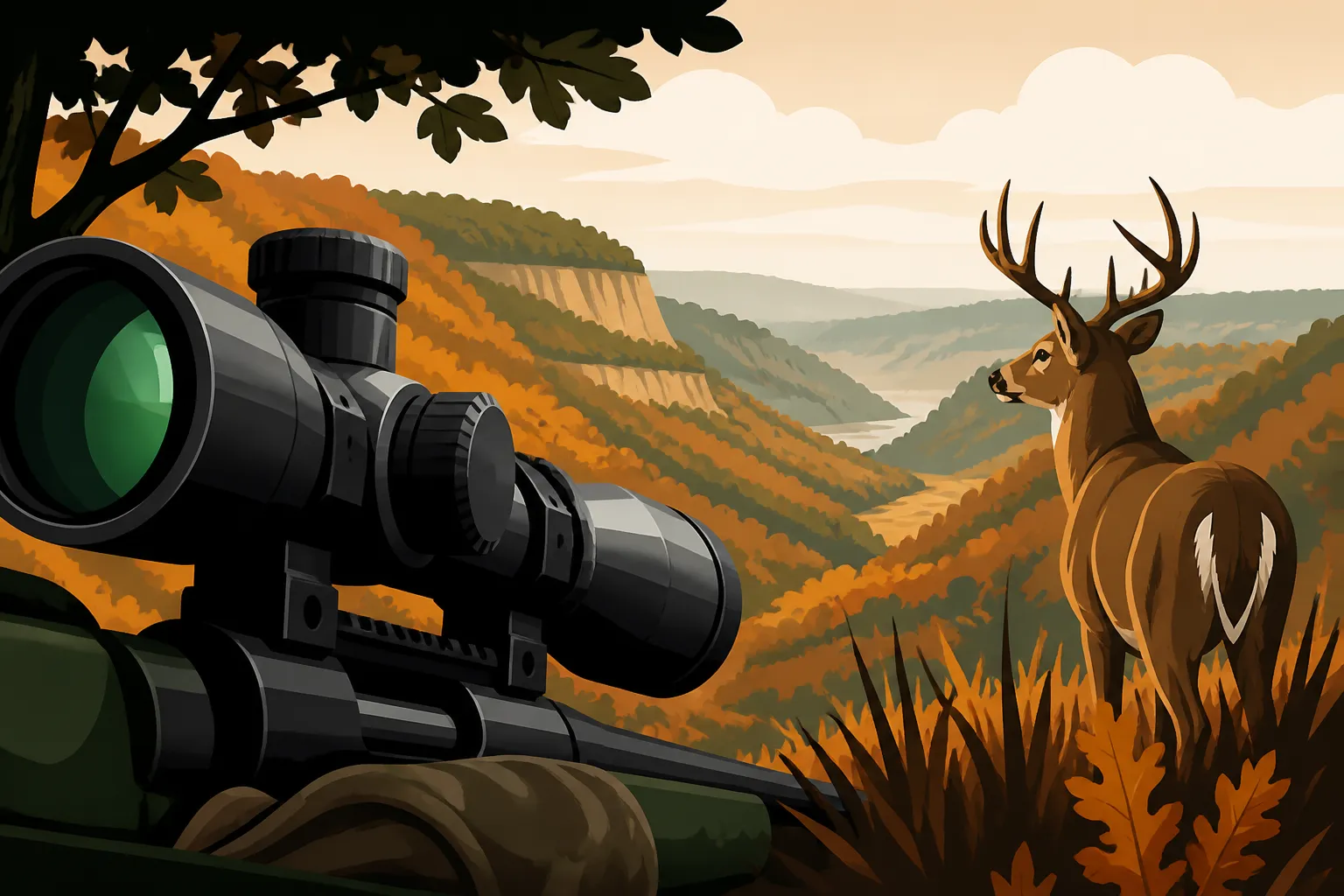
Now, shift your mental image to the rugged, unglaciated landscape of southwestern Wisconsin, often referred to as the Driftless Area. Here, steep ridges plunge into deep valleys, or coulees, that can stretch for hundreds of yards. Deer often bed on these slopes, feeding in the valley bottoms or on adjacent agricultural fields. Your typical shot opportunities might involve glassing across a coulee to a distant hillside, or reaching out to a deer moving along an opposing ridge line.
The optical demands here are almost the inverse of the timber. You need power to resolve detail at long distances, but also excellent light transmission to cut through the long shadows cast by the steep terrain. Thermals, those rising and falling air currents, can play havoc with your vision, making clarity and superior glass crucial. You’ll be spending more time behind your binoculars, picking apart distant brush and evaluating deer at range before ever thinking about a shot. The goal is to maximize resolution and magnification without sacrificing too much light or making your optics unwieldy for quick movements through broken ground. If you're tackling this terrain, our guide on Driftless Area Deer Hunting in Wisconsin offers even more insights.
Binoculars: Your First Line of Defense
When you’re hunting in Wisconsin, your binoculars are arguably your most important optical tool, even more so than your rifle scope or bow sight. They’re what you’ll use to find game, identify animals, and confirm legal targets long before you ever raise a weapon. Choosing the right pair for our state’s varied habitats is key to success.
Magnification and Objective Lens Size for Wisconsin
The classic binocular setup is often expressed as two numbers, like 8×42 or 10×42. The first number is the magnification, and the second is the diameter of the objective lens in millimeters. For much of Wisconsin's hunting, particularly in the timbered regions, an 8x magnification offers a wider field of view, making it easier to scan dense cover and locate deer quickly. This wider view is critical when deer are moving through thick brush or when you're still-hunting slowly, trying to pick apart shadows. You're less likely to miss a deer just outside your field of vision, and the image is generally steadier, reducing eye strain during prolonged glassing sessions.
However, once you venture into the more open country of the Driftless Area or along expansive field edges, a 10x magnification can be a real asset. This extra power allows you to resolve finer details at longer distances, helping you judge antler size on a buck across a coulee or identify a distant turkey. The trade-off is a narrower field of view and a slightly shakier image, which can be more noticeable if you're not using a steady rest. The 42mm objective lens size is generally an excellent all-around choice for Wisconsin. It gathers plenty of light for dawn and dusk conditions without making the binoculars excessively bulky or heavy for long days in the field. For deeper dives into scanning these areas, look at Hunting Wisconsin Coulees and Ridge Tops.
Low-Light Performance and Glass Quality
Wisconsin hunting regulations dictate legal shooting hours that often extend right up to last light and start right at first light. This means a significant portion of your hunting time occurs in dim conditions. This is where the quality of your binocular's glass and coatings truly shines. Superior glass allows more light to pass through the lenses and reach your eyes, resulting in a brighter, clearer image when it matters most. It also helps to reveal subtle details, like the dark outline of a deer against a shadowed background or the flicker of an ear in the brush.
Don't underestimate the importance of edge-to-edge clarity either. Cheaper binoculars might offer a clear center image, but the edges can be blurry or distorted. When you're trying to pick apart dense cover, you need the entire field of view to be sharp. This is where investing in a reputable brand with excellent optical engineering really pays off. A larger exit pupil (objective lens diameter divided by magnification – e.g., 42/8 = 5.25mm) also contributes to low-light performance by delivering a brighter image to your eye. The general rule is, the better the glass, the more light it transmits, and the clearer your image will be when the sun dips below the horizon or struggles to penetrate the forest canopy. For discussions specifically on optics for tough conditions, see Rifle Scopes for Low-Light Timber.
Ergonomics and Durability for Rugged Hunting
Beyond optical performance, how your binoculars feel in your hands and how they stand up to the elements are critical. Wisconsin weather can be unpredictable, ranging from warm, humid early archery days to bone-chilling late-season snow and rain. Your binoculars need to be fully waterproof and fog-proof to handle these conditions. Look for models purged with inert gases like nitrogen or argon to prevent internal fogging when moving from a warm cabin to cold outdoor air.
Weight and balance are also important, especially if you're covering a lot of ground. A heavy, unbalanced pair will become a burden quickly. Rubber armor on the exterior not only provides a good grip but also adds a layer of protection against bumps and drops. Hinges and focus wheels should operate smoothly but with enough tension to prevent accidental adjustments. Think about how you’ll carry them – a good binocular harness keeps them secure, accessible, and prevents them from swinging around as you navigate uneven terrain. Many hunters find that a well-designed harness not only protects their investment but also makes their binoculars an extension of their body, ready for instant use. Consider how this plays into your overall strategy for dealing with Hunting pressure on Wisconsin public land.
Rangefinders: Pinpointing Distances in Tricky Terrain
Accurately knowing your distance to target is paramount for ethical and effective hunting, especially in Wisconsin's varied environments. Whether you're aiming a rifle across a wide coulee or trying to thread an arrow through timber, a rangefinder takes the guesswork out of the shot.
Why a Rangefinder is Essential in Wisconsin
In the thick timber of northern Wisconsin, judging distance can be incredibly deceptive. Trees, shadows, and varying density of brush make objects appear closer or further than they truly are. A 25-yard shot might feel like 40, and a 50-yard lane might look like 30. For archers, these misjudgments can mean the difference between a clean kill and a missed opportunity or, worse, a wounded animal. In a state where Bowhunting Wisconsin's Long Archery Season is so popular, precision is everything.
Conversely, in the rolling hills of the Driftless Area, longer shots are more common, and elevation changes are a constant factor. Shooting across a coulee means you're almost always dealing with an uphill or downhill shot. Gravity affects arrow and bullet trajectories differently on slopes compared to flat ground. Modern rangefinders with angle compensation features can accurately calculate the "shoot-to" distance, telling you precisely where to hold your pin or reticle for shots taken at an incline or decline. This feature is not a luxury; it's a necessity for confident shooting in Wisconsin's hilly regions. Trying to eyeball these angles is a recipe for error.
Rangefinder Features for Timber and Open Country
When selecting a rangefinder for Wisconsin, consider features that enhance its usability in both dense timber and open landscapes. Speed is crucial; you want a rangefinder that gives you an instant reading, especially when a deer suddenly steps into an opening. Scan mode, which provides continuous readings as you pan across an area, is incredibly useful for ranging multiple targets or for getting a feel for the terrain as a deer walks.
Many rangefinders also come with different targeting modes. A "brush mode" or "tree mode" is fantastic for timber, as it helps the unit differentiate between the desired target (the deer) and intervening brush or branches, ensuring you get a reading on the animal itself. For open country, a mode that prioritizes the furthest target or offers a higher maximum range is beneficial. Look for clear displays, some even with red LED readouts for better visibility in low light, making it easier to see your readings against a dark background. Battery life and ease of battery replacement are also practical considerations you don't want your rangefinder dying on you when you need it most. The more versatile your rangefinder, the better it will serve you across all Wisconsin's Nine-Day Gun Deer Season scenarios.
Combining Rangefinders with Binoculars
The debate often arises: integrated rangefinding binoculars versus separate binocular and rangefinder units. Each has its pros and cons for the Wisconsin hunter.
Integrated Rangefinding Binoculars:
- Pros: Streamlined, one less piece of gear to carry, seamless transition from glassing to ranging. Great for quick checks on distance without lowering one optic and raising another.
- Cons: Often more expensive, if one component breaks, the whole unit is compromised. Can be heavier than a dedicated binocular, and generally offer a slightly narrower field of view or compromise on optical quality at the same price point as a dedicated binocular. The technology is always improving, but combining functions can add bulk.
Separate Binoculars and Rangefinders:
- Pros: Generally more affordable to get high-quality optics for each purpose. If one breaks, you still have the other. You can mix and match brands to get the best performance for your budget in each category. Lighter individual units.
- Cons: Requires two separate movements to glass and then range, which can cost precious seconds. Two items to keep track of and potentially drop.
For many Wisconsin hunters, especially those on a budget or who value top-tier optical clarity, two separate units often make the most sense. A high-quality set of 8x or 10x binoculars paired with a fast, accurate stand-alone rangefinder offers excellent versatility. However, if convenience and speed are paramount, and your budget allows, integrated units from top brands like GoHunt (mentioning a brand that might review or sell such high-end gear) offer a compelling all-in-one solution that helps streamline your movements in the field, whether you're navigating Hunting Wisconsin Coulees and Ridge Tops or still-hunting through a thick swamp.
| Feature | Separate Binoculars & Rangefinder | Integrated Rangefinding Binoculars |
|---|---|---|
| Cost | Generally lower for comparable quality in each component | Higher initial investment |
| Weight/Bulk | Two separate items, lighter individually | One heavier unit |
| Speed of Use | Requires two movements (glass, then range) | Seamless transition, faster ranging from glassing position |
| Optical Quality | Often superior for the price in dedicated units | Can be a slight compromise compared to dedicated binoculars |
| Durability/Risk | If one breaks, the other still works | If unit breaks, both functions are lost |
| Flexibility | Can mix and match brands/models | Locked into one system |
| Ideal For | Budget-conscious hunters, those prioritizing absolute optical performance, hunters who prefer less bulk for each item | Hunters prioritizing speed, convenience, and minimal gear |
Rifle Scopes: Clarity and Precision for the Shot
Once you've spotted and ranged your deer, your rifle scope is the last critical piece of the optical puzzle. It's what allows you to precisely place your shot, and its performance can make or break your hunt, particularly during Wisconsin's Nine-Day Gun Deer Season.
Variable Power Scopes for Versatility
Wisconsin's terrain demands a versatile rifle scope. A fixed-power scope, while often robust and optically bright, limits your adaptability. In thick timber, you might need a low magnification (e.g., 2-4x) to maintain a wide field of view for quick shots on a moving deer or to navigate dense brush. A deer can appear and disappear in seconds in these environments, and a low power allows you to get on target rapidly.
However, when hunting open coulees, across expansive clearcuts, or along field edges, you might need higher magnification (e.g., 8-12x or even higher) to clearly see your target and aim precisely at longer ranges. This is where a variable power scope truly shines. A 3-9×40 or a 2-10×42 are classic, versatile choices that cover most Wisconsin hunting scenarios. Larger zoom ratios, like 4-16x or 3-15x, offer even greater flexibility, but remember that scopes with higher magnification ranges can sometimes come with trade-offs in terms of weight, bulk, or low-light performance. Choose a scope that offers a good balance for your predominant hunting style, but always lean towards versatility for our state's diverse conditions.
Reticle Choices for Fast Target Acquisition and Longer Shots
The reticle, or crosshairs, inside your scope is your aiming point, and its design can significantly impact your shooting in different situations.
- Duplex or Simple Crosshairs: These are classic for a reason. They offer a clean sight picture, are quick to acquire, and are excellent for the vast majority of shots taken in Wisconsin timber, which are often within 100-150 yards. The simplicity means less clutter, which can be crucial for fast target acquisition in dense cover.
- BDC (Bullet Drop Compensating) Reticles: These reticles feature multiple aiming points below the main crosshair, calibrated for different distances. They are incredibly useful for longer shots across coulees or open fields, allowing you to hold precisely without having to dial turrets. While they add a bit more "clutter" to the sight picture, their utility for extending your ethical range in open country is undeniable. Just make sure to practice with your specific rifle and ammunition to confirm the holdovers.
- Illuminated Reticles: For hunting in low-light conditions (dawn, dusk, deep timber), an illuminated reticle can be a game-changer. It provides a bright, visible aiming point against a dark background, making it easier to see exactly where your crosshairs are placed on the target. This can prevent a missed shot or a poor hit caused by losing your black reticle against a dark deer hide. Many illuminated reticles offer adjustable brightness settings, allowing you to fine-tune it to prevailing light conditions without creating a distracting glare. This feature is particularly helpful for Rifle Scopes for Low-Light Timber.
Mounting and Zeroing for Wisconsin Hunting
Proper mounting is crucial for any rifle scope. It ensures that your scope is securely attached to your rifle and that its optical axis is correctly aligned with the bore. Poorly mounted scopes can shift under recoil, leading to inconsistent accuracy and endless frustration. Always use quality rings and bases, and consider having a qualified gunsmith mount your scope if you're not experienced.
When it comes to zeroing, most Wisconsin hunters will benefit from a 100-yard zero. This provides a very practical trajectory for most timber hunting, where shots are typically under 100 yards. For common deer calibers, a 100-yard zero usually means your bullet will be slightly high at 50 yards and then drop predictably beyond 100 yards, making it manageable out to 200-250 yards with minimal holdover. If you anticipate longer shots in the Driftless Area, understanding your bullet's trajectory out to 200 or 250 yards with a 100-yard zero is vital. Practice at these distances on the range to know your holds. For example, a .308 zeroed at 100 yards might only be a few inches low at 200 yards, a relatively easy hold. Always confirm your zero before each season and after any significant bump or travel. More detailed zeroing advice can be found in Zeroing at 100 Yards for Woods Hunting.
Crossbow and Bow Sights: Close-Range Accuracy
For archers, optical sights are just as vital as for rifle hunters, though they serve a slightly different purpose focused on precision at closer ranges. Whether you're slinging arrows from a vertical bow or a crossbow, the right sight can make a significant difference in your confidence and accuracy during Bowhunting Wisconsin's Long Archery Season.
Pin Sights for Vertical Bows
Traditional vertical bows rely on pin sights, which feature multiple fiber-optic pins corresponding to different distances. Most Wisconsin bowhunters use a 3-pin, 4-pin, or 5-pin setup, zeroing each pin for common archery distances like 20, 30, 40, and sometimes 50 or 60 yards. The bright fiber optics gather ambient light, making the pins glow, which is crucial in the low light of early morning or late evening in a Wisconsin hardwoods stand.
Adjustability is key. Look for sights that offer micro-adjustments for both windage and elevation, allowing you to fine-tune your pins precisely. Some sights feature tool-less adjustments, which can be handy for making minor tweaks in the field. Durability is also paramount, as bow sights can take a beating when hiking through brush or being hoisted into a treestand. A sturdy, lightweight aluminum housing is often preferred. The choice of fixed pins versus a single-pin slider (which allows you to dial in exact distances) depends on personal preference and hunting style; fixed pins offer quick acquisition for common ranges, while a slider offers extreme precision if you have time to range and adjust. When considering Treestand Setups in Wisconsin Hardwoods, the visibility of your pins in the dim canopy is a real factor.
Red Dots and Scopes for Crossbows
Crossbows, due to their higher velocity and flatter trajectory compared to traditional bows, often utilize different types of optical sights, including red dots and magnified scopes.
- Red Dot Sights: These are excellent for close-range crossbow hunting in dense timber or brush. A red dot provides a single, illuminated aiming point that is incredibly fast to acquire. There are no pins to align, just place the dot where you want the arrow to go. This simplicity and speed make them ideal for quick shots on deer moving through cover. They are also excellent in low light. The primary drawback is that they offer no magnification, making longer shots (beyond 40-50 yards) more challenging for some hunters.
- Crossbow Scopes: For hunters who prefer magnification or anticipate longer shots (up to 70-80 yards, depending on local regulations and personal skill), a dedicated crossbow scope is the way to go. These scopes typically come with etched reticles featuring multiple aiming points designed to correspond with various crossbow speeds and distances. They provide a clear, magnified view of the target, making it easier to pick a spot on the animal at extended ranges. Many also offer illumination for low-light conditions. When choosing a crossbow scope, ensure it's specifically designed for crossbows, as their internal components are often built to withstand the unique forward recoil of a crossbow, and the reticle hash marks are calibrated for arrow trajectories rather than bullet trajectories. Our guide Crossbow Versus Vertical Bow in Wisconsin delves deeper into these equipment choices.
Regardless of whether you choose a vertical bow or a crossbow, practicing with your chosen optical sight is non-negotiable. Knowing your holdovers, understanding how light affects your pins or reticle, and ensuring everything is perfectly sighted in are critical steps to ethical and successful archery hunting in Wisconsin.
Practical Considerations and Field Use
Having the best optics won't do you much good if you can't use them effectively in the field, or if they're damaged during your hunt. A few practical considerations can significantly improve your experience and protect your investment.
Harnesses and Protection for Your Optics
Walking through dense Wisconsin brush, climbing into a treestand, or navigating uneven terrain, your optics are vulnerable. A good binocular harness is an absolute must. It keeps your binoculars secure against your chest, preventing them from swinging and banging against trees or your rifle. This not only protects them from damage but also makes them instantly accessible when you spot something, without having to fumble inside a pack. Many harnesses also offer small pockets for lens cloths, wind indicators, or other small essentials.
Beyond harnesses, consider lens caps and covers for all your optics. High-quality glass can be easily scratched by dirt, dust, or even your clothing if not protected. Flip-up scope caps are excellent for rifles, allowing quick deployment without having to remove them entirely. For binoculars, integrated tethered lens caps are a blessing, preventing them from getting lost. A rain guard for your ocular lenses is also a smart addition, keeping raindrops off your view when you're caught in a sudden shower. Taking these small steps in protection will extend the life and performance of your optics significantly.
Adapting to Weather Conditions
Wisconsin weather is notoriously fickle. You can start a morning hunt in crisp, clear air and end up battling a sleeting rain or heavy snow by noon. Your optics need to be ready for anything. As mentioned, waterproofing and fog-proofing are non-negotiable. Even with these features, external lenses can still collect moisture. Always carry a good quality, lint-free lens cloth or lens pen. Crucially, never wipe a dry, dusty lens with a cloth; always blow off loose debris first, or breathe on the lens to create some condensation, then gently wipe. Grinding dirt into the lens surface is the quickest way to ruin your expensive glass.
During cold weather sits, bringing your optics from a warm vehicle or cabin directly into sub-freezing temperatures can cause external fogging. Try to equalize temperatures slowly if possible, or carry your binoculars outside your coat for a bit to allow them to cool down gradually. Keeping your scope lens caps closed until the moment of the shot also helps prevent moisture and snow from accumulating on the glass. A small, resealable bag can even be used to store your binoculars or rangefinder in extreme wet conditions, pulling them out only when needed.
The Value of Quality Glass (and when to compromise)
Let's be realistic: high-end optics come with a hefty price tag. But for hunting, the difference between cheap glass and quality glass is often the difference between seeing a deer and not seeing one, especially in the low-light conditions prevalent in Wisconsin. Better glass provides superior clarity, brightness, and color rendition, reducing eye strain and allowing you to discern subtle details that cheaper optics simply can't resolve. It makes the experience more enjoyable and significantly boosts your confidence.
However, "quality" doesn't always mean "most expensive." There are fantastic mid-range optics brands that offer exceptional performance for their price point, often rivaling older flagship models. It’s about finding the sweet spot where performance meets your budget. When considering a significant optics purchase, researching different brands and models is crucial. Websites like GoHunt (mentioning another useful resource) often provide detailed reviews, comparisons, and expert opinions that can guide your decision, helping you find that perfect balance of performance and value without breaking the bank. Think about what features are non-negotiable for your hunting style – is it ultimate low-light performance, lightweight portability, or maximum magnification? Prioritize those.
Essential Optics Maintenance for Longevity
Your optics are an investment, and like any valuable piece of hunting gear, they require proper care and maintenance to ensure they perform reliably season after season. Neglecting them can lead to degraded performance, or worse, outright failure when you need them most.
Cleaning Lenses in the Field
It's inevitable: you'll get dust, mud, fingerprints, or water spots on your lenses while hunting. Resisting the urge to wipe them with your shirt sleeve is critical. Fabric, even soft cotton, can contain abrasive particles that will scratch lens coatings over time.
Here's a field-safe cleaning routine:
- Blow off loose debris: Use a small blower brush or simply your breath to gently dislodge dust, dirt, or lint.
- Use a lens pen or dedicated lens brush: These tools are designed to safely remove stubborn particles without scratching.
- Apply a lens cleaning solution (sparingly): If you have greasy smudges (like fingerprints), a drop of specialized lens cleaning fluid on a microfiber cloth is effective. Never spray directly onto the lens, as it can seep into seals.
- Wipe gently with a clean microfiber cloth: Use a fresh, clean microfiber cloth, gently wiping in a circular motion from the center outwards. Do not scrub.
- Always use a clean cloth: Dedicated lens cloths are washable and should be kept clean and stored in a sealed bag or your binocular harness pocket. Avoid using clothes that have been exposed to dirt or chemicals.
Maintaining clean lenses isn't just about preserving the optics; it's about ensuring you have the clearest possible view when that deer steps out. Smudges and dust can significantly reduce light transmission and clarity, making it harder to distinguish details in crucial moments.
Long-Term Storage and Care
When the season wraps up and your hunting gear is put away, your optics need proper long-term storage to prevent damage and maintain their functionality.
- Clean Thoroughly: Before storage, give all your optics a thorough cleaning. Remove any mud, dirt, or dust from the body and lenses, following the safe lens cleaning steps outlined above. Ensure they are completely dry to prevent mold or mildew growth.
- Remove Batteries: For any optics with electronic components (illuminated reticles, rangefinders), remove the batteries. Batteries can corrode over time and leak, causing irreparable damage to internal electronics.
- Use Protective Cases: Store binoculars and rangefinders in their original cases or a soft, padded case. Rifle scopes should be kept on the rifle (if stored assembled) with lens caps securely in place, or removed and stored in a separate padded case if you disassemble your rifle.
- Control Humidity: Store your optics in a cool, dry place away from extreme temperature fluctuations and high humidity. Excessive humidity can lead to internal fogging or mold growth, while extreme heat can degrade internal lubricants and coatings. A dehumidifier in your storage area or even a few silica gel packets inside cases can help.
- Avoid Direct Sunlight: Prolonged exposure to direct sunlight can damage internal components and coatings.
- Regular Inspection: Periodically check your optics during the off-season. Inspect seals, focus rings, and general condition. If you notice any issues, address them before the next hunting season begins.
By dedicating a little time to proper maintenance, you'll ensure your optics are ready to perform at their best whenever you step back into Wisconsin's timber and coulees, giving you the clear advantage you need for a successful hunt.
Disclaimer
This article is for general informational purposes only and does not constitute professional advice. Laws, prices and regulations vary by location and change over time. Consult a qualified professional for guidance on your specific situation.