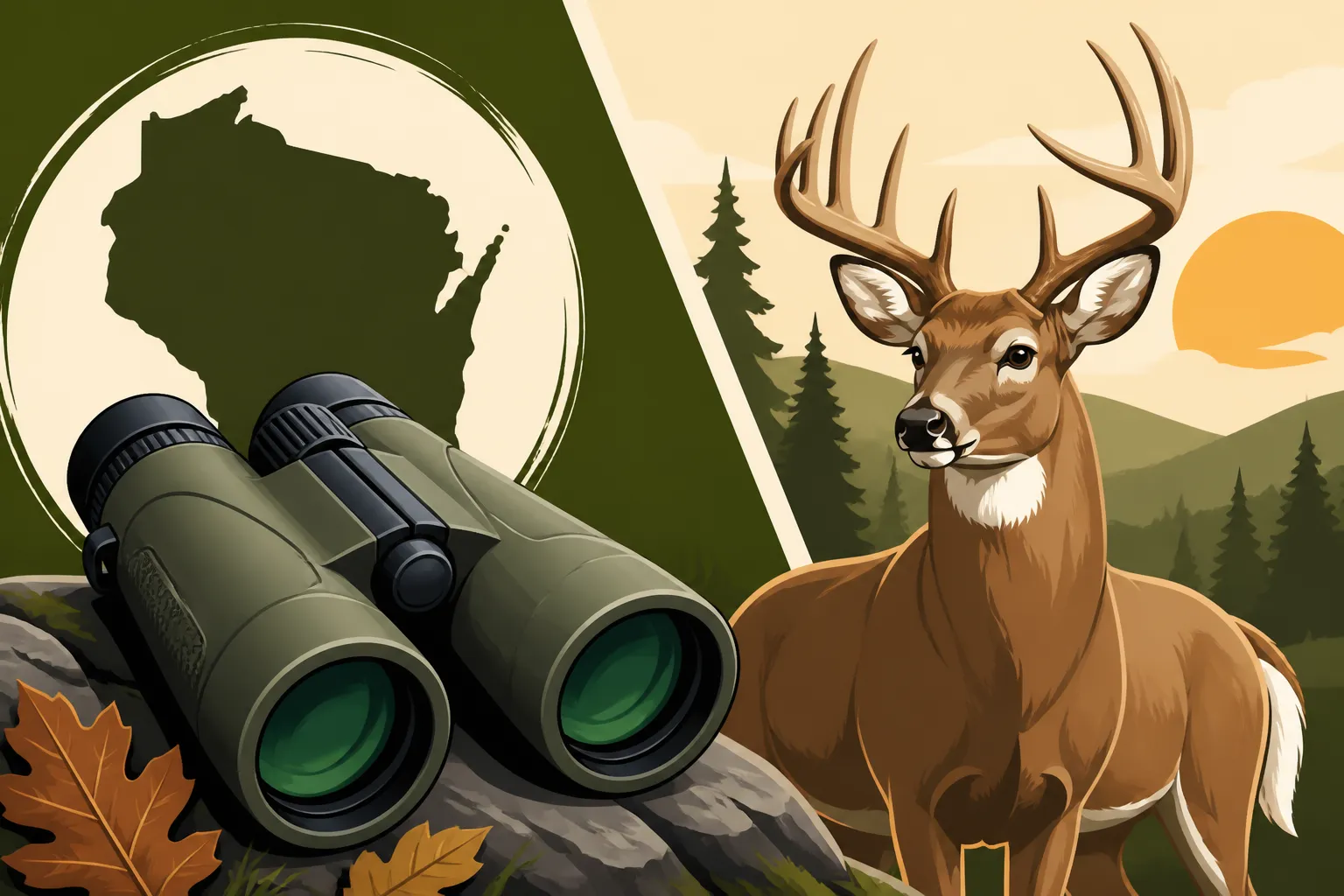
Binocular Choice for Wisconsin Whitetails
Trying to pick out the subtle flick of a deer's ear in a sea of tangled brush, or confirm a clear shooting lane across a vast, rolling coulee, can feel like an impossible task when you don't have the right tools. Wisconsin's diverse whitetail habitat, from the dense northern forests to the open farmlands and rugged Driftless Area, demands optics that can perform in every situation. This comprehensive guide will walk you through everything you need to know to choose the perfect binoculars for your Wisconsin deer hunting adventures, ensuring you spot more deer and make more informed decisions afield.
Why Binoculars Are Non-Negotiable for Wisconsin Whitetails
Many hunters, especially those new to the sport or sticking to heavily wooded areas, might think binoculars are an optional accessory. But in Wisconsin, where deer are masters of camouflage and often move through incredibly thick cover, good glass is absolutely essential. They're not just for open-country Western hunting; they're vital for close-range timber work and long-range field observation alike.
Spotting Deer in Varied Terrain
Wisconsin presents a checkerboard of hunting environments, each with its own optical challenges. In the vast, sprawling Northern Forest, you're often looking into dark, shaded timber, trying to pick apart shadows from a deer's leg or the curve of an antler. Here, light gathering and a wide field of view are paramount. You're not usually looking for a whole deer at once, but rather a horizontal line that shouldn't be there, a patch of hide, or the tell-tale flicker of a tail. Without binoculars, these subtle clues are almost impossible to discern, leaving countless deer unseen.
Move south to the rugged topography of the Driftless Area, with its steep coulees and ridge tops, and your needs shift. Here, you might be glassing across a valley hundreds of yards wide, trying to locate a buck feeding on an opposite slope before he slips into cover. You need the magnification to resolve details at a distance, but also the clarity to cut through haze and define edges. In open farmland settings, especially during late season hunts, deer might be bedded in distant CRP fields or feeding in corn stubble, requiring even greater reach and resolution. Without binoculars, these deer become distant specks, indistinguishable from stumps or rocks, and you've missed an opportunity to plan your stalk or adjust your setup.
Enhancing Safety and Ethical Shots
Beyond simply finding deer, binoculars play a critical role in hunter safety and ethical shot placement. Before you ever bring your firearm or bow up, your binoculars should be confirming your target. This means positively identifying whether that's a legal buck or a doe (or even a different species entirely), and ensuring there are no other deer, hunters, or obstructions in your line of fire. In the dense woods of Wisconsin, where visibility can be limited, quickly scanning your surroundings with binoculars before making a move or taking a shot can prevent accidents.
Imagine you're hunting in a popular public land area. You spot movement and instinctively raise your weapon. But with binoculars, you first confirm it’s a deer, then notice the blaze orange of another hunter walking a ridge behind your target. Or perhaps you see antlers, but upon closer inspection with your binos, you realize the deer is partially obscured by brush, or there’s a small sapling directly in your bullet’s path. Taking the time to glass before acting is a hallmark of a responsible hunter. It ensures you’re not only making an ethical shot on the animal but also keeping everyone in the woods safe.
Scouting and Patterning Deer
Binoculars aren't just for the hunting season itself. They are an indispensable tool for pre-season scouting and patterning deer behavior. Whether you're checking out a distant food plot from a covert vantage point or observing entry and exit routes to bedding areas, good optics give you an advantage. You can spend hours comfortably observing without disturbing the animals, gathering crucial intelligence about their daily movements.
When you're trying to figure out if a certain ridge point is a travel corridor, or if deer are consistently hitting a specific oak flat, your binoculars become your eyes in the field. You can set up far away, often with the aid of mapping tools like those found on GoHunt, to identify promising areas, then use your binos to confirm deer activity without leaving human scent. This kind of long-range observation allows you to stay hidden and learn the land without putting undue pressure on the deer. Many successful hunts start months before opening day, with diligent scouting that relies heavily on a quality pair of binoculars to Scouting Wisconsin Public Land Before Season.
Understanding Binocular Specifications and What They Mean for Deer Hunters
Walking into a sporting goods store, you'll be met with a dizzying array of numbers and technical terms on binocular boxes. Magnification, objective lens, field of view, eye relief – what does it all mean for a Wisconsin deer hunter? Understanding these core specifications is crucial to making an informed decision that suits your hunting style and the Badger State's varied landscapes.
Magnification and Objective Lens Diameter
The most prominent numbers you'll see on a pair of binoculars are typically something like "8×42" or "10×50." The first number, "8x" or "10x," refers to the magnification. An 8x binocular makes objects appear eight times closer than they are to the naked eye. The second number, "42" or "50," is the diameter of the objective lens in millimeters. This is the large lens at the front of the binoculars that gathers light.
So, what's the sweet spot for Wisconsin whitetails?
- 8x Magnification: Offers a wider field of view and is generally easier to hold steady, which is a huge advantage when quickly scanning thick timber or trying to pick out movement. They also gather light effectively, which is critical in the low-light conditions often encountered at dawn and dusk in the woods. Many seasoned timber hunters swear by 8x for its stability and broad perspective. For a deeper dive into the nuances, you might find more helpful information in 8×42 Versus 10×42 in the Woods.
- 10x Magnification: Provides more detail at longer distances, making it a favorite for open country, agricultural fields, or glassing across coulees. While they offer more "reach," they also magnify handshake, leading to a narrower field of view. This means you might have to scan more deliberately, and keeping them steady can be more challenging without support.
- 50mm Objective Lens: A larger objective lens gathers more light, resulting in a brighter image, especially beneficial in low-light situations. This is why you often see 10×50 or even 12×50 models. However, larger objective lenses also mean bulkier and heavier binoculars, which can be a consideration if you're hiking deep into public land.
The balance between magnification and objective lens size dictates how well your binoculars will perform in varying light conditions and how easy they are to use.
| Specification | 8×42 | 10×42 | 10×50 |
|---|---|---|---|
| Magnification | Moderate (8x) | High (10x) | High (10x) |
| Objective Lens (mm) | 42 | 42 | 50 |
| Field of View | Wider, easier to find targets | Narrower, more scanning required | Narrower, more scanning required |
| Low Light Performance | Good, good light gathering for size | Moderate, smaller exit pupil than 8×42 | Excellent, larger objective gathers more light |
| Stability | Easier to hold steady, less image shake | More prone to handshake, often needs support for long glassing | More prone to handshake, often needs support for long glassing |
| Weight/Bulk | Lighter, more compact | Moderate, good balance of size/performance | Heavier, bulkier due to larger lenses |
| Ideal Use Case | Thick timber, quick scanning, walking hunts | Mixed terrain, open woods, moderate distances | Long-range glassing, low-light situations, static sits |
Field of View and Eye Relief
Beyond magnification and objective lens, two other crucial specs are field of view (FOV) and eye relief.
Field of View refers to the width of the area you can see through the binoculars at a specified distance, typically 1,000 yards. A wider FOV means you can see more area at once without moving the binoculars, which is incredibly useful when trying to locate a moving deer in dense brush or scanning a large area quickly. For hunters in the thick woods of northern Wisconsin, a wide FOV on 8x binoculars can be a game-changer, helping them spot deer before they're fully visible. It reduces the amount of "panning" you have to do, which can introduce shake and slow down your target acquisition.
Eye Relief is the distance your eye can be from the eyepiece and still see the full, unvignetted image. This is particularly important for hunters who wear eyeglasses or sunglasses. If the eye relief is too short, you'll have to press your glasses right up against the eyepieces, which can be uncomfortable, or you'll see a dark ring around the edge of the image. Most quality binoculars offer adjustable eyecups that allow you to customize eye relief, ensuring a comfortable and full viewing experience whether you wear glasses or not. Long eye relief means less strain and fatigue, especially during those long periods of glassing.
Prism Types and Coatings
The internal workings of binoculars, specifically the prisms and lens coatings, play a massive role in image quality, brightness, and color fidelity.
Prism Types: There are two main prism designs:
- Porro Prisms: These are the classic, wider binocular designs where the objective lenses are offset from the eyepieces. They typically offer a wider field of view and excellent depth perception, often at a more affordable price point. However, they are generally bulkier and less rugged than roof prism designs.
- Roof Prisms: These binoculars have a more compact, streamlined "straight-barrel" design where the objective lenses and eyepieces are aligned. They are more robust, lighter, and often more expensive due to the complex manufacturing process required to achieve optical alignment. Most modern hunting binoculars today use roof prisms for their ergonomic design and durability.
Lens Coatings: This is where much of the magic happens in terms of light transmission and image quality. Lenses are coated with multiple layers of anti-reflective compounds to minimize light loss and glare as light passes through the glass.
- Coated: At least one lens surface is coated.
- Fully Coated: All air-to-glass surfaces are coated.
- Multi-Coated: One or more surfaces have multiple layers of coating.
- Fully Multi-Coated: All air-to-glass surfaces have multiple layers of coating. This is the gold standard for high-quality binoculars, maximizing light transmission (often 90% or more) and virtually eliminating glare, resulting in a significantly brighter, clearer, and higher-contrast image, especially in low-light conditions.
For Wisconsin deer hunters, especially during prime time at dawn and dusk, fully multi-coated optics are highly recommended. They allow more available light to reach your eyes, which can be the difference between seeing a deer melt into the shadows and confidently identifying it.
Optimal Binocular Choices for Different Wisconsin Hunting Scenarios
Wisconsin's diverse landscapes aren't a "one-size-fits-all" situation when it comes to binocular choice. What works wonders for spotting deer in the vast Chequamegon-Nicolet National Forest might not be ideal for pinpointing a trophy buck in the rolling hills of Buffalo County. Matching your optics to your primary hunting environment will significantly improve your success.
Dense Northern Forests and Cedar Swamps
When you're still-hunting the deep timber of Florence County or navigating the tangled cedar swamps of the Flambeau River State Forest, long-range glassing isn't your primary concern. Here, encounters are often close, fast, and fleeting. The challenge is picking apart dense cover to find a deer that's practically under your nose, or spotting subtle movement in incredibly low light.
For these environments, an 8×42 binocular is often the top recommendation. The 8x magnification provides a wider field of view, allowing you to scan broad swaths of thick timber more efficiently. This wider view is crucial for detecting peripheral movement and quickly acquiring your target amidst the maze of trees and brush. The lower magnification also means the image is easier to hold steady, reducing eye strain when you're glassing for extended periods in dense cover. The 42mm objective lens strikes an excellent balance, gathering plenty of light to brighten up those dark, shadowy sections of the forest without adding excessive bulk or weight. In these thick woods, where deer densities might be lower but the deer themselves are often older and wiser, being able to discretely observe without giving away your position is key. Having binos that perform well in the dark timber, allowing you to pick out the shape of a bedded deer or the glint of an antler, is invaluable for success in these challenging habitats. Hunters who spend time in these areas understand the struggle to see deer in the shadows; having 8x binos with excellent light-gathering capabilities can make all the difference. Northern Forest Deer Density in Wisconsin can vary, but quality optics are a constant advantage.
Driftless Area Coulees and Ridge Tops
The rugged, unglaciated terrain of the Driftless Area, spanning counties like Vernon, Crawford, and Grant, offers a different set of optical demands. Here, you'll find steep, heavily wooded coulees dropping into agricultural bottoms, dissected by winding creeks and topped with expansive ridge fields. You might be sitting on a ridge top, glassing an opposite hillside or the valley floor below for deer moving between bedding and feeding areas. This often involves longer viewing distances than the northern forests.
For this type of hunting, a 10×42 binocular often hits the sweet spot. The 10x magnification provides the extra "reach" needed to resolve details on distant hillsides, identify deer in distant food plots, or distinguish between a fallen log and a bedded buck. While the field of view is slightly narrower than an 8x, the increased magnification is a significant advantage when you're regularly glassing across hundreds of yards. The 42mm objective lens still provides ample light gathering for those crucial dawn and dusk hours when deer are most active in the coulees. If you plan on doing a lot of glassing from a stationary position, consider carrying a small tripod or monopod. Even a slight increase in stability makes a huge difference with 10x binoculars, reducing image shake and eye fatigue. Driftless Area Deer Hunting in Wisconsin presents unique opportunities that are best exploited with good glass.
Farmland Edges and Open Fields
In the agricultural heartland of southern and central Wisconsin, particularly in counties renowned for big bucks like Buffalo, Columbia, or Dodge, you might be hunting vast expanses of cut corn, soybean fields, or sprawling pastures. Here, deer are often visible at extreme ranges, and the ability to spot, evaluate, and pattern them from a distance is paramount. This is where higher magnification truly shines.
For those situations, a 10×42 or even a 10×50 binocular is an excellent choice. The 10x magnification is ideal for detailed observation of deer at long distances, allowing you to count points, assess body size, and determine a buck's age class without disturbing him. If you're consistently glassing at very long ranges or hunting into the low light of evening, the larger 50mm objective lens will provide a noticeably brighter image, extending your effective viewing time. However, with higher magnification comes an increased need for stability. A pair of 10x50s, while excellent optically, can be heavy. Consider a binocular harness to distribute the weight evenly, and definitely look into a tripod adapter for those long glassing sessions from a blind or elevated stand. These tools allow you to study deer for extended periods without fatigue, picking up on subtle patterns that might escape a quick glance. Many hunters use apps like GoHunt to scout these vast areas from home, then use their binos in the field to confirm activity in specific fields. Hunting Wisconsin Farmland Deer often means long-range glassing.
Features and Accessories That Enhance Your Wisconsin Whitetail Binos
Choosing the right base binocular is just the beginning. The challenging and often unpredictable Wisconsin hunting conditions demand optics with certain built-in features, and a few key accessories can dramatically improve your experience in the field. Don't overlook these details; they can be the difference between a frustrating day and a successful one.
Durability, Waterproofing, and Fog Proofing
Wisconsin weather is famously unpredictable. A crisp, sunny morning can quickly turn into a driving rain, sleet, or even a sudden snow squall. The last thing you want is for your expensive optics to fail when you need them most. Therefore, durability, waterproofing, and fog proofing are not optional; they are essential for any hunting binocular destined for the Badger State.
Look for binoculars that are O-ring sealed to prevent moisture, dust, and debris from entering the housing. This is what makes them truly waterproof, capable of withstanding heavy rain or even a brief accidental submersion. Equally important is fog proofing, which is achieved by purging the binocular barrels with an inert gas like nitrogen or argon, and then sealing them. This process eliminates internal moisture, preventing the lenses from fogging up when moving from a warm truck or cabin into the cold, damp woods, or when humidity is high. A quality binocular will clearly state these features in its specifications. Investing in optics with these protective measures ensures reliability, no matter what Mother Nature throws your way, making sure your investment lasts for many seasons to come.
Harnesses, Straps, and Tripod Adapters
How you carry and deploy your binoculars is almost as important as their optical quality. A binocular that's bouncing around on your chest or buried in your pack is useless when a deer suddenly steps into view.
- Binocular Harnesses: This is perhaps the most critical accessory. A good binocular harness distributes the weight of your optics across your shoulders and back, rather than concentrating it around your neck. This makes carrying them all day incredibly comfortable and prevents neck strain. More importantly, a harness keeps your binoculars secure against your chest, protecting them from bumps and scrapes, while also keeping them instantly accessible for quick glassing. Many harnesses feature additional pockets for wind checkers, lens cloths, or even a small rangefinder. Products often recommended by experienced hunters and found through scouting resources like GoHunt frequently include robust harness options. A well-designed harness like those discussed in Binocular Harnesses Worth Wearing will make a huge difference in your hunting comfort and efficiency.
- Neck Straps: While some binoculars come with a basic neck strap, these are generally less comfortable for all-day wear, especially with heavier optics. They also allow the binoculars to swing more freely, which can be noisy and lead to damage. If you're serious about hunting, upgrade to a harness.
- Tripod Adapters: For longer glassing sessions, particularly with 10x or higher magnification binoculars, a tripod adapter is invaluable. This small adapter allows you to mount your binoculars onto a standard camera tripod, providing rock-solid stability. This eliminates image shake, reduces eye fatigue, and allows you to pick out minute details that would be impossible to see freehand. If you're hunting open country, farmland, or large coulees where you'll be stationary for extended periods, a tripod setup for your binos is a game-changer.
Integrated Rangefinders and Image Stabilization
As technology advances, so do the features available in hunting optics.
- Integrated Rangefinders: Some high-end binoculars now come with a built-in laser rangefinder. This offers incredible convenience, combining two essential tools into one compact unit. Instead of fumbling for a separate rangefinder after glassing a deer, you can simply press a button and get an instant distance reading through the same optical path. This speeds up target acquisition and decision-making, which can be critical when a deer is moving. However, these units tend to be significantly more expensive and often heavier than stand-alone binoculars. The battery life might also be a consideration, especially in cold Wisconsin weather. While convenient, assess if the added cost and weight are worth the benefit for your hunting style. For more information on these specialized tools, refer to Rangefinding Binoculars Worth the Cost.
- Image Stabilization: This technology, more common in cameras and video binoculars, is starting to appear in some hunting binoculars. It actively counteracts handshake and other movements, providing a steady image even at high magnifications or when you're physically unsteady. While impressive, image-stabilized binoculars are typically very expensive, add significant weight, and require batteries, making them a niche choice for most deer hunters. For the average Wisconsin hunter, a good harness and perhaps a monopod or tripod will provide sufficient stability at a fraction of the cost.
Testing and Maintaining Your Binoculars in the Badger State
Acquiring a quality pair of binoculars is a significant investment in your hunting success. But that investment only pays off if you know how to use them effectively and keep them in top condition. Neglecting these aspects can lead to missed opportunities and premature equipment failure, especially in Wisconsin's demanding hunting environment.
Real-World Testing Before the Season
Don't let opening day be your first real test run with new binoculars. You need to become intimately familiar with your optics long before you hit the woods with your bow or rifle. Take them out during the off-season for walks in various conditions.
- Test in Varied Light: Practice glassing at dawn, dusk, and midday. How well do they gather light in deep shadows? Can you pick out details when the sun is low on the horizon, creating glare?
- Practice in Different Environments: Take them to a local woodlot, a field edge, or even just your backyard. Try to find camouflaged objects or simulate deer movement. How quickly can you acquire a target? How easily can you distinguish branches from antlers?
- Compare and Contrast: If you have access to other binoculars, compare them side-by-side. Look for differences in brightness, clarity, edge-to-edge sharpness, and chromatic aberration (color fringing). This will help you understand the strengths and weaknesses of your own pair.
- Adjust Eyecups and Focus: Spend time fine-tuning the diopter adjustment for your eyes and practicing quick focusing. You want this to be second nature when a deer appears suddenly.
By putting your binoculars through their paces beforehand, you'll build confidence in their performance and develop the muscle memory needed for quick, efficient use when it truly matters. This pre-season practice is as important as sighting in your rifle or patterning your shotgun.
Cleaning and Storage for Longevity
Hunting binoculars are exposed to the elements – dust, rain, mud, sweat, and sometimes even deer blood. Proper cleaning and storage are crucial to maintaining their optical quality and extending their lifespan.
- Cleaning Lenses: Always start by gently blowing off any loose dust or debris with a can of compressed air or a soft brush. Never wipe dry lenses, as this can scratch the delicate coatings. Then, use a specialized optical cleaning solution and a clean microfiber cloth (designated solely for optics) to gently wipe the lenses. Wipe from the center outwards in a circular motion. Avoid using harsh chemicals, paper towels, or your shirt, which can damage coatings.
- Cleaning Body: The body of the binoculars can be wiped down with a damp cloth to remove dirt and grime.
- Storage: When not in use, always store your binoculars in a protective case, away from direct sunlight and extreme temperatures. Ensure they are completely dry before storing to prevent mold or mildew from growing internally. A dry, stable environment is best. Never leave them rattling around loosely in your truck or backpack where they can be damaged. Proper care helps preserve the optical integrity and mechanical function of your binoculars, ensuring they're ready for your next hunt.
Budgeting for Quality Optics
Let's be realistic: high-end optics can carry a hefty price tag, and not everyone has an unlimited budget. However, when it comes to binoculars, you generally get what you pay for. Cheap binoculars often suffer from poor light transmission, narrow fields of view, soft edges, and lack durability, which will only lead to frustration in the field. But you don't necessarily need to break the bank for excellent performance.
The good news is that there are many fantastic mid-range options available today that offer a significant step up in quality without costing a fortune. Look for brands known for their optical quality and customer service. Prioritize fully multi-coated lenses, waterproof and fog-proof construction, and a comfortable ergonomic design. If funds are tight, consider starting with a solid 8×42, as it offers a versatile blend of performance for many Wisconsin hunting scenarios. Over time, you can always upgrade. Think of quality binoculars as an investment that will enhance your hunting experience for years, making you more effective and enjoyable in the field. Don't be swayed by ridiculously low prices; a truly useful pair of binoculars will likely cost at least a few hundred dollars. Reviewing resources like GoHunt or other reputable hunting blogs can provide insights into Are Cheap Binoculars Good Enough? or guidance on Optics for Wisconsin Timber and Coulees across various price points.
Disclaimer
This article is for general informational purposes only and does not constitute professional advice. Laws, prices and regulations vary by location and change over time. Consult a qualified professional for guidance on your specific situation.