Driftless Area Deer Hunting in Wisconsin
You drive into southwest Wisconsin, look at the maze of steep ridges and narrow valleys, and realize your flat-country stand tactics will not work here. Wind swirls, deer vanish into side coulees, and getting a buck out is a workout of its own. This guide breaks down how Driftless Area deer hunting really works, from reading terrain to dragging a deer uphill.
What Makes the Driftless Different
Land the Glaciers Missed
The Driftless Area is the part of southwest Wisconsin, along with corners of Minnesota, Iowa and Illinois, that the last glaciers never flattened. Instead of the rolling till plains you see across much of the state, you get sharp limestone ridges, deep coulees, spring creeks and small farms squeezed into every flat spot. Counties like Vernon, Crawford, Richland, Grant, Iowa, Buffalo, Pepin and Trempealeau sit in or along this country.
For a deer hunter, the result is a landscape where cover, food and water are packed tightly together. A single square mile can hold hardwood ridges, a cut alfalfa field, a cedar-lined bluff face, a creek bottom and a strip of standing corn. Deer do not need to travel far to meet their needs, which makes them hard to pattern and easy to bump.
The terrain also shapes how people hunt. Long shots are possible across a valley, but most deer are killed at modest range by hunters who understand how the land funnels movement. If you want a broader look at the region before you focus on deer, Hunting the Wisconsin Driftless Area is a good starting point.
Why the Bucks Grow So Big
The Driftless has a reputation for producing heavy-antlered bucks, and it is earned. Rich farm soils, mild winters by Wisconsin standards, abundant mast from oaks, and plenty of hiding places in steep country all help bucks survive to older ages. Buffalo County in particular has long been known for record-book whitetails.
Age is the bigger factor. Many landowners and hunters in the region pass young bucks voluntarily, and the steep terrain gives mature deer plenty of places to hide from pressure. A buck that reaches four or five years old in this country, with good nutrition, can grow antlers that hunters elsewhere rarely see. The reasons are explored further in Why the Driftless Grows Bigger Bucks.
That reputation also brings pressure. Leases and outfitted hunts are common, and public land gets plenty of attention during the gun season. Do not expect to have a coulee to yourself just because it looks remote on a map.
Chronic Wasting Disease in the Region
You cannot talk about Driftless deer without talking about chronic wasting disease. CWD was first found in Wisconsin in the southern part of the state, and prevalence in parts of the region is among the highest in the country, especially in adult bucks. That affects how hunters handle meat, where they can feed or bait deer, and how carcasses can be moved.
Many hunters here have their deer tested as a routine part of the season. The state runs sampling stations and self-service kiosks, and you can learn how the process works in Wisconsin CWD Testing for Hunters. If a test comes back positive, health officials recommend not eating the meat.
For background on how the disease moved across the state, How CWD Spread Across Southern Wisconsin gives the history. The short version for a hunter is to plan for testing, follow carcass movement rules, and know the baiting and feeding rules for the county you hunt.
Reading Coulees, Ridges and Bluffs
How Deer Use the Ridge System
Driftless ridges usually run in long fingers that branch off a main spine. Deer use the main ridge tops as travel routes, especially at night, and drop down the side points to reach bedding cover on the slopes. Saddles, where a ridge dips low between two higher knobs, are classic crossing spots because deer take the easy route over the top.
Bedding is often found just below the crest on the downwind side of a point, where a deer can smell what is behind it and see what is below. South-facing slopes get morning sun and are popular in cold weather. North-facing slopes stay cooler and often hold thicker cover that bucks like in early season.
When you study a ridge system, look for points where several of these features come together: a saddle near a bedding slope, with a food source in the valley below. That spot will see movement in almost any wind. You can find more on reading these terrain features in Reading a Ridge Point for Deer Movement.
Coulee Bottoms and Creek Crossings
Coulee bottoms often hold the best food: hay fields, corn, soybeans and food plots along the creek. Deer move from bedding on the slopes down into these fields in the evening and back up in the morning. The creek itself can be a barrier, so crossings at shallow spots, culverts or fallen trees become pinch points.
Bottoms can also be cold sinks. In the evening, cool air flows downhill, and if you sit low, your scent may drift down the valley with it. That can work for you if deer come from above, but it is a problem if they enter the field from the lower end. The section on wind below explains this further.
Steep coulee walls make some bottoms nearly impossible to reach quietly. Think about access before you think about the stand. A great spot you cannot get into without being seen or smelled is not a great spot.
Bluff Faces and Cedar Cover
Many Driftless valleys are lined by limestone bluffs with cedar, sumac and brushy goat prairie on the south faces. These open, steep slopes are often overlooked by hunters, but deer use the cedar pockets and ledges as bedding cover, especially when pressure picks up.
Hunting these faces usually means sitting the rim and watching for deer moving along the benches. Shots can be long and steep, so practice from elevated positions and know your effective range. Bluff areas also tend to be where bucks go after the first few days of gun season, when other cover has been pushed.
Be careful on these faces. Loose rock, hidden ledges and slick limestone make falls a real risk, especially in the dark or on frost.
Wind and Thermals in Steep Country
Why the Wind Never Seems to Hold
The single biggest frustration for new Driftless hunters is wind. A steady west wind on the weather forecast turns into a swirling mess once it hits a valley. Air rolls over ridges, eddies in coulees and bounces off bluffs. You can sit with the wind in your face on a ridge top and still have your scent blowing straight down to a bedded buck below.
Prevailing wind matters most on ridge tops and open fields. In coulees, terrain often matters more than the forecast. A stand that works with one wind direction on a ridge may be useless in the valley below with the same wind.
The practical answer is to carry a wind checker and use it constantly, not only at the stand but along your route in. Watch which way it drifts at different elevations and you will start to see the patterns for each property.
Morning and Evening Thermals
Thermals are the daily up-and-down movement of air caused by heating and cooling. In the morning, as the sun warms slopes, air begins to rise. In the evening, as the ground cools, air sinks into the valleys. In calm weather, these thermals can overpower a light wind.
That has a clear effect on stand choice. Morning hunts are often better on ridge tops or upper slopes, where rising air carries scent up and away from deer moving below toward bedding. Evening hunts often favor stands that are lower or set so that sinking air carries your scent away from where deer are expected to come.
The trick is the transition. Right after sunrise and close to sunset, thermals can reverse and swirl. Many experienced hunters time their entry and exit around these swings. Wind and Thermals in a Coulee digs deeper into reading these patterns.
Planning Entry and Exit Routes
Because of the wind and the terrain, entry routes are as important as the stand itself. A good route uses the backside of a ridge, a creek bottom, or a field edge to stay out of sight and keep scent away from bedding. Walking a ridge top into a morning stand can push every deer on the point below.
Many hunters mark entry routes on digital maps before they ever walk them, then scout them in daylight to check for noisy brush, fences and creek crossings. Mapping tools like GoHunt help with that by showing slope, aerial imagery and land status in one place, so you can see how a route lines up with the terrain. For more ideas, see Entry Routes on Steep Driftless Ground.
Remember that the best route in may not be the best route out. In the evening, deer may be feeding in the field you crossed that morning. Plan a separate exit so you do not spook a field full of deer every night.
Stand Setups and Hunting Methods
Treestands, Saddles and Ground Blinds
Treestands remain the most common method in the Driftless. Oaks and other hardwoods on the ridges give you plenty of trees to choose from, and an elevated position helps keep scent above deer on the slopes. Hang-on stands with climbing sticks are popular because they work on crooked trees and steep ground.
Tree saddles have become popular too, especially with mobile hunters. They are light, quiet and let you hunt the backside of a tree for better cover. On steep sidehills, a saddle can be easier to set than a stand because you can adjust the platform to the slope.
Ground blinds work well along field edges or in the bottom of a coulee where trees are lacking. On public land, check the current rules for leaving blinds and stands overnight, since those rules often differ from private land. For general tips on hanging a stand in this country, look at Hanging a Stand in a Wisconsin Coulee.
Bowhunting Through the Rut
Wisconsin’s archery and crossbow seasons run for months, giving bowhunters a long window in the Driftless. Early season can be good on field edges as deer stick to patterns, but the best action for many hunters comes from late October through mid-November.
The pre-rut is a great time to hunt scrapes and rub lines on ridge saddles and points. As the rut peaks, bucks cruise the ridges, checking bedding areas for does, and stands in saddles and on points that overlook bedding cover come alive. When the Wisconsin Rut Peaks explains the timing in more detail.
Calls and rattling can work well here, partly because the terrain limits how far sound carries. A rattling sequence on a ridge point may pull a buck off the slope below that never would have come in otherwise.
The Nine-Day Gun Season and Late Season
The gun deer season is when the Driftless changes most. Hunter numbers jump, and deer respond quickly. Within a day or two, many mature bucks head for the steepest cover, the thickest cedar faces and the most out-of-the-way coulee corners.
Many groups still run drives in this country, pushing small coulees or wooded fingers toward posted standers at the end. Drives work best when everyone knows the plan, the boundaries and the safe shooting lanes. Individual hunters do well by sitting escape routes that pressured deer use to slip from one ridge to another.
Late season brings cold, snow and a focus on food. Standing corn and bean fields can draw deer from long distances. Rim sits overlooking a valley with a food source can be productive in the last hours of daylight, and a fresh snow makes it much easier to see where deer are moving.
Public Land, Access and Pressure
Finding Public Ground in the Driftless
Much of the Driftless is private, but there is still public ground to hunt. State wildlife areas, state forests, fishery areas along trout streams, and the Mississippi River bottoms all offer access, as do lands enrolled in the state’s voluntary public access program. Many of these parcels are small, steep and broken up, so you will need to plan carefully.
Fishery areas along spring creeks are often overlooked by deer hunters, but they can provide access to creek bottoms and adjoining slopes. Check the rules for each property, as some allow only certain types of hunting.
To start your search, look at Wisconsin Driftless Public Ground, then study the state’s property maps county by county. A good mapping layer that shows land ownership is essential, because boundaries in this country often do not follow any visible feature.
Handling Hunting Pressure
Public land deer in the Driftless react fast to pressure. Trail heads and the first ridge from the parking lot get hunted hardest, and deer learn to avoid them. Walking an extra half mile, or crossing a creek or steep slope others avoid, can put you in front of deer that have not been bumped.
Another approach is to hunt the edges of pressure. On the gun opener, deer pushed off one ridge often use predictable escape routes to reach cover on the next. Sitting those routes, rather than the obvious feeding areas, can work well when others are moving through the woods.
Weekday hunts help too. If your schedule allows it, hunting midweek during archery season or the later days of the gun season can mean far fewer people.
Asking Permission and Leasing
Many Driftless landowners still give permission to hunt, especially to people who ask early, respectfully and in person. Offering to help with chores, sharing meat or helping control crop damage can build good relationships over time.
Leases are common in prime areas and can be expensive. If you lease, make sure the agreement is in writing and spells out who can hunt, which seasons are included and whether stands and food plots are allowed.
Whatever route you take, always know where the property lines are and respect them. In steep country, a wounded deer can easily cross onto a neighbor’s land, so talk to the neighbors in advance about how you will handle tracking.
Shot Placement, Tracking and Recovery
Shots on Steep Ground
Shooting downhill or uphill changes how the shot looks. On a steep angle, the vitals sit differently relative to what you see from the side, and a bullet or arrow on a steep angle may exit lower or higher than expected. Practice from elevated positions and steep angles before the season.
Rangefinders with angle compensation are a big help with archery gear, where small range errors matter. For gun hunters, long shots across a valley may be tempting, but wind in the valley can be very different from the wind where you sit. For guidance on that type of shot, see Long Shots Across a Wisconsin Coulee.
The table below sums up how shot situations often differ in the Driftless compared with flatter country.
| Situation | Flat farmland | Driftless coulee country |
|---|---|---|
| Typical shot distance | Often long across open fields | Short on ridges, long across valleys |
| Wind at the target | Usually similar to your position | Often different because of terrain |
| Shot angle | Mostly level | Often steep up or down |
| Recovery path | Flat drag to the truck | Often down into a bottom or up a wall |
| Tracking cover | Field edges and woodlots | Brushy slopes, cedar and creek bottoms |
Tracking a Hit Deer Downhill
Hit deer often run downhill, toward water and thick cover in the bottom. That means your search usually heads toward the creek, not back up the ridge. Mark where the deer was hit and the last place you saw it, then wait an appropriate length of time before taking up the trail.
When you follow blood, flag the trail as you go. On steep slopes, it is easy to lose your position, and flags help you find your way back if you need to start over. If you are tracking after dark, a strong light makes a huge difference, and a second person to hold the last spot of blood keeps you from losing the line.
If the deer crosses onto land you do not have permission to hunt, stop and contact the landowner before going further. Many landowners will help, but you must ask first.
Getting a Deer Out
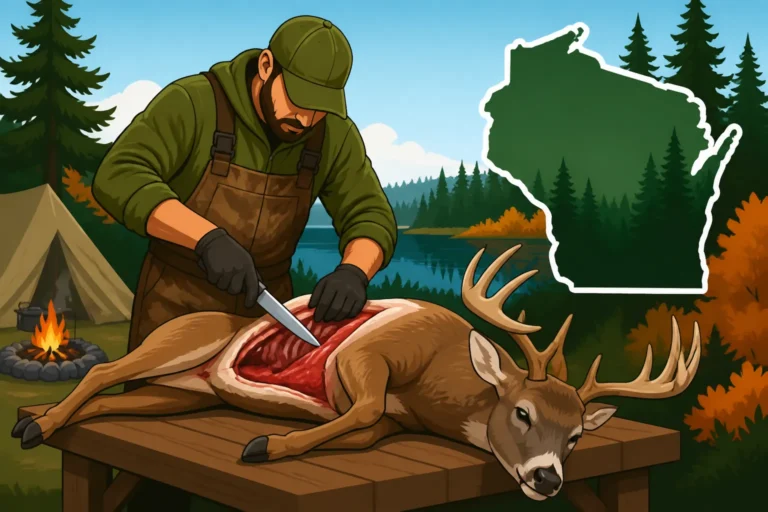
Getting a deer out of a coulee can be the hardest part of the hunt. If you can, drag downhill to a creek bottom or field road, then use a vehicle to get out. If you must go up, take breaks, use a good drag rope and bring help. Some hunters quarter deer on the spot to lighten the load, particularly when they are hunting alone.
A plan for the recovery should be part of choosing your stand. A spot that puts a downed deer at the bottom of a deep coulee half a mile from a road may still be worth hunting, but go in knowing what the pack-out will require. Dragging a Deer Up a Coulee Wall covers techniques that help.
Once the deer is out, register it by the state deadline and handle CWD testing if you plan to have the deer sampled. Doing both promptly keeps you legal and helps the state track disease in the herd.
Planning a Driftless Season
Scouting Through the Year
Good Driftless hunters scout year round. Spring shed hunting shows which bucks survived and where they spent the winter. Summer glassing of fields from roads can reveal bachelor groups. Early fall scouting focuses on food sources, especially acorns, which change from year to year.
Trail cameras are useful on travel corridors, saddles and field edges. On public land, follow the rules for placing and labeling cameras. Use digital tools such as GoHunt alongside topographic maps and aerial photos to identify likely features from home before you walk them.
Remember that every trip into the woods leaves scent. Limit in-season scouting near bedding areas, and do most of your intrusive scouting after the season or in early spring.
Building a Season Plan
A simple plan helps you make the most of your time. Here is a basic process many hunters use:
- Study maps and aerial photos to identify ridges, saddles, bedding cover and food sources on each property.
- Walk the ground in spring or late winter to confirm features and look for old rubs, scrapes and trails.
- Pick stand locations for specific winds and times of day, along with entry and exit routes.
- Prepare stands, saddles or blinds in late summer, following the rules for the land you hunt.
- Hunt early season over food, pre-rut on scrapes and saddles, and the rut near bedding areas.
- During the gun season, shift to escape routes, bluff faces and thick cover that pressured deer use.
- In late season, focus on food sources and rim sits overlooking fields.
Adjust as you go. Weather, crop harvest and acorn crops can all change where deer move.
Final Thoughts on Hunting the Driftless
The Driftless rewards patience, careful planning and respect for the land. It is not an easy place to hunt, and the terrain can humble even experienced hunters. But the combination of rich habitat, mature deer and beautiful country makes it one of the most rewarding places to hunt whitetails anywhere.
Learn the land, play the wind, plan your access and recovery, and stay on top of the rules for each county. Do that over a few seasons and you will begin to see the patterns that make this country special. Tools like GoHunt and paper topographic maps help, but nothing replaces time on the ground.
Disclaimer
This article is for general informational purposes only and does not constitute professional advice. Laws, prices and regulations vary by location and change over time. Consult a qualified professional for guidance on your specific situation.