Two-Way Radios on a Deer Drive
There's nothing quite like the camaraderie and strategic thrill of a Wisconsin deer drive, but coordinating one can feel like trying to herd cats in a blizzard. The dense woods, rolling hills of the Driftless, or expansive farmlands can swallow up shouted commands and hand signals faster than a hungry buck disappears into a cedar swamp. This guide is all about cutting through that noise, making your deer drives safer and far more effective by leveraging the power of two-way radios.
The Imperative of Clear Communication on Wisconsin Deer Drives
Imagine trying to push deer through a sprawling section of public land, maybe a mixture of thick pines and aspen cuts, without knowing where your blockers are positioned or if the drivers are moving too fast or too slow. It's a recipe for frustration, lost opportunities, and, most importantly, potential safety hazards. Deer drives are inherently dynamic, and reliable communication isn't just a convenience; it's absolutely essential for success and the well-being of every hunter involved.
Why Silence Isn't Golden: The Risks of Poor Communication
When you're attempting a deer drive, especially with multiple people spread out across a large piece of ground, a breakdown in communication can lead to all sorts of issues. For starters, hunters can easily get out of sync. Drivers might push too quickly, outpacing the blockers who are meant to be waiting at strategic escape routes. Or, conversely, blockers might get into position and wait endlessly, not knowing if the drive has even begun or if the deer have already slipped by unseen. This inefficiency often results in deer escaping the drive completely, leaving everyone feeling disappointed and like they've wasted precious hunting time.
Beyond just the effectiveness of the drive, there's a serious safety component at play. In areas like the Hunting Pressure on Wisconsin Public Land, it's crucial to know where every member of your party is at all times. Without clear communication, a driver could inadvertently push towards a blocker's position from an unexpected angle, or a blocker might shift positions without anyone else being aware. In dense cover, where visibility can be limited to mere yards, knowing precisely where your fellow hunters are is paramount to ensuring safe shooting lanes and preventing accidents. It's a tough environment out there, and leaving things to chance is never a good idea.
The Role of Radios in Drive Coordination and Safety
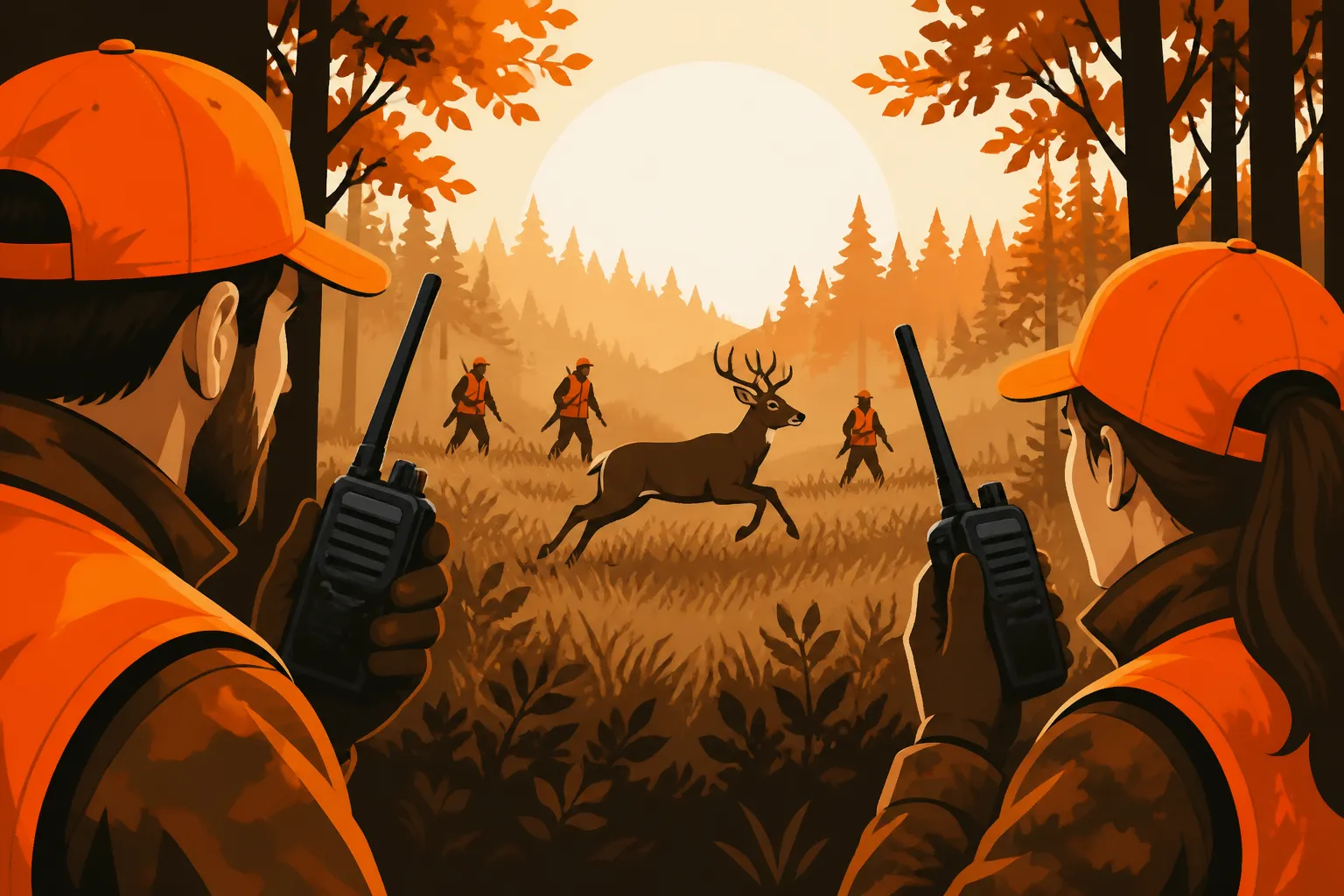
This is where two-way radios truly shine. They transform a chaotic free-for-all into a coordinated effort, much like a well-drilled football team. With radios, drivers can update blockers on their progress, the direction of deer movement, and any changes in terrain or cover. Blockers, in turn, can report back on deer spotted, their current position, and readiness. This real-time information flow allows the entire team to adapt and react to the ever-changing dynamics of a deer drive. You can call out, "Buck just broke left, heading towards Miller's ridge!" or "Drivers, slow down, we have a thick bedding area ahead."
Moreover, radios are an indispensable safety tool. If a hunter takes a fall, gets disoriented, or needs assistance, a quick radio call can alert the entire group to the situation. This is especially critical in challenging terrain, like the steep coulees of the Driftless Area Deer Hunting in Wisconsin or the vastness of the Hunting the Wisconsin Northern Forest for Deer. Even in less dramatic scenarios, knowing that everyone is accounted for and safe provides immense peace of mind. It allows everyone to focus on the hunt, confident that they can communicate instantly if needed, whether that's for a safety check or to shout, "Deer! Get ready!"
Choosing the Right Two-Way Radios for Your Hunting Crew
When it comes to selecting radios for your Wisconsin deer drives, you're not looking for fancy gadgets with a million features you'll never use. You need reliable, durable tools that can withstand the elements and provide clear communication when it matters most. There's a balance to strike between power, range, and practicality.
FRS and GMRS Radios: Understanding the Differences
The two most common types of two-way radios you'll encounter are Family Radio Service (FRS) and General Mobile Radio Service (GMRS). FRS radios are widely available, require no license, and are generally lower power, making them suitable for short-range communication in open areas. They're plug-and-play, easy for anyone to pick up and use, and perfect for small groups staying relatively close together, perhaps Deer Drives With Three or Four Hunters on a smaller woodlot. The downside is their limited range, especially in the thick timber or rolling terrain Wisconsin is known for.
GMRS radios, on the other hand, offer higher power output (up to 5 watts compared to FRS's typical 0.5 watts), which translates to significantly better range and clarity in challenging environments. To legally operate a GMRS radio, you need a license from the FCC, but it's a relatively simple process, covering your entire family for a set fee and period. Many modern hunting-specific two-way radios are GMRS-compatible, offering both FRS and GMRS channels, giving you the flexibility of license-free short-range use or licensed long-range power. Given the varied topography across Wisconsin, from the thick northern forests to the rugged Driftless, GMRS is often the preferred choice for serious hunting groups who need that extended reach.
| Feature | FRS Radio | GMRS Radio |
|---|---|---|
| Power Output | Low (typically 0.5W) | Higher (up to 5W) |
| Range | Shorter, best for line-of-sight/open areas | Longer, better penetration through terrain/cover |
| Licensing | No license required | FCC license required for GMRS channels |
| Channels | Shared with GMRS (channels 1-7, 15-22) | Dedicated GMRS channels plus shared FRS channels |
| Cost | Generally lower | Potentially higher for advanced models |
| Antenna | Fixed | Often fixed, but some GMRS allow detachable |
| Privacy Codes | Yes | Yes |
Features That Matter for Deep Woods Use
When you're out in the Wisconsin woods, certain radio features move from "nice-to-have" to "must-have." Durability is paramount. Look for radios that are rugged, impact-resistant, and preferably waterproof or at least water-resistant. A sudden downpour or an accidental drop in the mud shouldn't spell the end of your communication. The buttons and controls should be easy to operate even with gloves on, as fumbling with tiny knobs in the cold November air is a quick way to miss a crucial update.
Battery life is another huge consideration. A radio that dies halfway through the day is useless. Opt for models with long-lasting rechargeable batteries, and consider carrying spare battery packs or a portable power bank if your hunt will span multiple days or involve extended use. Look for features like battery save modes or low-battery indicators. Good antenna quality is also key for maximizing range in challenging terrain. While you can't always change the antenna on FRS/GMRS units, some higher-end GMRS radios allow for aftermarket antennas that can significantly boost performance.
Power, Range, and Battery Life Considerations
The advertised "range" on a radio's packaging is almost always an optimistic figure achieved under ideal, unobstructed conditions – think flat, open desert. In the real world of Wisconsin hunting, with its rolling hills, dense timber, and fluctuating weather, those numbers will shrink considerably. High power output (the "watts") helps push the signal through obstructions, but even a 5-watt GMRS radio won't guarantee miles of clear communication through a thick swamp or over a steep ridge. The actual range will depend heavily on line of sight, terrain, and atmospheric conditions.
Therefore, focus on radios that offer the maximum legal power for GMRS, which is 5 watts for most handheld units. Test your radios thoroughly in the specific type of terrain you'll be hunting before the season opens. Walk through the woods, send messages, and get a feel for their true effective range. Carrying spare batteries or having a way to recharge them in the field is a non-negotiable, especially for multi-day trips or in cold weather, which can notoriously shorten battery life. Just as you might consult a reputable source like GoHunt for reviews on hunting gear, looking into user experiences for specific radio models can give you a realistic expectation of battery performance in the field.
Mastering Radio Etiquette and Tactics for Effective Deer Drives
Having the right radios is only half the battle; knowing how to use them effectively and safely is just as important. A well-orchestrated deer drive relies on clear, concise communication, and that requires a little planning and practice.
Pre-Drive Planning: Channel Selection and Call Signs
Before you even step foot in the woods, gather your hunting party and discuss your communication strategy. First, decide on a primary channel to use. If you have GMRS radios, pick one of the dedicated GMRS channels (channels 8-14, 23-30) to minimize interference from FRS users. You might also want to select a secondary channel as a backup in case of unexpected static or interference on your primary. Utilizing privacy codes (also known as CTCSS or DCS codes) can further help filter out chatter from other radio users, making your communication clearer, though it doesn't make your conversation private.
Next, establish clear call signs for each member of the party. Simple, distinct names or numbers work best. Instead of "Hey John, this is Mike," it becomes "Alpha One, this is Bravo Two." This prevents confusion, especially when multiple people might have similar-sounding names. Assign specific roles and objectives to each hunter and review them using a map. For instance, "Delta Three, you're on the far left flank, pushing towards the old logging road," or "Charlie Five, you're blocking at the creek crossing." Using tools like the GoHunt app for satellite imagery can help everyone visualize these positions and plan routes before hitting the timber.
Real-Time Communication During the Drive
Once the drive begins, keep radio transmissions brief, clear, and to the point. Resist the urge to chat idly; every transmission ties up the channel and could prevent a critical message from getting through. Use the established call signs. When you see deer, report their direction of travel and approximate size if possible: "Alpha One, I have two does pushing east towards the big oak, over." If you need to stop, slow down, or change direction, communicate that clearly. "Bravo Two, holding position, waiting for Delta Three to catch up."
Blockers should report when they are in position and ready, and when deer pass their location. "Charlie Five in position, all clear so far." If a shot is taken, a simple "Shot taken, status update," can alert the group to be prepared for tracking or movement. It's also good practice to do periodic check-ins if the drive is long or covers difficult terrain. A quick "Radio check, all positions," followed by each member responding "Alpha One, clear," "Bravo Two, clear," ensures everyone is still operational and accounted for. This structured approach helps everyone stay on the same page and prevents confusion.
Addressing Common Challenges and Maximizing Performance
Wisconsin's diverse landscape can present challenges for radio communication. Dense foliage, steep hills, and deep valleys can all attenuate signals. To maximize range and clarity, try to maintain line of sight as much as possible, though this isn't always practical during a drive. When transmitting, hold the radio upright and ensure the antenna isn't obstructed. If you're struggling to get through, try moving to a slightly higher elevation or out from behind a particularly dense patch of timber. Sometimes just a few steps can make a difference.
Remember that cold weather can drain batteries faster, so keep spare batteries warm in an inside pocket. If your radio has an external microphone/speaker port, a good quality shoulder mic can make communication easier, especially when wearing bulky gloves or coats, allowing you to transmit without taking the radio off your belt. When planning your route, use a topographical map or a GPS mapping app to identify potential dead zones or areas where signal might be weaker due to terrain features. Just as you'd plan Entry Routes on Steep Driftless Ground, plan your radio communication around the landscape. Before you head out on Wisconsin's Nine-Day Gun Deer Season, perform a thorough gear check, including fully charging all radios.
Beyond the Drive: Radios as a General Hunting Tool
While invaluable for deer drives, two-way radios offer benefits far beyond coordinating pushes. They are a versatile piece of gear that can enhance safety and coordination for a variety of hunting scenarios across Wisconsin. Thinking of them solely for drives misses a lot of their potential.
Safety and Coordination for Still-Hunters and Solo Journeys
Even if you're not participating in a formal drive, radios provide a critical layer of safety when hunting with a partner or small group. Imagine Still-Hunting Wisconsin Cedar Swamps with a buddy. You might split up to cover more ground, but being able to communicate quietly and instantly about deer sightings, sign, or simply checking in on each other's location is a huge advantage. If one hunter takes a shot and needs assistance with Tracking a Deer in Wisconsin Snow, a quick radio call can bring help without needing to shout and spook other game.
For solo hunters, while a radio can't provide instant company, it can be a lifeline if you have planned rendezvous points or if you're hunting within range of a designated "base camp" with another radio user. In remote areas like the Chequamegon-Nicolet National Forest, where cell service is often nonexistent, a reliable two-way radio can be the only means of communicating with the outside world in an emergency. Many hunters carry a First Aid Kits for Remote Northwoods Ground – a radio is just as essential for truly being prepared for the unexpected.
Pairing Radios with Modern Hunting Apps
Modern hunting often involves a blend of traditional skills and cutting-edge technology. Pairing your two-way radios with a robust hunting app on your smartphone or GPS device can create a powerful synergy. Apps like the GoHunt app offer detailed topographic maps, satellite imagery, and the ability to mark waypoints, track your movement, and share locations with your group. While the app can show you where your buddies are on a map, a radio provides the direct verbal communication to understand why they are there or what they are seeing.
For example, a driver might radio, "I'm seeing heavy tracks at waypoint 27, looks like they're headed towards that thick stand of pines," while simultaneously sharing their location on the map. This combination of visual and auditory information gives everyone a comprehensive understanding of the situation. It’s particularly useful when trying to get a deer out of challenging terrain. After a successful shot, you might use your radio to direct a partner to your location with a Deer Sleds for Snow Country or Deer Carts on Forest Roads, coordinating the recovery process smoothly, even if one person is checking game and the other is moving gear.
Disclaimer
This article is for general informational purposes only and does not constitute professional advice. Laws, prices and regulations vary by location and change over time. Consult a qualified professional for guidance on your specific situation.