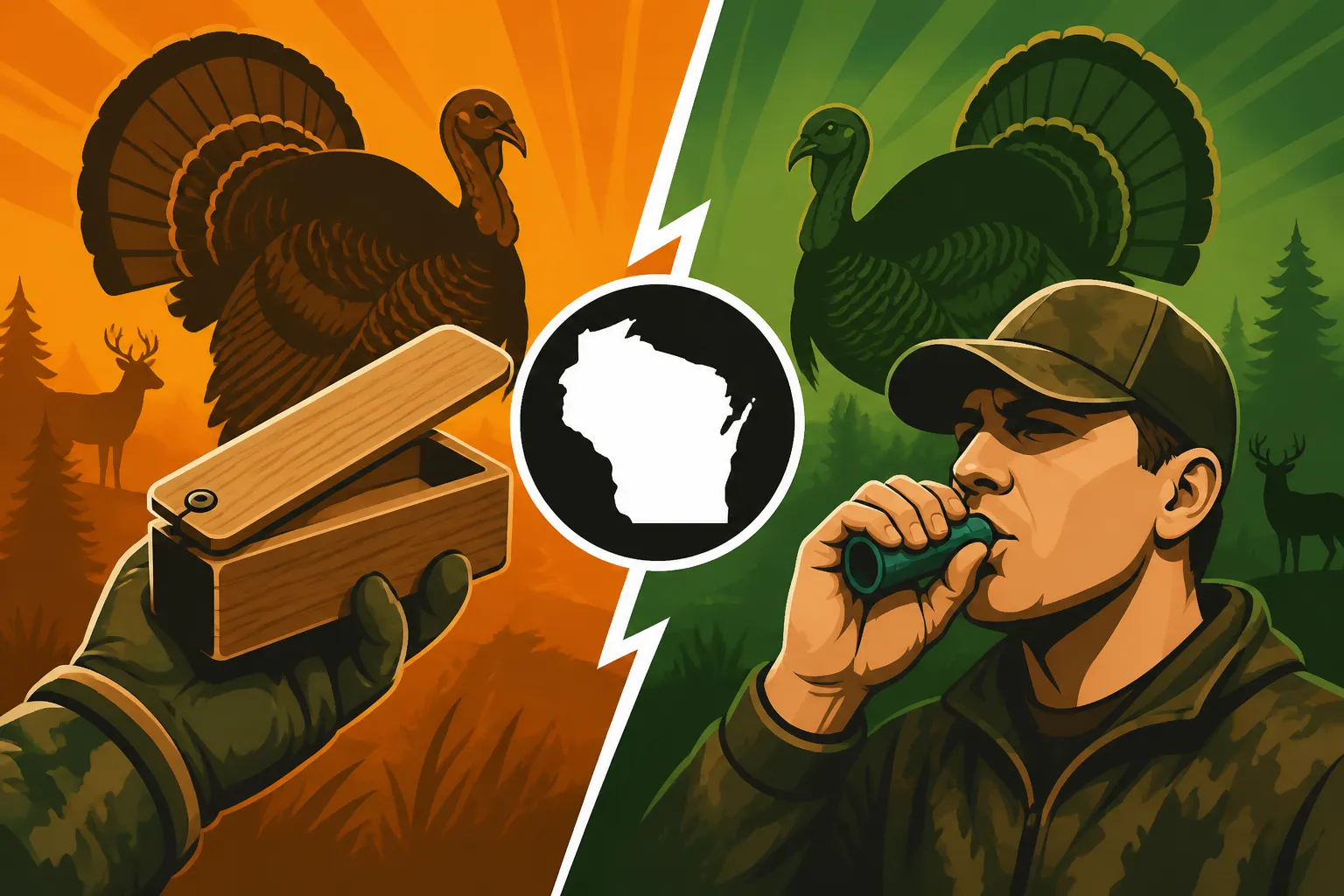
Box Calls Versus Mouth Calls
There are few things as frustrating as having a gobbler hang up just out of range, silent and suspicious, all because your call either couldn't reach him or spooked him with its movement. Whether you're chasing longbeards in the big timber of northern Wisconsin or trying to coax one off a roost in the farmlands, choosing the right turkey call is absolutely crucial. This guide will walk you through the distinct advantages and disadvantages of box calls versus mouth calls, helping you decide which one best suits your hunting style and the varied conditions you'll encounter across our beautiful state.
The Classic Box Call: Its Strengths and Weaknesses in Wisconsin
Ah, the box call. For many of us, it was the first turkey call we ever picked up. There's something inherently satisfying about the simple mechanics of drawing that paddle across the soundboard, creating those unmistakable yelps and clucks. It's a foundational piece of gear for a reason, and it's certainly got its place in the Wisconsin turkey woods.
Why Box Calls Shine for Volume and Consistency
One of the undeniable strengths of a box call is its sheer volume. When you need to reach out and touch a gobbler across a wide-open field or down a long ridge in the Driftless Area Deer Hunting in Wisconsin, a good box call can really project. You can crank out loud, attention-grabbing yelps that carry a significant distance, perfect for locating birds or pulling them from afar. This is especially useful on those windy spring mornings where subtle calls just get swallowed up by the breeze.
Beyond volume, box calls offer incredible consistency. Even a beginner can usually produce a decent-sounding yelp, cluck, and cut with minimal practice. The mechanics are straightforward: rub the paddle. This consistency means you're less likely to "blow" a call and spook a bird with an off-key sound, which can be a real confidence booster for new hunters or when you're under pressure. For me, there's a certain reliability to them, a comforting predictability that a good, well-tuned box call will perform when I need it most. They're also fantastic for imitating the excited cutting of a hen, which can be very effective in grabbing a gobbler's attention when he seems disinterested.
The realism can also be outstanding. A well-made box call can perfectly mimic the raspy, drawn-out yelps of an old hen, and some even produce superb purrs and putts when handled gently. It's an intuitive instrument, and with a little practice, you can add nuance to your calling. This consistency and volume make them ideal for "blind calling" – just setting up and broadcasting calls, hoping to elicit a response from an unseen gobbler, which is a common tactic, particularly When Wisconsin Gobblers Go Quiet.
Where Box Calls Fall Short in the Wisconsin Woods
Despite their charm and effectiveness, box calls do have some significant drawbacks that can impact your success in Wisconsin's diverse terrain. The most obvious limitation is that they are a two-handed operation. This means that if a gobbler suddenly pops into view and you're actively calling, you have to put the call down before you can raise your shotgun. In those critical moments when a tom is closing fast, every second counts. I've had more than one bird bust me because I fumbled with my box call, trying to get it safely out of the way before shouldering my gun. It's a real heart-sinker when that happens.
Another issue is their bulk. While not huge, a box call takes up space in a vest pocket or requires you to hold it. It's not something you can easily conceal or carry without some degree of noise, especially if you're Run-and-Gun Turkey Tactics on Public Land. The wood can also be susceptible to moisture. A rainy or particularly damp spring morning can make a box call's paddle stick, or the soundboard can swell, leading to a much less appealing, muted sound. There's nothing worse than needing a sharp, clear yelp and getting a soggy, dull squawk instead.
Perhaps the biggest downfall, especially when a gobbler is really close, is the movement and the sound required to operate it. In those tense final moments when a wise old tom is trying to pinpoint your exact location, the subtle motion of your hands and the slight squeak of the paddle on the box can be enough to give you away. They aren't the best for soft, close-range clucks and purrs that you might need to make a bird take those last few steps into range without him seeing any movement. For these reasons, many experienced hunters view box calls as a fantastic locator call or a long-range persuader, but not always the best choice for the "kill shot" call.
The Versatile Mouth Call: Mastering the Diaphragm in Wisconsin
Now, let's talk about the mouth call, often referred to as a diaphragm call. This tiny, unassuming piece of plastic and latex has revolutionized turkey hunting for many, offering a level of versatility and stealth that's hard to beat once you've mastered it. It's truly a game-changer when you're deep in the hardwoods or setting up in a tight spot.
The Unmatched Versatility and Stealth of Mouth Calls
The biggest advantage of a mouth call is its hands-free operation. This is a game-changer for those nerve-wracking moments when a gobbler is approaching your position. You can keep your gun shouldered, your face camouflaged, and still make calls without any detectable movement. This stealth factor alone can make the difference between a successful hunt and a missed opportunity. I can't tell you how many times I've had a gobbler eyeball my setup, and being able to let out a soft tree yelp or a subtle cluck without moving a muscle has kept him coming. This is particularly crucial when dealing with heavily pressured birds, or those wary toms found on public land.
Mouth calls are also incredibly compact. They fit right in your mouth or in a small plastic case in your vest, taking up virtually no space. This makes them ideal for the run-and-gun hunter who might cover a lot of ground in search of active birds, such as when employing Run-and-Gun Turkey Tactics on Public Land. They are also impervious to weather. Rain, snow, or damp conditions don't affect their performance, ensuring you always have a consistent call no matter what Mother Nature throws at you.
Their versatility in sound is also outstanding. With practice, a single mouth call can produce the entire vocabulary of a wild turkey: yelps, clucks, purrs, cuts, gobblers, and even the distinct sounds of a lost hen or a fly-down cackle. You can vary the tone, pitch, and volume significantly, allowing for incredibly realistic and nuanced calling. Being able to shift from a loud series of cuts to soft, reassuring purrs instantly without changing calls gives you a huge advantage in working a bird that's close but cautious. Many hunters find that Turkey Calls Worth Carrying in Wisconsin almost always includes a good mouth call for these exact reasons.
The Learning Curve and Challenges of Diaphragm Calls
Okay, let's be realistic: mouth calls are not easy to learn. This is their biggest hurdle. Many aspiring turkey hunters get frustrated trying to make a decent sound, often ending up with a squeaky, duck-like quack instead of a sweet yelp. It takes dedication, practice, and a good bit of trial and error to get the technique down. You'll need to learn how to place the call correctly on your tongue, how to control airflow, and how to vibrate the reeds with your breath. It's an art, not a science, and everyone's mouth is a bit different.
Finding the right mouth call can also be a challenge. There are countless variations in reed cuts, reed thicknesses, and frame shapes. What works perfectly for one hunter might be impossible for another. It's common to buy several different styles before finding one or two that you can consistently make good sounds with. I’ve certainly got a drawer full of calls that just didn’t click with my mouth, and it can be discouraging when you're first starting out.
Then there's the "spit-out" factor. Sometimes, especially when you're excited or trying to call loudly, the call can slip out of place in your mouth, or even pop out entirely. This can be incredibly frustrating, especially when you have a gobbler gobbling just over the ridge. It can also be a bit uncomfortable initially, and some people find they gag or have difficulty breathing while trying to master the technique. It's certainly not an instant gratification type of call, but for those who put in the time, the rewards are immense.
Choosing the Right Call for Your Wisconsin Hunting Scenario
So, with all these pros and cons, how do you decide which call to use? The best answer, like most things in turkey hunting, is that it depends on the situation. Experienced Wisconsin turkey hunters rarely rely on just one type of call. They often carry a variety to adapt to whatever the birds and the terrain throw at them.
Matching Calls to Terrain and Hunting Style
Consider the specific conditions you're facing. If you're starting your morning trying to locate a gobbler off the roost in a vast block of public timber, a box call or a loud pot call (which shares many characteristics with a box call in terms of volume and two-handed operation) is an excellent choice. You can blast out those calls, hoping to get a shock gobble from a distant bird. This is where you need that reach. You might be in a wide bottomland area near the Wisconsin River or scanning open ridges in the Driftless, and that maximum volume is key for initial contact.
However, once you've located that bird and started to close the distance, or if you're dealing with a gobbler that's already in relatively close quarters – say, within 100-150 yards – a mouth call quickly becomes your best friend. You can move into position, get set up against a tree, and then work the bird with subtle yelps, clucks, and purrs without any visible movement. This is especially true for Turkey Tactics for Driftless Farm Edges where birds can be incredibly wary and expect to see what's making the sound. When that tom is within easy shotgun range, ready to put on a show, those soft, hands-free calls are absolutely critical.
A GoHunt subscription can be invaluable for scouting different terrain types from home, helping you anticipate where you might need maximum volume versus ultimate stealth. Knowing if you'll be in open hardwoods or dense swamp edges can help you choose your primary call before you even step foot in the woods.
The Advantage of Carrying Both for Wisconsin's Varied Conditions
The truth is, the most effective strategy for hunting Wisconsin turkeys is to carry a combination of calls. A box call or pot call serves wonderfully as your "loud call" – great for locating, getting initial responses, and making aggressive, long-range appeals. It’s perfect for breaking the silence of an early morning or reaching across big fields. Many hunters will make their initial setup, hit the box call a few times, then wait. If a bird responds, they might then switch to a mouth call as they try to close the distance or when the bird gets closer.
The mouth call, then, becomes your "finishing call." It's what you use for those delicate, close-in negotiations. It's for when that gobbler is looking for the hen, pacing back and forth, trying to make her show herself. That's when you need to be absolutely still, and a mouth call allows you to deliver those soft, reassuring hen sounds that can often seal the deal. It lets you keep your hands on your gun and your eyes on the prize.
Think of it like this: your box call is the megaphone that announces your presence to the world, and your mouth call is the whispering voice that lures him into your embrace. They complement each other beautifully. I always have a few different mouth calls in my vest, alongside a reliable box call, because you never know what the day will bring. This dual approach gives you the flexibility to adapt to changing situations and the mood of the birds. It also provides a backup if one call type isn't getting a response, or if you're experiencing issues, like that box call getting a bit damp from the morning dew. Having that versatility in your Turkey Gear for a Wisconsin Spring is key to success.
| Call Type | Key Strengths | Key Weaknesses | Ideal Use in Wisconsin |
|---|---|---|---|
| Box Call | High volume, consistent sound, easy to learn, realistic cuts. | Two-handed operation, bulky, movement can spook close birds, susceptible to moisture. | Locating distant gobblers, reaching across open fields, aggressive initial calling, windy days. |
| Mouth Call | Hands-free, compact, wide range of sounds, weather-proof, ultimate stealth. | Steep learning curve, takes practice, can "spit out," less initial volume for beginners. | Finishing close-range gobblers, subtle calling, thick cover, silent setups, rainy days. |
Ultimately, both box calls and mouth calls have their rightful place in a Wisconsin turkey hunter's arsenal. While the mouth call offers unparalleled stealth and versatility for finishing a bird, the box call provides the volume and consistency needed for initial location and long-range persuasion. The real magic happens when you learn to use both, leveraging their individual strengths to adapt to every situation. Practice with both, get comfortable, and you'll be well on your way to punching more tags this spring.
Disclaimer
This article is for general informational purposes only and does not constitute professional advice. Laws, prices and regulations vary by location and change over time. Consult a qualified professional for guidance on your specific situation.