Why Aspen Cuts Grow Grouse
There's nothing quite like the heart-stopping thunder of a ruffed grouse exploding from cover, especially when you've put in the legwork to find those elusive birds. It can be incredibly frustrating to walk mile after mile of beautiful Wisconsin woods, hearing nothing but squirrels, and wondering where all the grouse have gone. But I'm here to tell you there's often a secret ingredient to consistent grouse encounters: aspen cuts. This guide will dive deep into why these seemingly barren patches of land are actually prime grouse habitat and how you can learn to find and hunt them effectively in our great state.
The Essential Needs of a Ruffed Grouse: More Than Just Trees
Before we can truly appreciate why aspen cuts are such a game-changer for ruffed grouse in Wisconsin, it's vital to understand what these incredible birds actually need to survive and thrive throughout their lives. They aren't just looking for any old forest; they're looking for very specific characteristics that provide food, shelter, and safety from predators. Knowing these core needs will help you "read" the woods better, whether you're scouting new areas or trying to understand why your favorite covert suddenly went quiet.
Dense Understory for Hiding and Nesting
Imagine being a small bird on the forest floor, constantly on the lookout for hawks, owls, foxes, and coyotes. You'd want some serious cover, right? That's exactly what ruffed grouse need: thick, impenetrable patches of young trees, shrubs, and briars. This dense understory, often created by new growth, is their sanctuary. It's where they can escape the keen eyes of predators and find refuge from harsh weather, be it a driving rain or a heavy snow. Without this thick cover, a grouse is practically an easy meal.
This isn't just about survival for adult birds; it's absolutely critical for successful nesting and chick rearing. Hens rely on dense ground cover to hide their nests, typically a shallow depression on the forest floor. Once the chicks hatch, they're tiny and incredibly vulnerable. The tangled web of young saplings and brush acts as a nursery, providing camouflage and a haven where the chicks can feed on insects and grow without being constantly exposed. If you're walking through wide-open, mature woods with little to no undergrowth, you're in an area that simply isn't meeting a grouse's most fundamental need for security.
Food Sources: Buds, Catkins, Berries
Grouse are surprisingly adaptable eaters, but certain foods are staples in their diet, particularly in Wisconsin. Their diet changes with the seasons, but the common thread is that these food sources are often abundant in the early successional habitats that aspen stands provide. In winter, when snow blankets the ground and insects are scarce, grouse rely heavily on the buds and catkins of trees like aspen, birch, and hazel. These high-energy food sources are literally lifelines, allowing them to survive the brutal cold.
As spring arrives and throughout summer and fall, berries become a crucial component of their diet. Think about wild raspberries, blackberries, hawthorns, and dogwoods – all plants that thrive in disturbed areas and along the edges of younger forest growth. Insects are also a key food source, especially for growing chicks, and these invertebrates are far more common in areas with diverse vegetation and sunlight penetration. When you find a healthy aspen cut, you're not just finding cover; you're finding a buffet that sustains grouse year-round. Understanding this connection helps you pinpoint areas where grouse are not only hiding but actively feeding.
Drumming Sites and Brood Cover
Every spring, male ruffed grouse engage in one of the most iconic sounds of the Northwoods: drumming. This isn't just a quaint sound; it's a vital part of their breeding ritual. Males choose specific "drumming logs" – often a fallen tree or a large rock – within their territory. From this elevated perch, they beat their wings rapidly, creating a vacuum that produces that deep, resonant thump-thump-thump-thump-thump-thump-thump-thump-thump-thump-thump sound. These drumming sites are almost always located within areas of dense cover, allowing the male to attract mates while remaining relatively hidden from predators.
Beyond drumming sites, successful grouse populations require excellent brood cover, which goes back to that dense understory we discussed. Brood cover is more than just a place to hide; it's a place where the hen can lead her chicks to feed on insects, warm themselves in the sun, and quickly disappear into the brush at the first sign of danger. Think of it as a nursery and a playground all rolled into one. Without a mosaic of drumming sites and robust brood cover, the cycle of life for ruffed grouse simply breaks down. This mosaic is precisely what well-managed aspen stands provide, giving you an idea of why Wisconsin Ruffed Grouse Cycles are so tied to timber practices.
The Life Cycle of Aspen and How it Creates Habitat
Aspen, particularly quaking aspen and bigtooth aspen, is a fascinating tree species, and its unique life cycle is precisely why it's so critical to ruffed grouse in Wisconsin. Unlike many other hardwoods, aspen doesn't rely solely on seeds to reproduce. This difference is what makes it such a powerhouse for creating the kind of habitat grouse need. When you understand the "aspen story," you'll start to see a cut-over area not as a barren landscape, but as a future grouse haven.
Aspen's Unique Regeneration: Suckering
Here's the cool part about aspen: it's a clonal species. That means a single aspen tree isn't just an individual; it's often part of a vast underground network of roots, all connected to a "parent" tree. When that parent tree is cut down or dies from disease or fire, it triggers an incredible response in its root system. Thousands of dormant buds on those roots suddenly burst to life, sending up new shoots, or "suckers," all at once. This phenomenon is called suckering, and it's what creates those incredibly dense stands of young aspen that grouse adore.
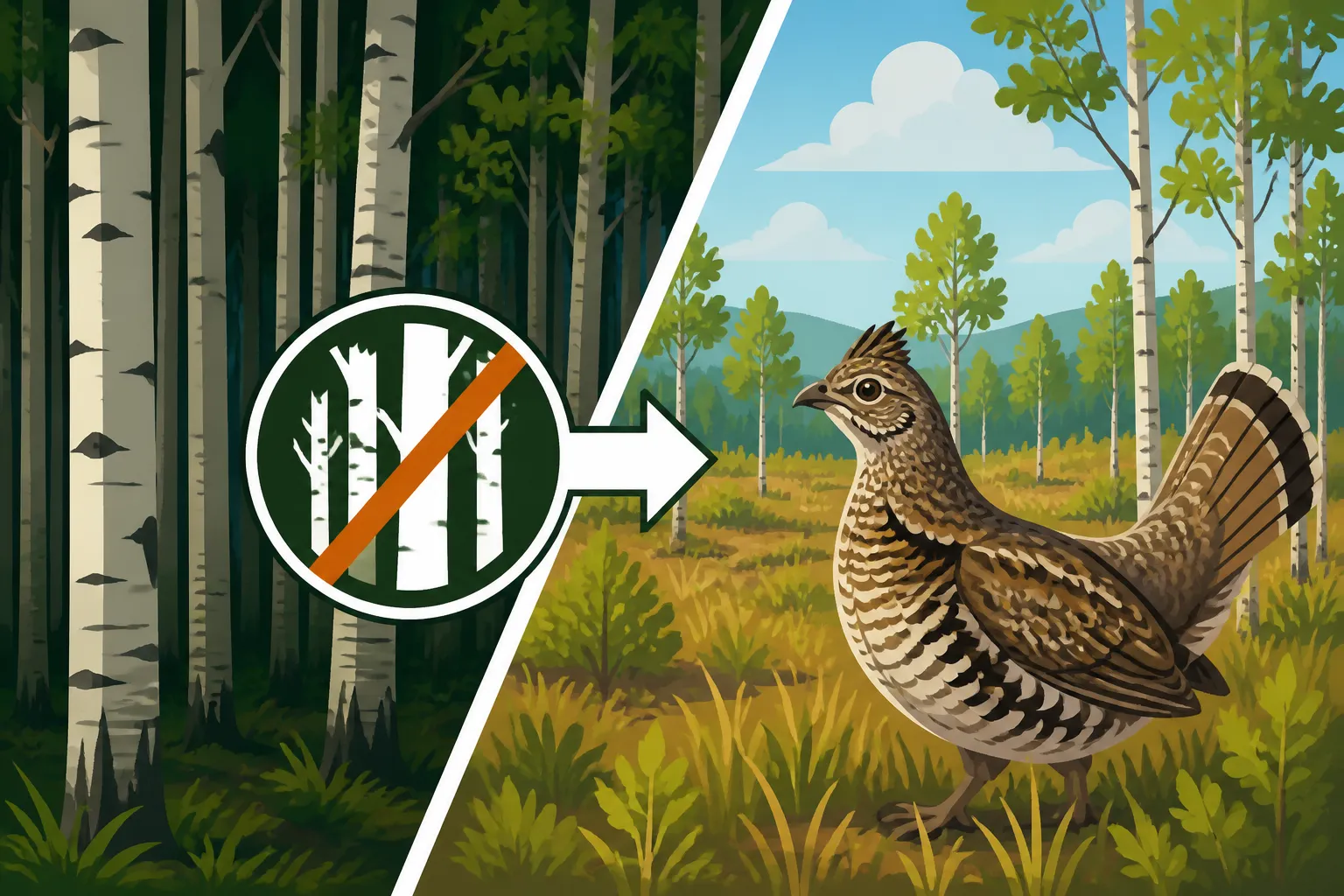
Imagine a mature aspen stand, perhaps 40-60 years old. When it's clear-cut, the sunlight suddenly floods the forest floor. This, combined with the stress on the root system, prompts an explosion of growth. Within a year or two, you'll see tens of thousands of aspen suckers per acre, sometimes hundreds of thousands. This instant, thick regeneration is crucial. It means that almost overnight, what was once open, mature forest becomes an incredibly dense, almost impenetrable thicket – exactly the kind of cover a grouse needs.
Young Aspen: The Ideal Grouse Nursery
It's these young, suckering aspen stands, typically 1 to 15 years old, that are the absolute sweet spot for grouse. When the aspen is 1-5 years old, it's so thick you can barely walk through it. This is phenomenal security cover for both adult grouse and, crucially, for broods of chicks. Predator visibility is extremely low, and there are countless places for a bird to hide instantly. The sheer density provides an umbrella against aerial predators like hawks and owls.
As the stand grows a bit older, say 5-15 years, it starts to thin out naturally, but it remains very dense near the ground. At this stage, it's still excellent cover, but it also begins to offer more in terms of food. The developing buds and catkins become available, and the filtering sunlight allows for the growth of berry-producing shrubs and other herbaceous plants on the forest floor. These areas act as primary brooding grounds and wintering cover for grouse, providing a perfect blend of food and shelter. Many hunters use mapping tools, like those available through GoHunt, to identify recently cut areas that will soon enter this prime "grouse nursery" phase.
Mature Aspen: Providing Overhead Cover and Food
While the youngest aspen is king for grouse, mature aspen stands still play a role, albeit a different one. Once an aspen stand reaches 20-40 years old, it typically thins out significantly at ground level. Walking through it feels much more open than those early growth stages. However, these stands still provide overhead cover from aerial predators and, importantly, a consistent supply of winter food. The buds and catkins on mature aspen trees are a vital resource for grouse during the colder months when other food sources are buried under snow or simply unavailable.
For a robust grouse population, you need a mix of these age classes. Mature aspen stands might not hold as many birds as the younger cuts, but they are essential components of the broader habitat mosaic. They are where grouse will feed heavily in late fall and winter, especially during periods of deep snow. A healthy forest for grouse isn't just one age of aspen; it's a diverse landscape with different stages of growth providing continuous food and cover throughout the year. Knowing this, you can look for areas with older aspen adjacent to younger cuts, creating a perfect transition zone.
The Role of Timber Management: Creating and Sustaining Habitat
It might seem counterintuitive to cut down trees to help wildlife, but for ruffed grouse in Wisconsin, well-planned timber harvesting is absolutely essential. Nature used to manage these forests through large-scale events like wildfires and major windstorms, but in our modern landscape, responsible timber management often steps in to replicate these natural processes, especially when it comes to aspen. This active management is the cornerstone of sustainable grouse populations.
Clear-Cutting: Simulating Natural Disturbances
The primary method for regenerating aspen is clear-cutting. This means harvesting all the trees in a designated area. To a casual observer, a freshly clear-cut area can look devastated, almost like a moonscape. However, for a ruffed grouse, it's the start of something beautiful. As we discussed, clear-cutting triggers that massive suckering response from the aspen roots. It simulates the ecological impact of a large-scale fire or severe wind event, which would naturally open up the forest canopy and allow sunlight to reach the forest floor.
Without clear-cutting, aspen stands would eventually "overmature," meaning the trees would get too old, become susceptible to disease, and eventually die without the vigorous regeneration needed for grouse habitat. The dense understory would disappear, replaced by a more open, park-like forest floor that offers little to no cover for grouse. Timber companies, often working with the Wisconsin DNR and private landowners, use clear-cutting as a tool to reset the clock, ensuring a continuous supply of young, healthy aspen growth that benefits not only grouse but a host of other wildlife species that rely on early successional forests. This management is crucial for Aspen Management and Wisconsin Grouse.
Age Diversity: The Key to Continuous Habitat
A single, massive clear-cut might create fantastic grouse habitat for a few years, but grouse need more than just one patch of good cover. They need a variety of age classes nearby – a mosaic of different stages of aspen growth. Imagine a hen with a brood of chicks. She might lead them from the ultra-dense 3-year-old cut where they hatched, to the edge of an 8-year-old stand for feeding, and then perhaps toward a more mature 30-year-old stand for winter buds later in the year. This diversity ensures they have continuous access to food and cover throughout their life cycle and across all seasons.
Foresters, especially on state and county lands, plan timber harvests in a checkerboard or patchwork pattern, ensuring that new cuts are created every few years while other areas are allowed to mature. This creates a rotating system of prime habitat. When scouting, you're not just looking for "an" aspen cut; you're looking for an area with a mix of cuts of different ages, ideally within a short distance of each other. This kind of landscape, particularly evident in places like the northern Wisconsin county forests, is a grouse hunter's dream. Services like GoHunt can help you visualize this age diversity by often showing recent timber sales on their maps.
Long-Term Planning for Grouse Success
Effective grouse habitat management isn't a one-and-done deal. It requires long-term planning, often spanning decades. Foresters consider factors like soil types, topography, and existing tree species to determine the best areas for aspen regeneration. They also factor in other wildlife goals, water quality protection, and recreational uses. The goal is to create a sustainable cycle of timber harvesting that ensures a continuous supply of early successional habitat.
This long-term vision is particularly important in Wisconsin, where much of our public land, including national and state forests and especially our extensive county forest system, is actively managed. These areas are living examples of how forestry practices can directly benefit game species like ruffed grouse. When you're Hunting Grouse Wisconsin Aspen Cover, you're often walking through areas that have been carefully managed over many years, all to ensure that the unique needs of the grouse are met.
Finding the Right Aspen Cuts for Hunting
So, you understand why aspen cuts are so important for grouse. Now comes the exciting part: finding them and putting boots on the ground! This is where your knowledge truly pays off, transforming theory into tangible hunting success. It takes a bit of detective work and a willingness to explore, but the rewards are definitely worth it.
Reading Maps and Aerial Imagery
Your scouting journey should always start with a good map, preferably one with aerial photography. In Wisconsin, the DNR's online mapping tools and commercial apps like GoHunt are invaluable. You're looking for light-colored patches in a sea of green, which often indicate younger, more open areas – recent clear-cuts. Pay attention to the edges where these cuts meet older timber or other cover types. Grouse love edges, using the dense cut for security but venturing out into slightly more open areas for food.
Look for areas that have been clear-cut within the last 1 to 15 years. Cuts that are 5-10 years old are often in their prime for holding birds. Newer cuts (1-4 years) can be almost too thick to hunt effectively, but they're worth checking, especially on their perimeters. Older cuts (15+ years) will start to thin out but can still hold birds, particularly if there's good residual cover or if they're adjacent to newer cuts. Zoom in on these areas and look for variations in tree height and density. Reading Aerial Photos for Coulee Deer skills transfer perfectly to grouse scouting – look for that diverse mosaic.
Table: Aspen Stand Age and Grouse Habitat Value
| Aspen Stand Age (Years) | Primary Habitat Value | Hunting Accessibility | Grouse Density Potential | Notes for Hunters |
|---|---|---|---|---|
| 1-4 | Dense Brood Cover, Escape Cover | Extremely Difficult | High (especially broods) | Focus on edges, walk slowly, bring tough Brush Pants for Wisconsin Alder. |
| 5-10 | Prime All-Purpose Cover & Food | Challenging but Productive | Very High | Excellent for flushes, still requires effort. |
| 11-15 | Good Cover, Developing Food | Moderate | High | Stand starts to thin, easier walking, but still dense enough. |
| 16-25 | Declining Cover, Winter Food | Easier | Moderate | Birds may be more scattered, focus on food sources. |
| 26+ | Winter Buds & Roosting Cover | Easy | Low (primarily feeding) | Connects to younger cuts for daily movements. |
On-the-Ground Scouting for Sign
Once you've identified promising areas on your map, it's time for boots on the ground. There's no substitute for actually walking through prospective covers, even outside of hunting season. What are you looking for? First, confirm the age of the cut. Is it truly that young, dense aspen you identified on the map? Look for grouse droppings, which are often cylindrical and dark. In spring, listen for drumming. In fall, look for evidence of feeding, like pecked berries or chewed buds.
Also, pay attention to the terrain. Grouse often prefer areas with some slight elevation changes or depressions within the cuts, which can offer additional shelter. Don't overlook the edges where the aspen meets conifers or other hardwoods; these transition zones are often travel corridors and escape routes. Walk slowly, take note of where you see potential drumming logs, and mark any areas where you find fresh sign. This type of detailed Scouting Wisconsin Public Land Before Season will give you a significant advantage when the season opens. You'll soon realize how critical it is to walk the ground to verify what the maps suggest.
Timing Your Hunt in Aspen Cover
Knowing when to hunt these aspen cuts is almost as important as knowing where. Early in the season (September), grouse can be found deeper within the thickest cover, often still in family groups or "broods." As the season progresses into October and November, grouse may spread out more, and you'll find them hitting those berry patches hard. Remember to consider Wisconsin Grouse Season Dates.
The weather also plays a huge role. After a light rain, grouse might be more active, moving around and feeding. On very cold, windy days, they might hunker down in the densest conifer pockets adjacent to aspen cuts to escape the elements. The middle of the day, when the sun is out, can be productive as birds move to feed or sun themselves. Don't forget that late season hunting can be fantastic in these cuts after a good snow, as the birds concentrate on winter food sources. A good pair of Boots for Walking Wisconsin Aspen Cuts will be your best friend, allowing you to cover more ground comfortably and quietly.
Ultimately, hunting grouse in Wisconsin's aspen cuts is about understanding their habitat needs and leveraging the land management practices that create those environments. It's challenging, but incredibly rewarding, and those explosive flushes are what keep us coming back year after year. For a more comprehensive overview of upland hunting in the state, make sure to check out Grouse and Woodcock Hunting in Wisconsin.
Disclaimer
This article is for general informational purposes only and does not constitute professional advice. Laws, prices and regulations vary by location and change over time. Consult a qualified professional for guidance on your specific situation.