First Focal Plane Versus Second
It’s a common scenario for Wisconsin hunters: you’re trying to choose a new rifle scope, and suddenly you’re staring at technical terms like “First Focal Plane” and “Second Focal Plane.” It feels like you need an engineering degree just to understand what kind of glass will help you actually connect with a deer in the hardwoods or across a wide-open field. This guide is here to cut through the jargon, explain the differences in plain English, and help you decide which scope design is truly best suited for your unique Wisconsin hunting adventures, from the dense northern forests to the rolling coulees of the Driftless.
Understanding the Basics: What are First and Second Focal Plane Scopes?
At its heart, the difference between a first focal plane (FFP) and a second focal plane (SFP) scope boils down to one critical thing: how the reticle behaves when you change the magnification. This isn't just a minor technical detail; it profoundly impacts how you use your scope for ranging, holdovers, and even just simply seeing your aiming point clearly in different hunting situations. It’s about more than just a pretty picture; it’s about practical application when a buck steps out.
First Focal Plane (FFP): Reticle Grows and Shrinks
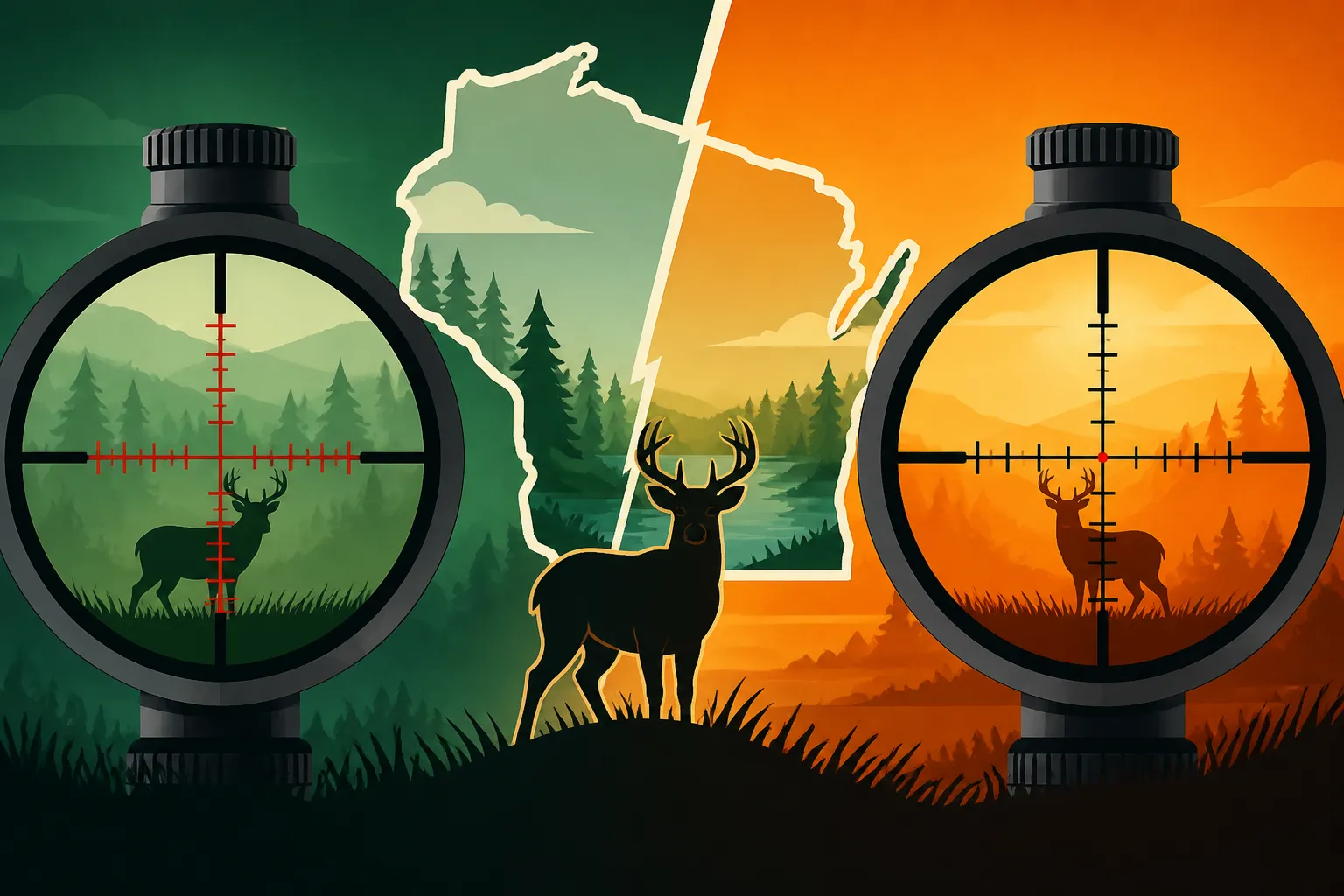
Imagine a scope where the reticle, those crosshairs or dots you aim with, actually changes size as you zoom in and out. That’s essentially what a First Focal Plane scope does. The reticle is placed in front of the magnification erector system, meaning it magnifies along with your target.
What this translates to in the field is that your reticle's subtensions—the spaces between your holdover dots or hash marks—remain consistent relative to your target at all magnification levels. So, if a deer takes up two hash marks in your reticle at 4x power, it will still take up two hash marks at 12x power. This is a huge advantage if you use your reticle for ranging or for precise holdovers for bullet drop and windage. Whether you're zoomed all the way in for a precise shot across a field or backed out to find a deer quickly in the timber, your ballistic data remains true to the reticle. Think of it like a photograph where the frame (your reticle) scales perfectly with the subject as you zoom the lens. For situations like making Long Shots Across a Wisconsin Coulee, this consistent relationship can be incredibly valuable, removing a layer of mental calculation.
Second Focal Plane (SFP): Reticle Stays the Same Size
Now, picture a scope where no matter how much you zoom in or out, your reticle stays exactly the same size in your field of view. That’s a Second Focal Plane scope. Here, the reticle is placed behind the magnification erector system.
Because the reticle doesn't magnify, it always appears equally bold and visible to your eye, regardless of your zoom setting. This can be fantastic when you need a clear, uncluttered aiming point, especially in dense cover or at lower magnifications. However, the trade-off is that the subtensions of your reticle—those hash marks for holdovers—are only accurate at one specific magnification setting, typically the highest power, or sometimes a marked intermediate power. If you zoom out from that setting, those holdover points will no longer correspond to the same distance on your target. For example, if your 200-yard holdover dot is accurate at 9x, it might represent 250 yards or more if you drop down to 6x. This means you need to either adjust your magnification to the correct setting for ranging/holdovers or mentally calculate how those holdover points change with your current magnification. For quick, close-range shots in places like Wisconsin cedar swamps, where you might not be thinking about complex holdovers, an SFP can be perfectly clear and effective.
The Pros and Cons for Wisconsin Hunters
Choosing between FFP and SFP isn't about one being inherently "better" than the other; it's about which design best suits your specific hunting style, the terrain you hunt in, and how you prefer to use your optics. In the diverse landscapes of Wisconsin, from the open prairies to the thick Northwoods, each has its distinct advantages and disadvantages.
Advantages of FFP in Wisconsin
For many modern hunters, especially those who demand precision and versatility, FFP scopes offer some compelling benefits.
- Consistent Holdovers and Ranging: This is the big one. Whether you're dialed down to 3x power trying to get on a deer that slipped into a dense patch of pines or cranked up to 12x to analyze a buck across a hayfield, your reticle's holdover points for bullet drop and wind drift remain accurate relative to the target. This consistency removes guesswork, which is crucial when seconds count. For example, if you’re trying to hold for wind on a distant target in the Driftless Area Deer Hunting in Wisconsin, you can trust your reticle markings no matter your zoom.
- Accurate Ranging at Any Magnification: If your reticle has built-in ranging features (like stadia lines or mil/MOA scales), an FFP design allows you to use them accurately at any power setting. This means you don't have to fiddle with your magnification to get a reliable range estimate, which can be a significant time-saver.
- Ideal for Dialing: If you're a hunter who prefers to dial in your elevation and windage adjustments rather than using holdovers, the consistent relationship between your reticle and the target's size simplifies this process, especially if your turrets match your reticle's units (e.g., MIL/MIL or MOA/MOA). Tools from
GoHuntcan help you plan ballistic solutions, which are easier to apply with a consistent FFP reticle. - Adaptability for Varied Terrain: Wisconsin offers a mix of hunting environments. From the vastness of the Chequamegon-Nicolet National Forest to the rolling topography of the Kettle Moraine, shot distances can vary wildly. An FFP scope allows you to adapt to these changing conditions without worrying about your reticle's accuracy.
Disadvantages of FFP for Wisconsin Hunting
While FFP scopes offer powerful advantages, they also come with certain compromises that might not suit every Wisconsin hunter.
- Reticle Visibility at Low Magnification: Because the reticle shrinks with the target at lower powers, it can become very fine and difficult to see against dark backgrounds or in low light conditions, such as during the first and last legal shooting hours in the timber. This can be a real issue when a deer suddenly appears close in thick brush and you need to get on target fast. Imagine a quick shot in the thick undergrowth, and your reticle has all but disappeared.
- Reticle Obscurement at High Magnification: Conversely, when cranked up to maximum power, the reticle can become quite thick, potentially obscuring smaller targets or fine details at extreme distances. While less common in typical Wisconsin deer hunting, it's something to consider for very long-range precision work or small game.
- Higher Cost: FFP scopes are generally more complex to manufacture than their SFP counterparts, which often translates to a higher price tag. This can be a significant factor for hunters operating on a tighter budget.
- Learning Curve: For hunters accustomed to SFP scopes, there can be a slight learning curve to get comfortable with a reticle that changes size. It's not a deal-breaker, but it requires practice.
Advantages of SFP for Wisconsin Hunting
For many traditional hunters, the Second Focal Plane scope remains a reliable and popular choice, especially given its straightforward nature.
- Clear and Consistent Reticle: The biggest advantage of SFP is that the reticle always appears the same size and thickness in your field of view. It remains clear and easy to see at all magnification levels, which is a huge benefit in scenarios where a quick, precise shot is needed without any visual clutter. In the low light of a Wisconsin morning or evening, having a bold, unwavering reticle can make all the difference.
- Generally More Affordable: Due to simpler manufacturing, SFP scopes typically cost less than comparable FFP models, making them an excellent value for many hunters.
- Uncluttered View at High Magnification: Since the reticle doesn't grow, it never thickens to obscure your target, even at maximum zoom. This can be beneficial for precision aiming at smaller targets or when you need to see fine details.
- Simple Operation: For hunters who primarily aim for the center of the crosshairs and rarely use complex holdovers, or who consistently hunt at a specific magnification, SFP scopes are incredibly simple and intuitive to use.
Disadvantages of SFP in Wisconsin
While SFP scopes are dependable, their fixed reticle size does present some limitations, particularly for those relying on advanced reticle features.
- Holdovers Only Accurate at One Magnification: This is the primary drawback. If your reticle has hash marks for bullet drop or windage, they will only be accurate at one specific magnification setting (usually the highest, or a marked one). If you adjust your zoom away from that setting, your holdovers will be off, requiring you to either mentally recalculate, adjust your magnification back, or dial in the correction. This can be a real scramble when a deer appears suddenly, especially during the chaos of Hunting the Wisconsin Rut in November when shot opportunities can be fleeting.
- Ranging Inaccurate at Varying Magnifications: Similarly, if your reticle includes ranging features, they will only provide accurate estimates at the designated magnification. Using them at other powers will lead to incorrect ranges, which defeats the purpose of having them.
- Less Versatile for Dynamic Shooting: For hunters who frequently change magnification, perhaps tracking a deer through varying cover or shifting between close and long shots, the need to remember or adjust for accurate holdovers can become a distraction or lead to errors. It demands a more disciplined approach to magnification management.
Here's a quick comparison of the two types:
| Feature | First Focal Plane (FFP) | Second Focal Plane (SFP) |
|---|---|---|
| Reticle Size | Grows/shrinks with magnification | Stays the same size regardless of magnification |
| Reticle Subtensions | Consistent and accurate at all magnifications | Only accurate at one specific magnification (usually highest) |
| Ranging Capability | Accurate at all magnifications | Only accurate at one specific magnification |
| Visibility at Low Power | Can become very thin, potentially hard to see | Always clear and visible |
| Visibility at High Power | Can become thick, potentially obscuring target | Always clear and unobtrusive |
| Complexity | More complex to manufacture and use initially | Simpler to manufacture and use |
| Cost | Generally higher | Generally lower |
| Best Use Case | Long-range, precision, dynamic distance changes, dialing | Close-range, fast acquisition, consistent magnification use |
Making Your Choice: Which is Right for Your Wisconsin Hunt?
Deciding between an FFP and SFP scope isn't about following the latest trend; it's about understanding your personal hunting style and the unique challenges and opportunities that Wisconsin's diverse landscapes present. What works perfectly for a hunter in the vast elk country out west might be overkill or even a hindrance in the dense timber of northern Wisconsin.
Consider Your Primary Hunting Style and Terrain
Think about where you spend most of your time hunting in Wisconsin.
- Dense Timber and Brush Country: If you primarily still-hunt or sit in thick woods, like the vast areas of the Nicolet side of the Chequamegon-Nicolet National Forest, your shots are likely going to be within 100-150 yards, often much closer. In these scenarios, quick target acquisition and a clear reticle in low light are paramount. An SFP scope might be ideal here, as the reticle remains bold and easy to find even at low magnification, allowing for fast, instinctive shots. You're less likely to be relying on precise holdovers at these distances, focusing more on point-and-shoot accuracy.
- Rolling Coulees and Ridge Tops: The Driftless Area offers a different challenge, with steep valleys, ridge points, and open fields interspersed with timber. Here, you might get a 30-yard shot in a draw or a 300-yard shot across a valley. This is where an FFP scope truly shines. Its consistent holdover points across all magnifications mean you can zoom in to verify a distant deer without worrying that your ballistic data has changed. If you often find yourself Reading a Ridge Point for Deer Movement and needing to be prepared for varied shot distances, FFP offers valuable flexibility.
- Farmland Edges and Open Fields: Hunting Wisconsin Farmland Deer often means long sightlines across cornfields, alfalfa, or pastures. While many shots might be taken at a consistent, higher magnification, the ability to quickly range and holdover at any power can be advantageous if deer appear at different distances or you need to zoom out to scan a wider area before zooming in for the shot. In these areas, using detailed map layers available through
GoHuntcan help visualize potential shot angles and distances, reinforcing the need for versatile optics.
Magnification Range and Reticle Use
Your preference for magnification and how you use your reticle also plays a significant role.
- Do You Rarely Change Magnification? Some hunters find their "sweet spot" magnification (e.g., 6x or 8x) and keep their scope there almost constantly. If this sounds like you, and your shots are generally within a known range where you can easily compensate for drop, an SFP scope will serve you well without any added complexity or cost. You simply learn your holdovers for that one magnification, and you're good to go.
- Do You Rely on Holdovers and Ranging Marks? If you actively use the hash marks in your reticle for bullet drop compensation, windage, or even ranging a target, then an FFP scope simplifies your life immensely. You can trust those marks at 3x or 12x, eliminating mental gymnastics in the heat of the moment. This is particularly useful if you frequently shoot at varying distances and don't always have time to dial your turrets.
- Do You Prefer to Dial Your Turrets? If you primarily use your scope's turrets to dial in your elevation and windage corrections, the choice between FFP and SFP becomes less critical regarding reticle accuracy. Both can work. However, many who dial still appreciate the consistent relationship of an FFP reticle to confirm their zero or make quick corrections if a follow-up shot is needed.
Budget and Clarity Preferences
Let's be realistic: budget always matters. FFP scopes generally sit at a higher price point due to their more complex internal mechanics. If you're looking for solid, reliable performance without breaking the bank, a high-quality SFP scope can often be a better investment than a budget FFP model with compromised glass or mechanics.
Beyond cost, consider your personal preference for reticle appearance. Some hunters simply prefer the clean, consistent look of an SFP reticle, finding the changing size of an FFP reticle distracting. Others find the FFP's dynamic reticle intuitive and appreciate the visual feedback it provides. It’s a highly personal choice, and it's worth looking through both types of scopes in a store or at a range if possible. Sometimes, the "right" choice is simply the one that feels most comfortable and intuitive to you.
Practical Application and Tips for Wisconsin Hunters
Once you've weighed the pros and cons and considered your hunting style, the real work begins: putting your chosen scope to practice. No matter if you pick FFP or SFP, it’s all about becoming intimately familiar with your gear so it performs flawlessly when that moment of truth arrives in the Wisconsin woods.
Training and Familiarization
This cannot be stressed enough: practice is paramount. Buying the most expensive, technologically advanced scope won't do you any good if you don't know how to use it under pressure.
- Know Your Reticle: If you choose an FFP scope, practice at various magnifications to understand how the reticle appears at different powers. Get comfortable with it thinning out at low power and thickening up at high. If you opt for an SFP, identify the exact magnification at which your holdovers are accurate, and consciously practice using them at that setting. Practice at your lower, quicker magnifications too, understanding that in those instances, you’re likely just using the center crosshair.
- Range Time is Crucial: Don't just zero your rifle and call it good. Spend time shooting at different distances, practicing holdovers or dialing as appropriate for your scope type. For SFP users, specifically practice making shots where you might normally use a holdover, but instead, you adjust your magnification to the correct setting. For FFP users, practice those quick snap shots at low power, ensuring you can still pick up the reticle quickly. This is also where you can truly implement advice on Zeroing a Rifle for Mixed Distances – understanding your point of impact at 50, 100, and 200 yards is invaluable.
- Simulate Hunting Conditions: If possible, practice in conditions that mimic your actual hunts: low light, odd angles, or from a treestand. Get familiar with how your scope performs when you’re not on a flat bench at a well-lit range.
Pairing with Other Optics
Your rifle scope is part of a larger system of optics that enhances your hunting experience.
- Binoculars and Rangefinders: A high-quality set of binoculars is essential for spotting deer long before they enter rifle range. Binocular Choice for Wisconsin Whitetails depends on the cover you hunt, but clear glass is always key. A good rangefinder is equally vital. For SFP users, a precise rangefinder removes the need to use your reticle for ranging, making your SFP scope simpler to operate. For FFP users, while the reticle can range, a dedicated rangefinder is often faster and more accurate. Many hunters find that a combination of
GoHuntmap data and a reliable rangefinder creates the most complete scouting and shot preparation package. - Low-Light Performance: Consider how your scope’s low-light capabilities—often tied to objective lens size, glass quality, and coatings—align with Wisconsin’s legal shooting hours. Even the best FFP or SFP reticle can't help if you can't see the target itself. Explore options like those discussed in Rifle Scopes for Low-Light Timber to ensure you're prepared for those critical dawn and dusk periods.
Field Experience and Adaptability
Ultimately, the real test of your chosen scope will come in the field. Wisconsin hunting is rarely predictable. A deer might appear in a thicket at 40 yards when you expected a 200-yard shot, or vice-versa.
- Be Flexible: Your gear should enhance your ability to adapt. An FFP scope allows for quick adjustments to varying distances without recalculating holds. An SFP scope demands a more consistent approach to magnification or a quicker hand on the turrets. Understand these nuances.
- Confidence is Key: No matter which scope you choose, confidence in your equipment and your abilities is what will lead to success. That confidence comes from understanding your scope's strengths and weaknesses, and by spending enough time with it at the range and in the woods. Whether you're making a calculated shot from a Treestand Setups in Wisconsin Hardwoods or adapting to a new rule like Hunting Without Bait in a Banned County, the more familiar you are with your scope, the better equipped you'll be.
Take the time to consider your hunting journey, the places you roam, and how you genuinely prefer to interact with your gear. With a clear understanding of FFP and SFP, you can make an informed choice that will serve you well for many Wisconsin seasons to come.
Disclaimer
This article is for general informational purposes only and does not constitute professional advice. Laws, prices and regulations vary by location and change over time. Consult a qualified professional for guidance on your specific situation.