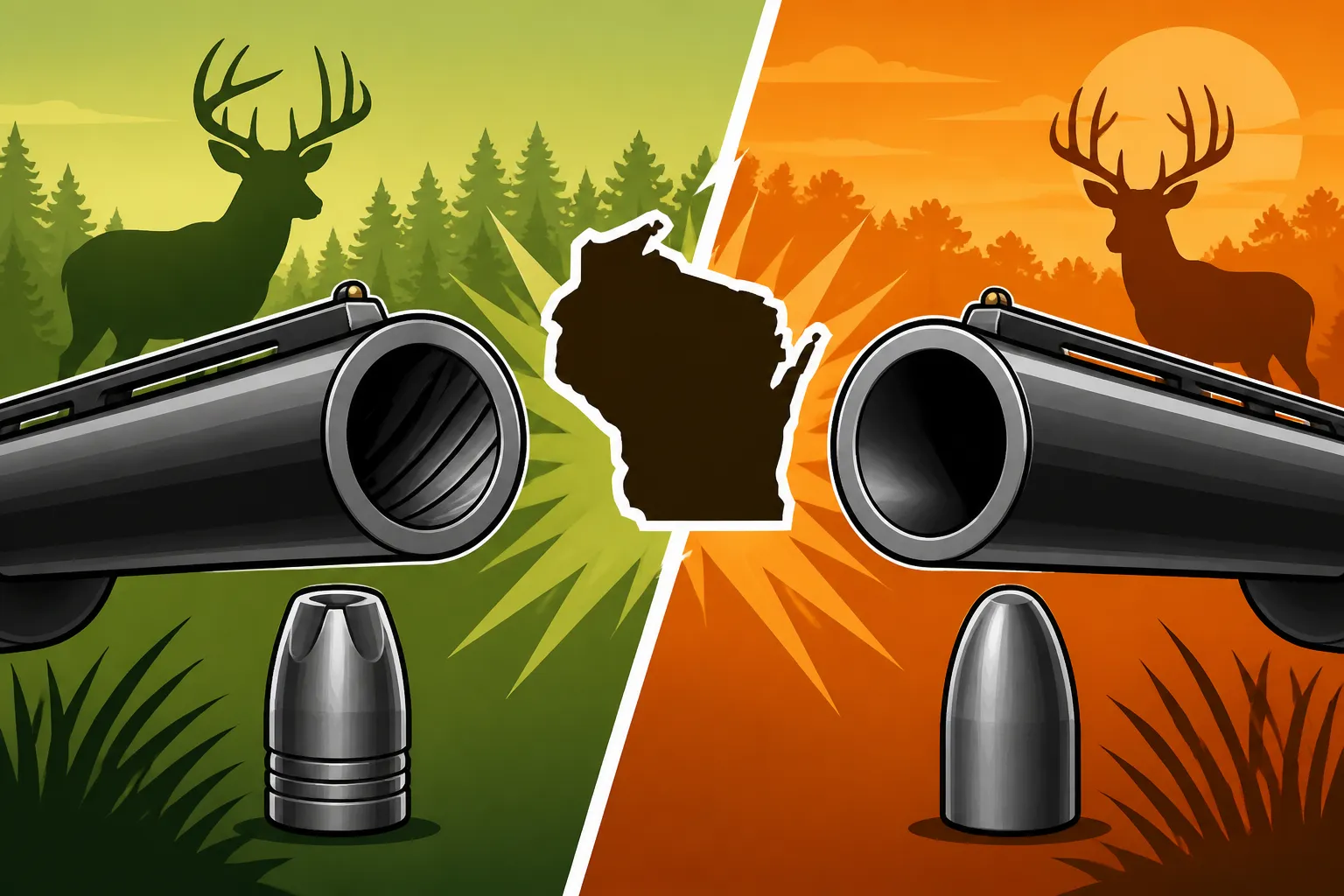
Rifled Versus Smoothbore Slug Barrels
It’s a classic Wisconsin hunting dilemma: you’ve got your shotgun, you’re ready for deer season, but then the question hits – smoothbore or rifled barrel for slugs? The choice can feel overwhelming, especially with so much conflicting advice out there, and the ethical responsibility of making a clean shot always weighing on our minds. This guide is here to cut through the noise, helping you understand the real differences between smoothbore and rifled slug barrels so you can confidently pick the best setup for your hunting style and the diverse Wisconsin terrain you plan to cover.
Unpacking the Fundamentals of Shotgun Barrels
Before we dive into the nitty-gritty of performance, let's establish a clear understanding of what each barrel type actually is. The fundamental design difference dictates everything from ammunition choice to effective range, and knowing this foundation will empower you to make an educated decision for your hunting season. It’s not just about what looks cool; it’s about how the internal mechanics affect your shot downrange.
The Traditional Smoothbore Barrel: Simple Design, Broad Utility
A smoothbore barrel is exactly what it sounds like: the inside of the barrel is perfectly smooth, without any grooves or rifling. This is the traditional design for most shotguns, making them incredibly versatile. With a smoothbore, you can shoot a variety of shotshells—anything from birdshot for grouse and woodcock to buckshot for close-range deer, and of course, slugs. The simplicity of the smoothbore design has been around for centuries, and for good reason: it's effective for a wide array of hunting situations.
For a Wisconsin hunter, a smoothbore means you might be using the same firearm for spring turkey, fall pheasant, and then swapping to slugs for deer during the gun season. This adaptability is a huge advantage for many, especially those who can only afford one primary hunting firearm. You can change out choke tubes to optimize patterns for different loads, further enhancing its versatility. Imagine walking into a timber stand with your trusted pump-action, knowing you can easily transition from chasing squirrels in the morning to being ready for a close-range whitetail encounter later in the day.
Introducing the Rifled Barrel: Engineered for Precision
In stark contrast, a rifled barrel features helical grooves cut into the bore's interior, much like a rifle. These grooves are designed to impart a spin on the projectile as it travels down the barrel. This spin stabilizes the slug in flight, similar to how a quarterback throws a spiral. The result is significantly improved accuracy and a much flatter trajectory over longer distances, fundamentally changing the performance characteristics of your shotgun.
The creation of rifled slug barrels was a game-changer for shotgun deer hunting, particularly in areas where traditional rifles were restricted due to population density or safety concerns. Suddenly, shotgun hunters could achieve accuracy levels previously only associated with centerfire rifles. This meant extending ethical shooting ranges and feeling more confident taking shots at distances that would have been unthinkable with a smoothbore and standard slugs. For those serious about pushing the limits of their shotgun's accuracy, a rifled barrel is often the immediate go-to choice.
Why This Distinction Matters for Wisconsin Deer Hunters
The distinction between smoothbore and rifled barrels is paramount for Wisconsin deer hunters because it directly impacts your ethical shooting range and the type of ammunition you should use. Using the wrong slug in the wrong barrel can lead to poor accuracy, reduced performance, and potentially unethical shot placement. Wisconsin offers such a diverse landscape, from the thick cedar swamps of the north to the sprawling cornfields of the farmland zone, and your barrel choice should ideally align with the typical shots you'll be taking in your hunting area.
In counties where rifles are restricted, shotguns become the primary firearm for deer hunting, putting even more emphasis on understanding your slug setup. You don't want to be caught in a situation where a buck steps out at 100 yards in an open field, and you only have a smoothbore patterned effectively for 50. Conversely, if you're deep in thick brush, the ultra-long-range precision of a rifled barrel might be overkill, and the versatility of a smoothbore for other small game could be more appealing. This guide aims to help you navigate these scenarios, ensuring you're making a choice that truly fits your hunting aspirations and the challenges of the Wisconsin woods.
The Smoothbore Experience: Tradition, Power, and Close Quarters
For many hunters, the smoothbore shotgun is where it all began. It's the workhorse of the hunting world, capable of everything from flushing pheasants to dropping a whitetail. When it comes to deer hunting with a smoothbore, it’s about understanding its strengths and limitations, and embracing the traditional, close-quarters hunting experience it offers.
Optimal Ammunition for Smoothbore Barrels: Foster and Brenneke Slugs
When you're shooting a smoothbore barrel for deer, your primary ammunition choice will be what are often called "Foster-type" slugs or Brenneke slugs. These are full-bore diameter projectiles, meaning they are designed to fit snugly down the entire barrel. Foster slugs typically have a hollow base, which gives them a weight-forward design. The skirt of the slug is usually rifled (though these are not true rifle grooves, but rather compression ribs) to allow it to safely squeeze through different choke constrictions and potentially help a tiny bit with air resistance, but they do not impart spin. Their stability in flight comes from that weight-forward design, like a badminton shuttlecock. Brenneke slugs are similar but often feature a lead slug permanently attached to a wad, which helps stabilize the projectile more effectively.
These slugs are hard-hitting, delivering a tremendous amount of energy on impact. They are often made of soft lead, allowing for good expansion and energy transfer into the deer. While the exterior "rifling" on a Foster slug might look like it's meant to spin, it's really there to help deform the slug as it passes through a choked barrel, preventing dangerous pressure spikes. The sheer mass and blunt force of these slugs make them devastating at short range, perfect for dense cover where game isn't likely to present a long shot.
Realistic Expectations for Range and Accuracy
Let's be realistic: a smoothbore shooting Foster or Brenneke slugs is not a long-range precision instrument. While individual shotgun and slug combinations can vary, a typical effective range for a smoothbore with iron sights or a red dot is usually somewhere between 50 and 75 yards. Beyond that, accuracy tends to drop off significantly, and the trajectory becomes quite rainbow-like, making precise shot placement difficult. At 100 yards, you might still hit a deer-sized target, but consistency might suffer, and an ethical kill shot becomes less assured.
Many seasoned hunters will tell you they can achieve "minute of deer" accuracy at 75 yards, meaning they can consistently hit a dinner-plate sized area. This is often perfectly adequate for the types of shots encountered in thick timber or heavy brush. Factors like the specific slug brand, barrel length, and even the choke tube (often a cylinder or improved cylinder choke is best for slugs) will influence your group sizes. It's absolutely critical to pattern your smoothbore with different slug brands to see what it likes best. Don't just assume; go to the range and find out! The confidence gained from knowing your limitations can be just as valuable as extending your range. Remember, Practical Range in Wisconsin Timber often means shots are much closer than you think.
When a Smoothbore is Your Best Bet in Wisconsin
A smoothbore slug barrel truly shines in specific Wisconsin hunting scenarios. If you're hunting dense alder thickets, a cedar swamp, or areas of regenerating clear-cuts, your shots are likely to be up close and personal. In these environments, the raw stopping power of a full-bore slug at 30-60 yards is incredibly effective, and the wider spread of a slightly less accurate projectile is less of a concern. Think about still-hunting through thick public land: deer often burst out at spitting distance, requiring a fast, powerful shot.
Furthermore, if you hunt multiple species with one firearm, the smoothbore is incredibly versatile. You can have it set up for ducks in the morning, then swap to slugs for an afternoon deer hunt if you're in a mixed-bag area. The lower cost of Foster-type slugs compared to sabot slugs is also a factor for many hunters. When you're Hunting Wisconsin Cedar Swamps, stealth and quick reaction are key, and a reliable smoothbore can be an excellent choice. It’s the quintessential "point and shoot" deer gun for close cover, and many successful Wisconsin deer hunters rely on this classic setup year after year.
Rifled Barrel Precision: Reaching Out for Wisconsin Whitetails
While smoothbores are fantastic in their niche, the rifled slug barrel was developed to overcome their inherent limitations, especially when it comes to range and precision. If you're looking to stretch your ethical shooting distance with a shotgun, this is where you'll want to focus your attention.
Unleashing the Potential with Sabot Slugs
The rifled barrel truly comes alive when paired with sabot slugs. A sabot (pronounced "SAY-bow") is a plastic cup or sleeve that encases a smaller, rifle-like projectile, often made of lead, copper, or a combination. As the sabot and slug travel down the rifled barrel, the plastic sabot engages the rifling, imparting a spin to the entire assembly. Once the projectile leaves the muzzle, air resistance causes the sabot to peel away, leaving the aerodynamic, sub-caliber slug to continue on its stabilized, spinning path.
These slugs are designed for accuracy, resembling a rifle bullet more than a traditional shotgun slug. They come in various weights and designs, often featuring ballistic tips for improved aerodynamics and expansion. The velocities achieved with sabot slugs can be significantly higher than full-bore slugs, translating to a flatter trajectory and better energy retention downrange. It's like turning your shotgun into a large-caliber rifle, purpose-built for deer hunting.
Maximizing Your Ethical Shooting Distance
With a properly matched rifled barrel and sabot slug, hunters can realistically expect ethical shooting distances to extend significantly. While factors like firearm quality, ammunition brand, and shooter skill always play a role, it's not uncommon for hunters to achieve consistent accuracy out to 100, 125, or even 150 yards. Some combinations might push that even further, with groups comparable to many hunting rifles at these ranges. This dramatically expands the types of hunting scenarios a shotgun hunter can confidently tackle.
The flatter trajectory of sabot slugs means less holdover is required at intermediate distances, simplifying shot placement. This increased confidence allows you to assess shots more accurately, knowing your equipment is capable of delivering the precision needed for a clean kill. If you're set up on the edge of a large alfalfa field or watching a long logging road, having that extra range can be the difference between tagging a deer and watching it walk away. It's a true game-changer for those who find themselves in more open country where longer shots are common.
Common Applications for Rifled Barrels in Wisconsin
Given their precision and extended range, rifled slug barrels are incredibly popular in Wisconsin, particularly in the southern and eastern parts of the state Where Wisconsin Restricts Rifles for Deer in certain management units due to population density. In these areas, a rifled slug gun becomes the ultimate tool for deer hunters, offering rifle-like performance within the confines of shotgun-only regulations. Imagine hunting the rolling hills of the Driftless Area or the agricultural fields of southeastern Wisconsin; shots can often present themselves at 80-120 yards across open draws or crop stubble.
Beyond regulatory considerations, rifled barrels are also favored by hunters who prioritize accuracy and confidence at longer ranges, regardless of local restrictions. If you're primarily a stand hunter over a food plot or field edge, a rifled barrel allows you to maximize your effective range and increase your chances of success. They provide that extra margin of error for tricky shots or for when a deer just won't come in close enough. For many, the investment in a dedicated rifled slug barrel or a complete rifled slug gun is a small price to pay for the enhanced capability it brings to their deer hunting strategy, especially if they are frequently Hunting Wisconsin Farmland Deer.
Making an Informed Decision for Your Wisconsin Hunt
Choosing between a smoothbore and a rifled slug barrel isn't about one being inherently "better" than the other. It's about finding the right tool for your specific hunting conditions, budget, and personal preferences. An informed decision will lead to more effective and ethical hunting.
Weighing Pros and Cons: A Side-by-Side Look
Let's break down the advantages and disadvantages of each barrel type in a simple comparison. This can help visualize which aspects align best with your hunting style and local Wisconsin regulations.
| Feature | Smoothbore Slug Barrel | Rifled Slug Barrel |
|---|---|---|
| Barrel Interior | No rifling, smooth bore | Helical grooves (rifling) |
| Ammo Type | Foster, Brenneke (full-bore slugs) | Sabot slugs (sub-caliber, plastic sleeve) |
| Stabilization | Weight-forward design, air resistance | Spin imparted by rifling |
| Effective Range | ~50-75 yards (often less than 100) | ~100-150+ yards (can rival rifles) |
| Accuracy | Good at close range, drops off with distance | Excellent at extended range |
| Versatility | Highly versatile for shot, buckshot, slugs | Best for slugs only, specific to the bore |
| Cost (Ammo) | Generally less expensive | Generally more expensive (often significantly) |
| Recoil | Can be substantial with heavy slugs | Often substantial with high-velocity sabots |
| Ideal Scenario | Thick cover, close-range shots, mixed-bag hunting | Open fields, longer shots, rifle-restricted zones |
Crucial Considerations: Hunting Style, Terrain, and Regulations
Your personal hunting style heavily influences the ideal barrel choice. Are you a still-hunter, meticulously creeping through thick woods hoping for a close encounter? A smoothbore might be perfectly adequate. Are you primarily a stand hunter overlooking a long field edge or a food plot? The extended range of a rifled barrel could be a significant advantage. The terrain you hunt in Wisconsin also plays a massive role. The dense forests of the north might lend themselves to closer shots, while the expansive agricultural lands and rolling coulees of the south could offer more long-range opportunities. Always consider the typical shot distance you realistically expect.
Beyond personal preference, understanding Wisconsin Deer Seasons and Zones and local regulations is non-negotiable. Some areas mandate shotgun-only deer hunting, making the choice of slug barrel even more critical. There might be specific rules regarding ammunition types or the use of certain optics. Before you even buy a barrel, consult the latest Wisconsin DNR regulations for your specific deer management unit. A fantastic resource for this is the GoHunt app, which can provide up-to-date maps of public lands and relevant regulations based on your location. Knowing these details upfront will save you headaches and ensure a legal, successful hunt. It pays to do your homework and familiarize yourself with the terrain you'll be hunting, whether it's through scouting or using mapping tools like GoHunt to identify potential shot scenarios.
The Non-Negotiable Step: Patterning Your Shotgun
Regardless of whether you choose a smoothbore or a rifled barrel, there is one step you absolutely cannot skip: patterning your shotgun with your chosen ammunition. Every shotgun is a law unto itself, and what shoots well in one gun might be wildly inaccurate in another, even if they're the exact same model. This means taking your shotgun to the range and shooting several different brands and types of slugs at various distances (e.g., 25, 50, 75, and 100 yards).
Pay close attention to group size and point of impact. Does your gun consistently put slugs in a tight group? Is it shooting high, low, left, or right? You might need to adjust your sights or optics. Don't be afraid to try different manufacturers – one brand of sabot slug might give you 3-inch groups at 100 yards, while another might scatter wildly. This trial-and-error process is crucial for establishing your gun's true capabilities and your ethical maximum range. Tools like the GoHunt app can also be used to log your load data and pattern results, helping you keep track of what works best. Remember, knowing exactly where your slug will hit is the ultimate confidence booster and the foundation of responsible hunting. This patterning process is just as important as Zeroing at 100 Yards for Woods Hunting with a rifle; it builds skill and confidence.
Disclaimer
This article is for general informational purposes only and does not constitute professional advice. Laws, prices and regulations vary by location and change over time. Consult a qualified professional for guidance on your specific situation.