Saddle Hunting in Wisconsin Oaks
The rustle of fallen oak leaves underfoot, the scent of damp earth, and the faint hope of spotting a whitetail ghosting through the timber – it's a feeling every Wisconsin deer hunter knows. But sometimes, finding that perfect tree for a conventional stand in a dense oak forest can feel like an impossible task, leaving you frustrated and limited. This guide is all about embracing the stealth and flexibility of saddle hunting, specifically tailored to help you navigate and succeed in Wisconsin's sprawling oak country.
Why Saddle Hunting Shines in Wisconsin's Oak Country
Hunting Wisconsin's oak forests presents a unique set of challenges that can make traditional hang-on or climbing stands feel cumbersome and limiting. But it's precisely these challenges where saddle hunting truly comes into its own, offering advantages in mobility, concealment, and safety that are hard to beat.
The Unique Challenges of Oak Forests
Wisconsin's oak forests are beautiful, productive, and notoriously difficult to hunt from a static position. You're often dealing with a dense canopy that limits vertical visibility, especially early in the season before the leaves drop. The trunks themselves can be highly irregular – gnarled, crooked, or heavily branched, making it a real headache to find a tree that's straight enough for a climber or wide enough for certain hang-on stands.
Think about those vast tracts of public land in the Kettle Moraine State Forest or the expansive county forests in western Wisconsin. You scout hard, find some promising buck sign – fresh rubs, a hot scrape line, or recent acorn cuttings. You know the deer are here, but the perfect "stand tree" just isn't there. You might find one decent tree, but it's facing the wrong way for the wind, or it doesn't give you the shooting lanes you need, especially with the 360-degree awareness bucks possess. The frustration is real when you feel tied to a handful of less-than-ideal spots because of tree limitations. Deer in oak country are often feeding sporadically, moving through pockets of acorns, and their patterns can change daily. Being able to adapt on the fly is paramount, and a fixed stand simply can't offer that flexibility.
Unmatched Mobility and Adaptability
This is where saddle hunting truly differentiates itself. Imagine being able to set up in virtually any tree with a decent straight section for your climbing sticks. Suddenly, those dense oak stands aren't a hindrance; they're an advantage, offering endless options. You can quickly scout an area, identify fresh sign, and then pick the best tree for that specific day's wind and deer movement, not just the one tree that happens to be "hang-on friendly."
If the wind shifts unexpectedly mid-hunt, or if you see deer moving along a different ridge than anticipated, you can silently adjust your position around the tree, giving you unparalleled shot opportunities and the ability to stay hidden. There's no noisy stand platform to bang against the tree, no creaky seat to alert game. You ascend quietly, set your platform, and melt into the canopy. The ability to move deeper, further, and more silently into prime oak pockets, away from heavily pressured areas, is a game-changer. You're not just hunting a spot; you're hunting the woods, able to flow with the deer's unpredictable movements. This adaptability is particularly useful during the rut when bucks are cruising widely, or when hunting Late-Season Food Sources for Whitetails like lingering acorns or browse.
Enhanced Safety and Concealment
Safety is a top priority for any elevated hunter, and saddle hunting inherently builds in a robust safety system. From the moment your feet leave the ground, you are tethered to the tree via your lineman's belt. As you ascend with your climbing sticks, you maintain continuous attachment. Once you reach your desired height, you transfer to your tree tether, which keeps you securely connected throughout your hunt. This constant connection drastically reduces the risk of falling, which is a major concern with traditional stands, especially when setting up or taking down in the dark.
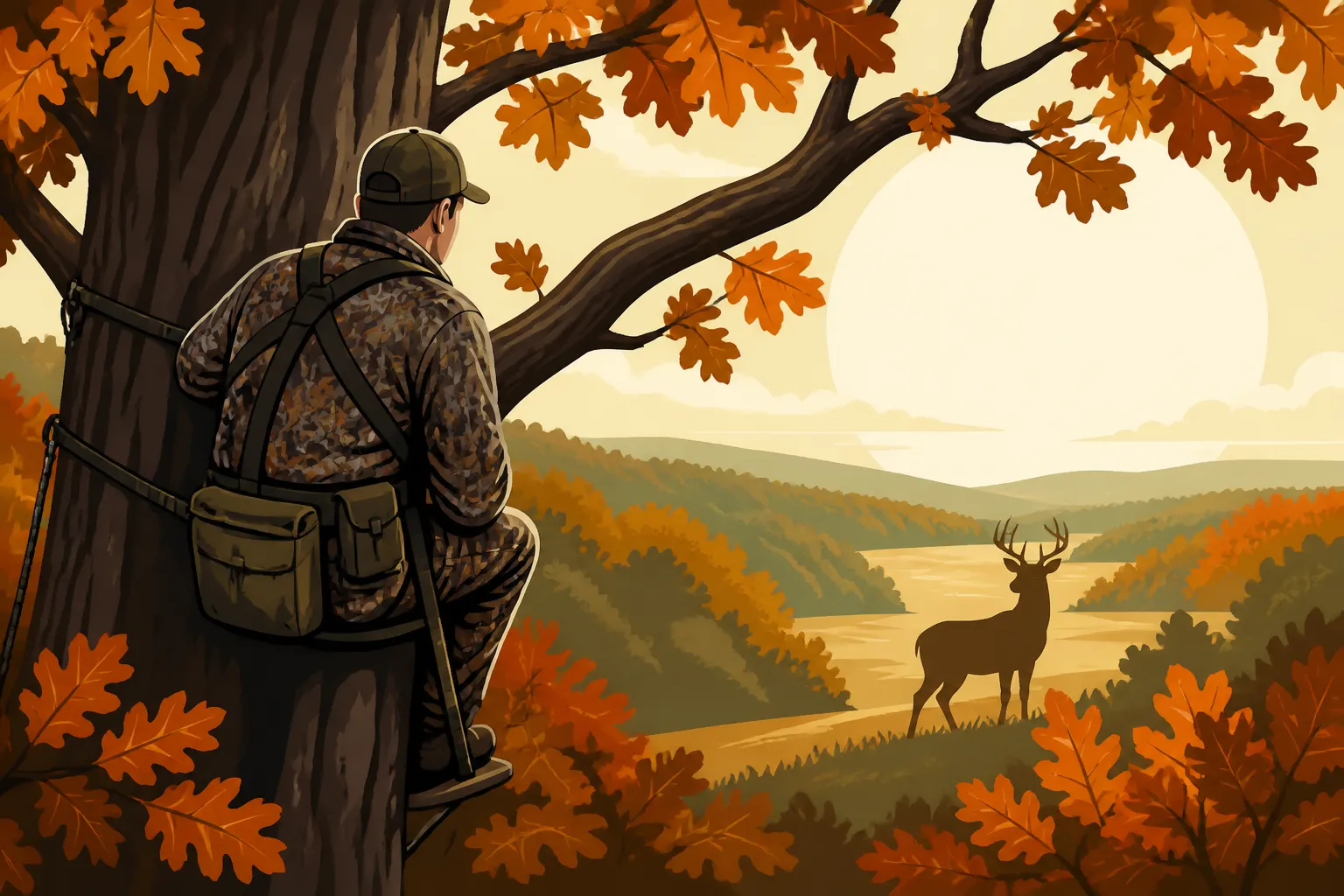
Furthermore, saddle hunting offers superior concealment. Instead of being perched on a flat platform, exposed on all sides, a saddle allows you to hunt behind the tree. You literally use the trunk itself as cover. This 360-degree capability means you can swivel around the tree to shoot, keeping the trunk between you and an approaching deer until the last possible moment. This natural camouflage is incredibly effective in broken oak timber, where deer are constantly scanning for threats. You can pivot, lean, and even drop a knee to present a smaller profile, blending seamlessly with the tree itself. It feels less like sitting in a stand and more like becoming part of the tree.
Essential Gear for Your Wisconsin Oak Saddle Hunt
Getting into saddle hunting means investing in a few key pieces of specialized gear. While the initial setup might seem a bit different from your traditional stand, the benefits in mobility and stealth in Wisconsin's oak forests are well worth it. It's not just about buying a saddle; it's about building a system that works for you.
Choosing Your Saddle and Platform
Your saddle is the heart of your system, so comfort and function are paramount. Saddles come in various styles, from minimalist designs that prioritize light weight and packability to more padded, supportive models built for all-day sits. Consider the bridge length – some prefer a longer bridge for more maneuverability and a wider range of motion, while others like a shorter bridge for a more compact feel. For the often-long walks into deep oak country, a saddle that distributes weight evenly and doesn't dig into you is crucial. You might find your ideal setup by researching options on platforms like GoHunt, comparing different saddle designs and features before making a purchase.
Next is your platform. This is what you stand on to maintain your footing and stability. There are two main types: a dedicated mobile platform or a "ring of steps." Mobile platforms are generally larger, offering more standing room and stability, which can be nice for longer sits. Ring of steps setups are typically lighter and more compact, which is a huge advantage when you're packing deep into an oak flat or climbing a less-than-perfect tree. In the often-dense and varied terrain of Wisconsin's oak woods, portability is key, so many hunters lean towards lighter, more packable platforms or a ring of steps system. The goal is to find something that allows you to shift weight, rotate around the tree, and remain comfortable without adding unnecessary bulk or noise.
Climbing Methods and Sticks
The way you get up the tree is just as important as your saddle. For saddle hunting, climbing sticks are the standard. These attach individually to the tree, allowing you to bypass crooked sections or low branches that might impede a climbing stand. They come in various lengths and designs, with an emphasis on being lightweight, strong, and quiet. Single sticks are popular for their minimal weight and versatility, often used with an aider (a short loop of rope or webbing) to increase your effective step distance with each stick. Double or triple step sticks offer more stability but add a bit more weight.
When you're sneaking into a pristine oak ridge or a remote pocket of timber, every ounce and every decibel matters. Many manufacturers focus on making sticks that nest together tightly to prevent clanking during transport. Practicing your stick placement at home, learning how to quickly and silently secure them, will pay dividends in the field. Remember, in oak country, you might encounter trees with rough bark or slight lean – your sticks need to be secure and stable on a variety of trunk types. Don't forget your lineman's belt here; it keeps you safely attached to the tree as you ascend and place each stick, which is especially important on cold mornings or when you're tired.
Accessories for an Efficient Setup
Beyond the core saddle and climbing system, a few accessories can significantly enhance your saddle hunting experience in Wisconsin's oak forests. First and foremost are your tree tether and lineman's belt. These are your lifelines and are absolutely non-negotiable for safety. The tree tether attaches your saddle to the tree once you're at hunting height, while the lineman's belt is used during the climb. Look for high-quality ropes or straps that are quiet and easy to adjust.
A reliable haul rope is essential for pulling up your bow, backpack, and any other gear after you've reached your desired height. This keeps your hands free and prevents accidental drops during the climb. Many saddles also offer integrated loops or MOLLE webbing for attaching gear hangers, which are invaluable for keeping your rangefinder, calls, and other essentials within easy reach while you're in the saddle. A small cam cleat can be a fantastic addition to your tether system, allowing for quick, one-handed adjustments to your height or angle around the tree. Some hunters also utilize backbands or additional bridge accessories for enhanced comfort during longer sits, which can make all the difference during a chilly November afternoon. When planning your gear list, checking forums and reviews, perhaps even on a site like GoHunt, can provide insights into what other hunters are using for tree accessories in similar terrain. Every piece should be chosen for its light weight, quiet operation, and ability to improve your efficiency and comfort in the field. Packs for a Day on Public Land should be considered for carrying your gear efficiently.
Tactics for Successful Saddle Hunting in Oak Stands
Saddle hunting isn't just a different way to hang in a tree; it's a different approach to hunting altogether. To truly leverage its advantages in Wisconsin's oak forests, you need to adapt your scouting, shooting, and stealth tactics.
Scouting and Tree Selection
Effective scouting is the bedrock of successful saddle hunting, perhaps even more so than with traditional stands. Since you have the freedom to hunt nearly any tree, your focus shifts from finding "the perfect stand tree" to finding the best deer sign and the best cover. Before the season starts, spend ample time on the ground. Look for fresh rubs, recent scrapes, and especially areas with significant acorn cuttings. Oak trees can drop acorns at different times, so being aware of which oaks are producing is key. You can use mapping apps like those often featured on GoHunt to identify oak stands and potential travel corridors long before you set foot in the woods. Pay attention to terrain features like ridge points, saddles, and creek bottoms, as these often funnel deer movement. Reading a Ridge Point for Deer Movement and Finding Sign in Big Timber are invaluable skills here.
Once you've identified a hot area, it's time for tree selection. Unlike a traditional stand that needs a fairly straight, branch-free trunk for a long section, a saddle setup only needs a suitable straight section for your climbing sticks and enough branches to break up your outline. Look for trees that offer good background cover, even sparse branches above or behind you can help you disappear. Consider trees on the downwind side of travel corridors, or those that allow you to set up with the sun at your back in the morning or evening. Don't be afraid to choose a slightly smaller-diameter tree than you might for a hang-on, as long as it's healthy and sturdy. The goal is concealment and the ability to pivot for a shot, not just a wide platform.
Mastering the Shot from a Saddle
Shooting from a saddle is a unique experience that requires practice. Because you're hanging in a harness, you can rotate 360 degrees around the tree and even lean out to shoot. This is a massive advantage for shot opportunities but can feel awkward at first. You need to practice shooting at various angles – forward, backward, to both sides, and even at steep downward angles if you're high up in the canopy.
When a deer approaches, you'll learn to use the tree trunk as maximum cover, slowly rotating until you have a clear shot. Your tether length will influence how far you can lean out and how much you can pivot, so practice with your actual hunting setup. Many saddle hunters find that they can comfortably shoot from either side of the tree, which doubles your effective shooting lanes compared to a typical stand. Pay attention to how your bow string clears the tree when drawing and releasing, and adjust your body position accordingly. A strong core is beneficial, as is practicing controlled breathing. Consider reviewing Bow Draw Weight for Wisconsin Whitetails to ensure your setup is optimized for smooth, stable shots in any position. Practice makes perfect, and the more you simulate real-world hunting scenarios from your saddle, the more confident you'll be when that Wisconsin buck steps into range.
Staying Stealthy and Comfortable
Stealth in the oak woods goes beyond just silent climbing. It's about minimizing every sound and movement from the moment you leave your vehicle until you're back. This means checking all your gear for potential clanks or scrapes. Wrap anything metallic, silence zippers, and keep your movements deliberate and slow. Your climbing sticks should be placed as quietly as possible, and your platform set with minimal fuss.
Comfort, especially on long sits in Wisconsin's unpredictable weather, is crucial. Layering is your best friend. Start with good Base Layers for a Wisconsin November that wick moisture, add insulating layers, and top it with a quiet, weather-resistant outer shell. The beauty of a saddle is that you're constantly moving, even subtly, which can help circulation compared to a static seat. However, for extended cold sits, consider insulated seat pads that attach to your saddle or even a heated vest. Keeping your feet warm is vital – good quality, insulated boots are a must-have, especially when sitting high up where the cold can seep in. Insulated Boots for All-Day Sits are an excellent investment. Hand warmers, placed in your pockets or a hand muff, can make a huge difference, allowing you to maintain dexterity for your bow. Many hunters share their silent setup techniques and comfort hacks in online communities or articles, some of which might be aggregated or discussed on sites like GoHunt, offering valuable tips to new saddle hunters. Remember, the longer and more comfortably you can stay on stand, the higher your chances of success.
Overcoming Common Saddle Hunting Challenges in Wisconsin
While saddle hunting offers incredible advantages, it's not without its own set of challenges, especially when navigating Wisconsin's diverse landscapes and regulations. Knowing how to anticipate and overcome these hurdles can make your experience much smoother and more successful.
Dealing with Difficult Trees and Public Land Rules
Wisconsin's oak forests, while offering ample tree choices, also present their share of irregular, heavily branched, or multi-trunked oaks. While a saddle offers more flexibility than a traditional stand, you'll still encounter trees that are difficult to climb or don't offer stable attachment points for your sticks. The key is adaptation and practice. Sometimes, it means going a bit higher to bypass a gnarly section, or using a "floating" stick method where you place a stick, climb it, and then place the next one without reaching the ground. Learning to read a tree for its climbability is a skill developed over time.
Public land rules are another significant consideration. Many Wisconsin public lands, including county forests and state wildlife areas, have specific regulations about leaving stands or equipment overnight. For instance, Leaving a Stand Overnight on Public Land is often prohibited or requires specific tagging. This means you need a system that's efficient for setting up and taking down your entire rig with each hunt. This reinforces the need for lightweight, packable gear. Also, be mindful of hunting pressure on popular public land. While saddle hunting allows you to go deeper and quieter, you might still find yourself competing for prime trees or dealing with other hunters. Respecting space and being considerate is part of being a good hunter.
Cold Weather and Long Sits
Wisconsin winters can be brutal, and even early season mornings can be surprisingly chilly. Sitting still in a saddle, exposed to the elements, can be a challenge. Your clothing system becomes paramount. Instead of bulky layers, focus on a strategic layering system that traps heat efficiently. As mentioned before, excellent base layers are crucial. Add a quality mid-layer, perhaps a fleece or down jacket, and an outer layer that cuts the wind and is water-resistant. Many saddle hunters opt for a "sit-and-wait" system where they wear minimal layers during the hike in to avoid sweating, and then add their heaviest insulated outer layers once they're in the saddle.
Managing blood circulation is also key. Wiggling your toes, flexing your ankles, and shifting your weight on the platform can help. Hand warmers and foot warmers are not a luxury; they're a necessity for comfortable, extended sits in late season. Some hunters even bring a small, insulated mat to place on their platform for an extra layer of warmth beneath their feet. Don't forget a hot drink in an insulated thermos – that internal warmth can be a real morale booster when the mercury drops. Remember, the more comfortable you are, the longer you can stay focused and vigilant.
Packing Light and Efficiently
The primary advantage of saddle hunting is mobility, and that mobility is severely hampered if you're hauling a heavy, bulky pack. Streamlining your gear is critical. Every item in your pack should serve a purpose and be as lightweight as possible. This means choosing a minimalist backpack that can comfortably carry your saddle, sticks, platform, and essentials without excess bulk. Many saddle hunters opt for modular packs that allow components to be strapped externally, or small lumbar packs that don't interfere with the saddle itself.
Prioritize what you truly need: water, snacks, a headlamp (Headlamps for Walking Out After Dark), a first-aid kit, calls, rangefinder, and your weapon. Leave anything superfluous at home. Practice packing and unpacking your gear so it becomes second nature, allowing for quick, silent setups and takedowns in the field. The goal is to be a self-contained, mobile hunting unit, able to move quickly and efficiently through Wisconsin's oak forests, ready to adapt to whatever the deer (and the weather) throw at you.
| Feature | Traditional Hang-on Stand | Saddle Hunting System |
|---|---|---|
| Mobility | Good, but limited by tree size | Excellent, fits most trees |
| Setup Speed | Moderate to fast (if pre-set) | Fast (with practice) |
| Concealment | Good, but often exposed | Excellent, uses tree as cover |
| Safety | Requires separate lifeline | Continuous tethered connection |
| Comfort | Seat often provides comfort | Relies on saddle/body position |
| Shooting Lanes | Fixed platform, often front | 360-degree around the tree |
| Weight/Bulk | Varies, can be bulky | Generally lighter and more compact |
| Tree Specificity | Needs straight, clear section | More forgiving of irregular trees |
Disclaimer
This article is for general informational purposes only and does not constitute professional advice. Laws, prices and regulations vary by location and change over time. Consult a qualified professional for guidance on your specific situation.