Entry Routes on Steep Driftless Ground
There's nothing quite like the feeling of heading into a promising hunting spot in Wisconsin's Driftless Area, full of anticipation, only to have a flurry of white flags erupt from the very draw you planned to hunt. It's frustrating, disheartening, and a common struggle on this steep, broken terrain. Mastering undetectable entry routes is absolutely crucial for success here, preventing you from bumping deer before you even settle in. This comprehensive guide will walk you through proven strategies to approach your hunting grounds silently and effectively, giving you the upper hand on those elusive Driftless whitetails.
Understanding the Driftless Terrain and Deer Behavior
The Driftless Area of Wisconsin is a truly special place, a geological anomaly untouched by the last glacial advance. This means no flattened plains, but instead, a dramatic landscape of steep hills, deep valleys (often called coulees), meandering creek bottoms, and rugged bluff country. If you've ever tried to walk straight up or down one of these hills, you know the challenge firsthand. This unique topography doesn't just make walking difficult; it profoundly shapes how deer live, move, and react to pressure.
The Unique Challenges of Coulees and Ridges
When you look at a topo map of the Driftless, it's a spiderweb of contour lines. Those lines represent sharp elevation changes, creating literally thousands of hidden pockets, draws, and secluded benches. The primary challenge for a hunter is that these features offer deer countless escape routes and places to hide. A buck bedded just over the lip of a ridge might hear or smell you long before you ever see him, sending him rocketing down into an adjacent coulee. The sheer number of potential ambush points, combined with the difficulty of silent movement, makes the Driftless a thinking hunter's game. You can't just barge in; you need a plan.
The steepness of the terrain also means that sound carries differently, and thermals (air currents created by temperature changes) are constantly in play, especially around sunrise and sunset. A sound that might be muffled on flat ground can echo loudly between the hills, and your scent can be carried uphill on morning thermals or downhill on evening ones, revealing your presence to every deer in the vicinity. This complex interaction of sound, scent, and sight lines requires a precise and disciplined approach, one that most hunters learn through trial and error—and often, through frustrating encounters with spooked deer.
How Deer Navigate and Utilize Topography
Deer in the Driftless are masters of their environment. They don't typically walk straight up and down these steep hills if they can avoid it. Instead, they favor benches, subtle changes in slope, and the "points" of ridges that finger out into the valleys. These features provide easier travel corridors and often offer a vantage point to survey the terrain below. When pressured, they'll use the steepest, thickest draws as escape routes, quickly dropping out of sight and gaining distance. Understanding these travel patterns is your first step toward effective entry.
For example, a big buck might bed on a bench about two-thirds of the way up a south-facing slope, enjoying the sun and surveying the coulee below. His escape route will likely be a steep, brushy draw that drops into the next valley. If you try to walk straight up that main coulee, you're walking directly into his comfort zone, probably pushing him out long before shooting light. Instead, knowing how deer move, you'd want to use the terrain to your advantage, perhaps approaching from an adjacent ridge or using a deep gully further away to mask your approach. These local deer understand their home range intimately, using every nuance of the landscape to their benefit, so you need to think like them.
Identifying Bedding and Feeding Areas on Steep Ground
Identifying where deer bed and feed is crucial for planning your entry, especially in steep terrain. Bedding areas are typically found on secluded benches, ridge points, or within thick cedar or multiflora rose patches along a slope, offering deer security and a good vantage. Feeding areas, on the other hand, might be agricultural fields down in the valleys, oak ridges dropping acorns, or even browse lines in younger timber cuts. The challenge is connecting these two without disturbing the deer.
The unique topography can make these connections tricky. A deer might bed on a high, secluded bench and then drop hundreds of feet in elevation to feed in a cornfield in the valley below. Your entry route needs to allow you to reach your observation or stand location without crossing directly through their primary travel corridor or, worse, their bedding area. This is where diligent scouting, often using tools like GoHunt's mapping features to analyze satellite imagery and topographic maps, becomes invaluable. You can virtually explore the terrain, identifying potential bottlenecks, transition zones, and sanctuaries. Always remember that deer will take the path of least resistance when traveling, unless they are pressured, in which case they'll opt for the path of most cover and stealth.
Key Principles for Stealthy Entry
Entering your hunting area undetected in the Driftless is about more than just walking quietly; it’s a holistic approach that integrates knowledge of wind, thermals, terrain, and your own impact. Ignoring any one of these can instantly ruin a hunt, sending deer scattering long before you have a chance. We've all done it – misjudged the wind, stepped on that one loud branch, or hiked right into a deer's sanctuary. These principles are designed to minimize those mistakes.
Mastering Wind and Thermal Dynamics
The wind is always your number one consideration, but in the Driftless, thermals add another layer of complexity. Mornings usually see thermals rising as the sun heats the ground, pulling your scent uphill. Evenings, as the air cools, the thermals often drop, pushing your scent downhill into the valleys. However, this isn't a hard and fast rule; local terrain features, shaded areas, and even slight changes in cloud cover can influence these patterns. This is why paying attention to the specific microclimates of a coulee is vital. You can read more about the nuances of Wind and Thermals in a Coulee to truly grasp how complex and impactful these forces are.
For a morning hunt, you ideally want to approach from above your desired hunting location, allowing your scent to be carried up and away, over the ridge, or into an area where deer aren't likely to be. Conversely, for an evening hunt, approaching from below, with thermals carrying your scent down into the valley, can be effective. Always carry a wind checker, like a small bottle of powder or milkweed fluff, to constantly monitor swirling air currents as you approach your stand. Even a slight eddy around a thick patch of timber can funnel your scent directly into a deer's nose, undoing all your careful planning.
Using Topography for Concealment
The rugged terrain itself can be your best friend when it comes to concealment, both visual and auditory. Instead of walking along the top of a wide-open ridge where you'll be silhouetted, or trudging up a noisy creek bottom, use the natural folds, dips, and draws in the landscape to hide your movement. Imagine the terrain as a series of natural tunnels and walls. Your goal is to navigate these without exposing yourself.
For instance, if you're trying to reach a stand on a ridge point, rather than walking the visible ridge line, consider staying slightly below the crest on the leeward side, using the rise of the land as a visual barrier. Or, if you need to cross a field or open area to get to the base of a hill, look for any ditch, fenceline, or strip of brush that can provide cover. Often, the most direct path on a map is the most exposed path in reality. Learning to read aerial photos for these subtle features is a skill that can be refined with practice, and mapping applications like GoHunt can highlight these elevation changes and potential cover very effectively. Don't be afraid to take a longer, more circuitous route if it means staying hidden.
Minimizing Scent and Sound Signature
These are the fundamental, often overlooked, keys to stealth. Minimizing your scent means showering with scent-free soap, washing hunting clothes in scent-free detergent, and storing them in airtight containers. But it also means being mindful of what you touch on the way in. Leaning against a pine tree, brushing past fragrant sumac, or even handling your vehicle's steering wheel before putting on gloves can leave a telltale scent trail. The more you can minimize foreign odors, the better your chances.
As for sound, it's about deliberate, slow movement. Avoid snapping twigs, shuffling leaves, or clanking gear. This is particularly challenging in the Driftless, where dry leaves and steep slopes can create a symphony of noise with every step. Wear soft, quiet clothing, and ensure your backpack and gear are cinched down and not rattling. Footwear choice is paramount here; soft-soled boots can make a huge difference compared to stiff, clunky ones. You'll find that having the right pair of Boots for Wisconsin Swamps and Snow is a game-changer, even when the ground isn't covered in white. Each step should be placed intentionally, feeling for solid ground before shifting your weight. Think about moving like a predator, slow and purposeful.
Specific Entry Route Tactics for Different Scenarios
The beauty and the beast of Driftless hunting is its endless variety. No two coulees are exactly alike, and what works perfectly one morning might be a disaster that evening. Developing a repertoire of entry tactics allows you to adapt to the specific conditions of your hunting spot and the behavior of the deer on any given day.
Approaching from Ridge Lines and Saddles
Ridge lines and saddles are often natural travel corridors for deer, making them prime locations for stand setups. However, they can also be challenging entry points. If you walk directly along a main ridge, you risk being silhouetted against the sky and easily spotted. Furthermore, many deer will bed on the side slopes of these ridges, just below the crest, making a direct approach on top quite risky. Instead, consider staying just off the crest, using the slight elevation difference to your advantage.
Imagine you're targeting a saddle between two major ridges. Instead of walking the very top, try to walk parallel to the ridge line, perhaps 20-30 yards down the leeward side (the side opposite the prevailing wind). This keeps you below the skyline, and your scent is carried away. If the thermals are dropping in the evening, this also keeps your scent from pooling directly in the saddle where deer might be moving. When you get close to your stand, you can carefully angle up to the crest. This subtle shift in your path can be the difference between a successful, undetected entry and a blown opportunity. It's often the strategy employed when doing Treestand Setups in Wisconsin Hardwoods where ridge points are key.
Utilizing Creek Bottoms and Drainages
Creek bottoms and drainages offer excellent concealment, as the steep banks and dense vegetation can hide your movement and muffle sound. These low-lying areas often cut through thick timber and serve as natural travel corridors for deer moving between feeding and bedding areas. They can also act as natural funnels, especially if they are relatively dry and passable.
However, creek bottoms also present challenges. Your scent will often pool in these low areas, making you more detectable if deer are in the vicinity. Additionally, water can make a lot of noise, whether it's flowing or just the sound of your boots squishing through mud. The key is to use them when the conditions are right and your stand is positioned strategically. For a morning hunt, if you plan to sit high on a ridge, using a creek bottom further down the valley as an entry might work, as your scent will typically rise with the thermals. However, if your stand is directly over the creek, your rising scent will be pushed right to it. Always consider the wind and thermals meticulously when choosing to walk a drainage. Make sure your boots have good traction, as these areas can be slick with mud and wet leaves.
Side-Hilling and Contouring for Low Impact
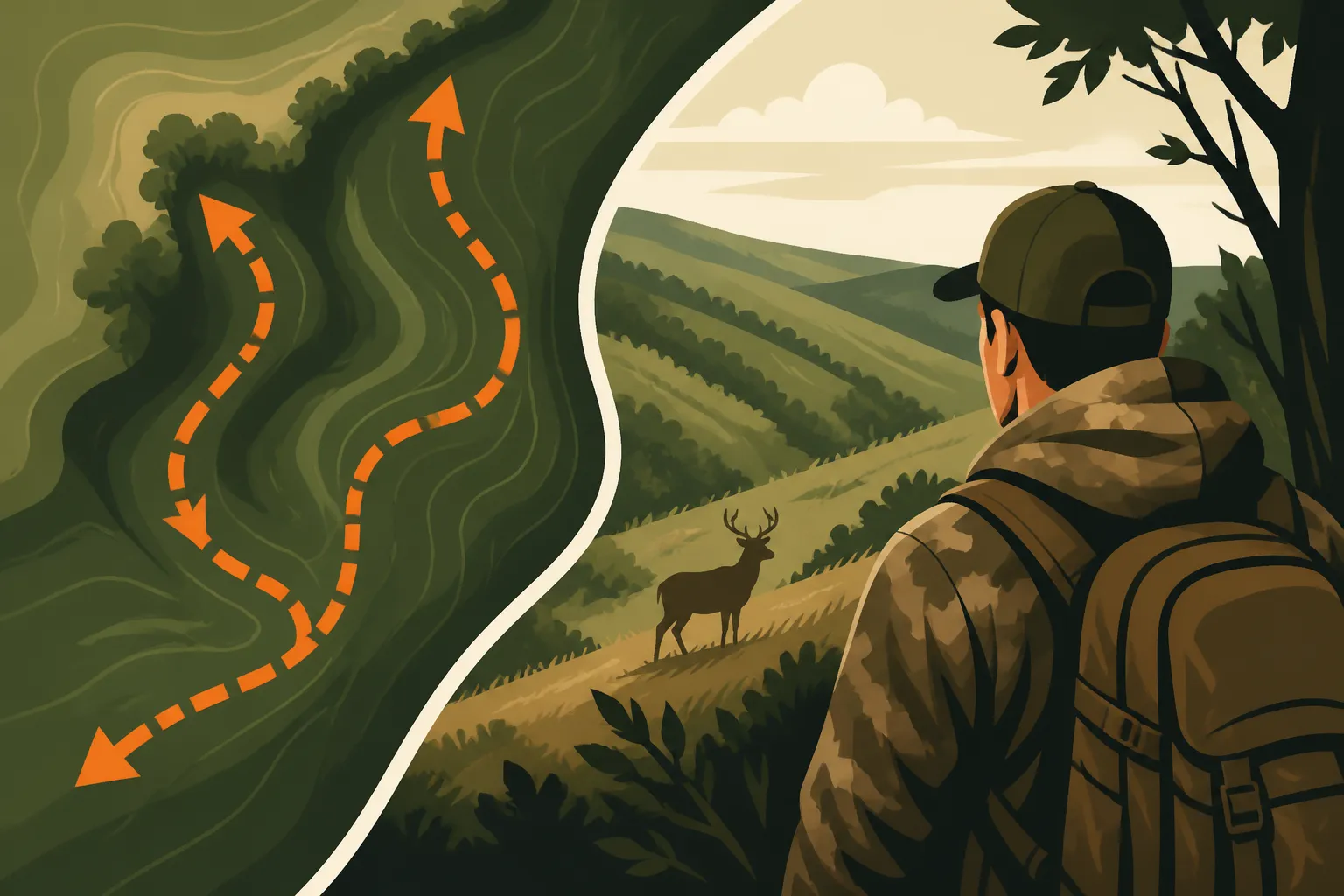
This is perhaps the most advanced and effective technique for steep Driftless ground. Side-hilling involves walking horizontally or diagonally across a steep slope, rather than directly up or down. This method offers several advantages: it's less physically demanding, reduces noise, and keeps you out of the deer's direct line of sight from above or below. Contouring means following the natural elevation lines, taking advantage of subtle benches or terrain features that provide an easier, quieter path.
When side-hilling, you're essentially using the land itself as a giant blind. Your profile is minimized against the slope, and you're less likely to be silhouetted. This technique is particularly useful when you need to access a specific bench or saddle high on a ridge, allowing you to approach from an unexpected angle. When planning your route, use your mapping app to identify gentle contours or faint game trails that might offer a less strenuous and quieter path. This strategy works exceptionally well during the Hunting the Wisconsin Rut in November when bucks are cruising these very same contours looking for does. Just be mindful of your footing, as steep side-hilling can be strenuous and even dangerous in wet or icy conditions.
Adapting to Changing Conditions Morning vs. Evening, Wind Shifts
The Driftless is dynamic, and your entry strategy needs to be too. What works for a morning hunt as thermals rise might be a disaster for an evening hunt when they fall. Similarly, a subtle shift in wind direction can completely negate an otherwise perfect plan. This is where constant awareness and flexibility become your greatest assets.
Consider a morning hunt: you've climbed high on a ridge before dawn. As the sun comes up, warming the air, thermals will begin to pull your scent uphill. This is generally good if your stand is above the primary deer movement zone. For an evening hunt, as the sun sets and the air cools, thermals will drop into the valleys, pushing your scent downhill. This means if you're hunting a food plot in a valley, approaching from an adjacent high ridge with a dropping thermal can be ideal, as your scent is carried away from the deer's likely approach. Always check a detailed weather forecast, paying close attention to predicted wind changes throughout your hunt. Having a few different entry and exit routes scouted for each stand can save a hunt when conditions unexpectedly change.
| Time of Day | Ideal Wind Direction | Recommended Entry Route | Rationale |
|---|---|---|---|
| Morning | Crosswind/Uphill | Ridge Top / Side-hill | Scent rises with thermals, staying above deer; less exposed on ridge. |
| Evening | Crosswind/Downhill | Creek Bottom / Side-hill | Scent drops with thermals, staying below deer; uses low ground for concealment. |
| Mid-day | Consistent | Contour / Thick Cover | Deer are often bedded; focus on maximum concealment and quiet. |
Gear and Planning for Difficult Entries
Success in the Driftless doesn't just happen; it's the result of meticulous planning and having the right tools for the job. The steep hills and often remote nature of the terrain demand more than just a rifle and some camo. Thinking through your gear and pre-hunt preparation can literally make or break your hunt, especially when those long, steep hikes are involved.
Essential Scouting and Mapping Tools
Before you even step foot in the woods for a hunt, the real work begins with scouting. In the Driftless, this means a heavy reliance on detailed topographic maps and aerial imagery. Digital mapping applications, like those offered by GoHunt, are indispensable. These tools allow you to virtually scout the terrain from your home, identifying potential funnels, bedding areas, food sources, and most importantly for this discussion, safe and stealthy entry and exit routes. You can spend hours poring over contour lines and tree cover, marking potential stand locations and drawing out your approach paths.
When you're actually in the field doing some Scouting Wisconsin Public Land Before Season, these digital maps become your live navigation system. You can drop pins for sign, note terrain features, and confirm your planned routes. The ability to visualize the terrain in 3D, calculate distances, and understand elevation changes instantly can prevent wasted time and spooked deer. Without these tools, you're essentially walking into a maze blindfolded, hoping to stumble upon success. Being able to visualize the lay of the land, especially when Reading Aerial Photos for Coulee Deer, gives you a profound advantage.
Footwear and Clothing for Stealth and Comfort
Your choice of footwear and clothing might seem minor, but it's absolutely critical for quiet movement and enduring the elements in the Driftless. For boots, you need something with excellent ankle support for traversing steep, uneven ground, and a sole that provides good traction but isn't overly stiff or noisy. Rubber boots are great for scent control, especially if you're crossing wet areas or want to keep ground scent to a minimum. Look for models with aggressive tread for gripping those steep slopes.
Clothing should be layered for warmth and moisture wicking, but equally important, it needs to be quiet. Any material that swishes, rustles, or crinkles will instantly compromise your stealth on a silent morning or evening. Wool and soft fleece are excellent choices. Avoid outer layers with noisy synthetic fabrics. In Wisconsin, especially during late season, you'll be glad for quality gear that helps you stay warm and dry, allowing you to focus on the hunt, not the cold. Consider how your Packs for a Day on Public Land also affect noise; ensure everything inside is padded and secured to prevent rattling.
Emergency Preparedness and Safety
Hiking steep, rugged terrain, especially in low light or alone, always carries inherent risks. A twisted ankle, a sudden fall, or even just getting turned around in unfamiliar country can quickly turn a hunt into an emergency. Always carry a small first-aid kit, a headlamp with extra batteries, a knife, a fire starter, and a way to communicate, even if it's just your cell phone (understanding that service can be spotty in many Driftless coulees).
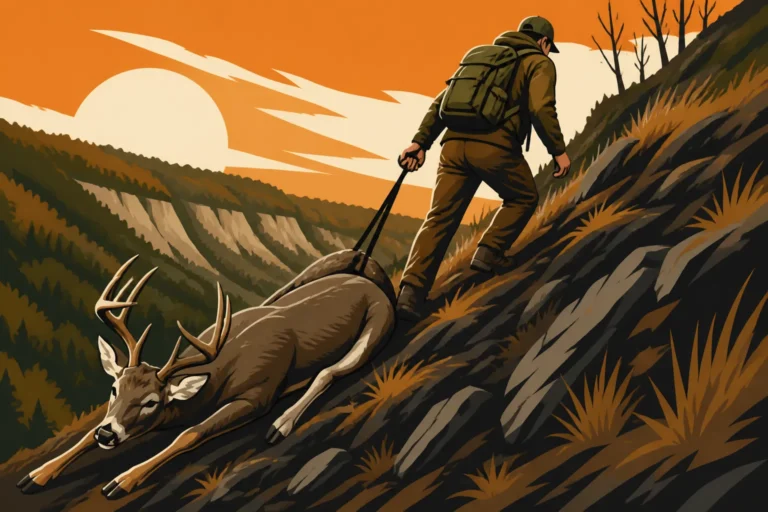
Let someone know exactly where you're going and when you expect to return. Consider carrying a GPS device or having your mapping app downloaded for offline use, as cell service can be nonexistent in some of the deeper coulees. If you're fortunate enough to harvest a deer, the task of Dragging a Deer Up a Coulee Wall is a significant physical challenge, and having a plan, perhaps even a partner, is vital. Don't underestimate the physical demands of this type of hunting, and always prioritize your safety.
Disclaimer
Hunting is an inherently dangerous activity. This article provides general information and recommendations. Always consult the official Wisconsin Department of Natural Resources (DNR) regulations and local laws before hunting. Practice safe firearm handling, wear appropriate safety gear, and hunt ethically and responsibly. The author and publisher are not liable for any incidents or accidents resulting from the application of this information.