Vehicle Rules on Wisconsin Public Land
You finally found that perfect public land spot in Wisconsin, only to drive up and see a gate, a chain, or a "No Vehicles Beyond This Point" sign. It's frustrating, right? Knowing where you can and can't drive on Wisconsin's vast public lands can make or break your hunt, impacting everything from scouting efficiency to game retrieval. This guide is all about navigating those vehicle rules so you can hunt smart, stay legal, and avoid unnecessary headaches, ensuring your outdoor adventures are about the hunt, not a parking ticket.
Understanding Wisconsin's Public Land Classifications and Vehicle Access
Navigating Wisconsin's public lands can feel like deciphering a secret code, especially when it comes to vehicle access. It's not a one-size-fits-all situation; different types of public land operate under different management philosophies and, consequently, different rules for vehicles. This is often where hunters get tripped up, assuming that what's allowed in a County Forest is also fair game in a State Wildlife Area. It's a common misconception, and frankly, it's easy to make when you're just eager to get out into the woods.
The core reason for these varied rules comes down to the primary purpose and management goals of each land type. Some lands are managed for timber production and recreation, others for wildlife habitat preservation, and still others for primitive recreation. Each of these goals dictates how motorized vehicles are integrated, or restricted, from the landscape. Ignoring these distinctions can lead to fines, environmental damage, and even loss of hunting privileges. We want to avoid all of that. Understanding these classifications is your first step to being a responsible and effective public land hunter.
The Management Philosophy Behind Vehicle Restrictions
Think about it this way: the land managers, whether it's the DNR for State Forests and Wildlife Areas, county boards for County Forests, or the US Forest Service for National Forests, have a delicate balance to maintain. They're trying to provide recreational opportunities for hunters, hikers, and campers, while also protecting the natural resources, ensuring wildlife isn't unduly disturbed, and preventing damage to trails and sensitive ecosystems. Vehicle use, particularly off-road or on undesignated routes, can wreak havoc on all these fronts.
For instance, driving off a designated road into a wetland to retrieve a deer might seem harmless in the moment, but it can destroy delicate plant life, compact soil, create ruts that lead to erosion, and disturb nesting birds or other wildlife. In many areas, especially those designated for wildlife habitat, the goal is to create as little human disturbance as possible, and that includes the noise and physical impact of vehicles. Other areas, like some County Forests, are designed with more robust road systems for timber harvest, which can then be utilized by hunters for access. It's a complex puzzle, and knowing the underlying philosophy helps you predict what kind of rules you might encounter.
Where to Find Current Vehicle Access Information
Before you even load your gear, scouting the regulations for your chosen hunting spot is crucial. Relying on old habits or hearsay can get you into trouble. The official sources are always your best bet. For state-managed lands (State Forests, State Wildlife Areas), the Wisconsin DNR website is the authority. Each specific property usually has its own webpage detailing specific rules, including vehicle access.
County Forests are managed by individual counties, so you'll often need to visit that specific county's website, usually under the "Forestry Department" or "Parks and Recreation" section, to find maps and regulations. National Forests, like the Chequamegon-Nicolet, have their own websites under the U.S. Forest Service, often with specific motor vehicle use maps (MVUMs) that clearly show what roads are open to what types of vehicles. Tools like onX Hunt can be incredibly helpful here, as they often overlay these public land boundaries and, in many cases, designated road systems, allowing you to visualize permitted vehicle access right on your phone before you even leave home. This can save you a ton of time and frustration from driving to a gated road.
Specific Vehicle Rules by Public Land Type
Let's dive into the nitty-gritty of vehicle rules on different types of Wisconsin's public lands. This is where the rubber meets the road, quite literally. Each category has its own quirks, and understanding them can save you a major headache.
Wisconsin State Forests
Wisconsin's State Forests, like the Northern Highland-American Legion Forest or the Kettle Moraine State Forests, are generally managed for multiple uses, including timber production, recreation, and wildlife habitat. For vehicles, this usually means that access is restricted to designated roads and parking areas. You won't typically find open cross-country travel here.
Imagine you're heading into the Black River State Forest for a deer hunt. You've scouted a great spot deep within, but the logging road you want to take seems to narrow and become less maintained. Before you push further, check your maps. Most State Forests will have maps, either online or at forest headquarters, that clearly mark roads open to public vehicles. Driving beyond a "road closed" sign or through a gate that looks passable but is meant to restrict access can result in citations. Sometimes, specific roads might be open seasonally for hunting access, but these exceptions are usually well-marked or noted in the special regulations for that forest. Always assume that if a road isn't clearly marked as open for public vehicle traffic, it's not. Don't be that hunter who creates new ruts where there shouldn't be any. Northern Highland Forest Deer Ground is an excellent resource to learn more about a specific State Forest.
Wisconsin County Forests
County Forests make up a significant portion of Wisconsin's public hunting land, particularly in the northern half of the state. These lands are primarily managed for timber production, which means they often have extensive networks of logging roads. The good news for hunters is that many of these roads are open to public vehicle traffic, providing excellent access.
However, "many" doesn't mean "all." Again, specific rules vary from county to county. A county like Marinette might have a very open policy for designated forest roads, while another might have more stringent seasonal closures or restrictions. It's common to find roads that are open until a certain point, then gated beyond, or roads that are only open during certain hunting seasons. How County Forests Work in Wisconsin explains more about the general structure. For instance, in Langlade County, you might find a well-maintained gravel road that transitions into a two-track. The two-track might be open, but pay attention to signs. You'll often see signs indicating "Open to Public Travel" or "Designated ATV/UTV Route." Conversely, a simple chain across a road, even without a "No Entry" sign, typically means it's closed to motorized vehicles. When in doubt, contact the specific county's forestry department. They are usually very helpful and can provide maps that show designated open roads, including those accessible by ATVs and UTVs.
Wisconsin State Wildlife Areas
These lands, often called "flowages," "marshes," or just "wildlife areas," are managed primarily for wildlife habitat and public recreation centered around wildlife observation and hunting. Due to their focus on preserving sensitive habitats and minimizing disturbance, vehicle access in State Wildlife Areas is generally much more restricted than in State or County Forests.
Expect to park in designated parking lots and proceed on foot. While some larger wildlife areas might have a main access road, driving off that road onto dikes, field edges, or access trails is almost universally prohibited. This is particularly true in wetland areas, where even light vehicle traffic can severely damage water control structures and aquatic vegetation. For example, if you're hunting ducks at Horicon Marsh, you'll park at a designated lot and likely walk or paddle in. There are very few opportunities for motorized vehicle use beyond the main perimeter roads. The goal here is to keep these areas as wild as possible for the species that depend on them. Always assume foot traffic only unless explicitly stated otherwise. Hunting Horicon Marsh Waterfowl has more details on specific access.
Chequamegon-Nicolet National Forest
Wisconsin is lucky to host a significant portion of the Chequamegon-Nicolet National Forest, a vast expanse of land in the northern part of the state. As a National Forest, it operates under federal regulations, which can differ from state and county rules. The key concept here is the Motor Vehicle Use Map (MVUM).
The MVUM is your Bible for vehicle access in the National Forest. These maps designate every road and trail open to motorized vehicles, specifying what type of vehicle (e.g., street-legal vehicles, ATVs, UTVs) is allowed on each route and during what seasons. If a road or trail isn't on the MVUM as open, it's closed. Period. This is a critical point that many hunters miss. Just because a two-track looks drivable doesn't mean it's legal. These rules are in place to protect sensitive forest ecosystems, prevent erosion, and maintain the wilderness character of certain areas. You can often download MVUMs from the U.S. Forest Service website or pick up paper copies at Ranger Stations. These maps are invaluable for planning your hunt, whether you're chasing grouse in aspen cuts or still-hunting for deer. Hunting the Nicolet Side for Deer can offer more insights into hunting in this specific forest.
ATVs, UTVs, and Off-Road Vehicles: What You Need to Know
ATVs and UTVs have become incredibly popular tools for hunters, and for good reason. They can cover a lot of ground quickly, haul gear, and help with game retrieval. However, their use on Wisconsin public land comes with its own set of rules and limitations, which are often distinct from those for street-legal vehicles. Misunderstanding these rules is a common source of frustration and citations.
Designated Trails and Routes Only
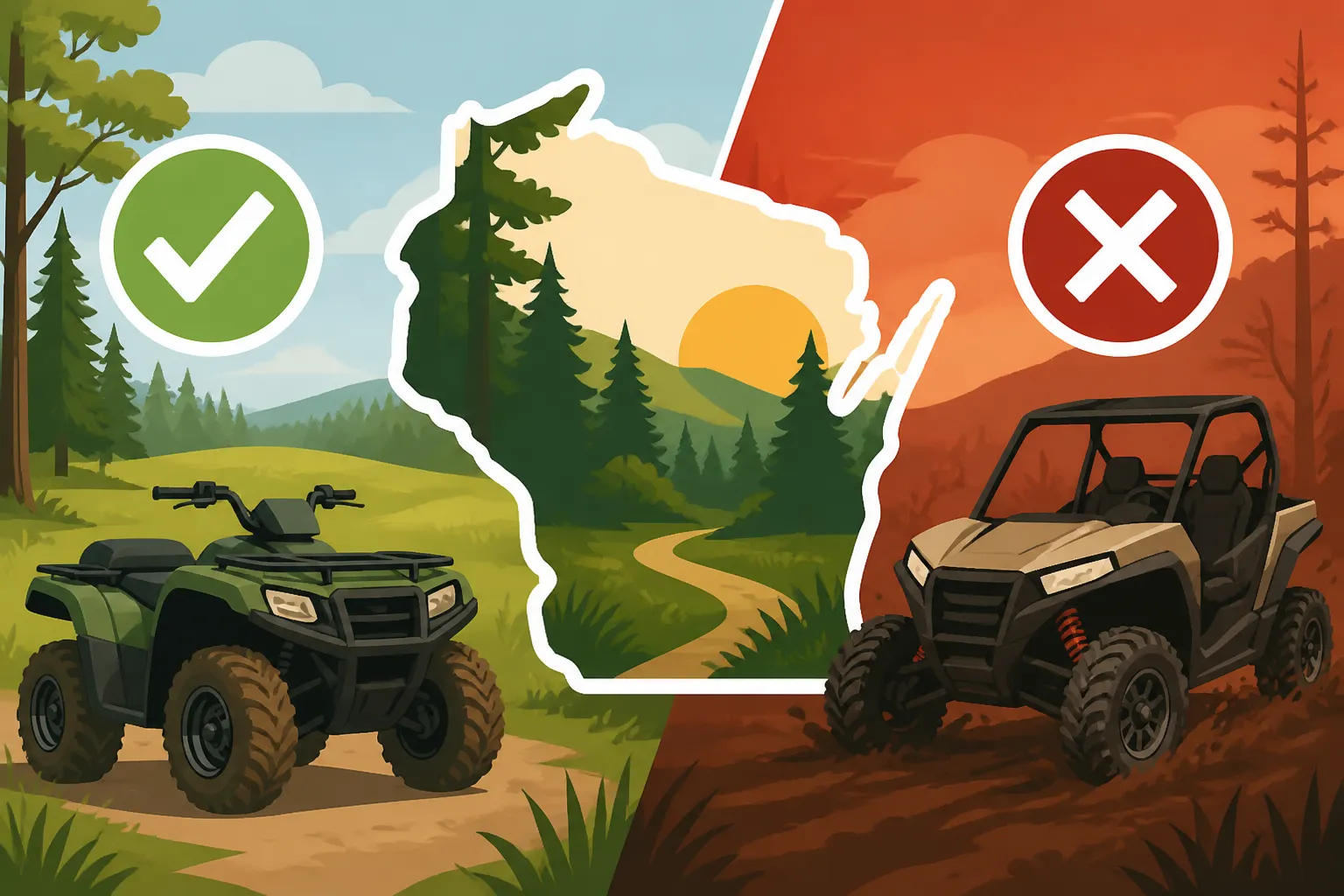
The overarching rule for ATVs and UTVs on most Wisconsin public lands is that they are generally restricted to designated ATV/UTV trails or routes. You cannot simply drive them wherever a deer might have gone, or onto any old logging road you find. These designated routes are typically well-marked with signs and often appear on specific trail maps provided by the managing agency (DNR, County Forestry, or US Forest Service).
Think of it this way: if you're not on a marked ATV/UTV trail or a road explicitly designated for their use, assume you shouldn't be there. This is especially true in State Wildlife Areas, where ATV/UTV use is often very limited or entirely prohibited off main access roads. In County Forests, you'll find more opportunities, but again, stick to the marked routes. Many northern counties have extensive county-wide ATV/UTV trail systems that intersect with hunting lands, which can be a huge asset for access.
Special Regulations and Seasonal Closures
Beyond designated routes, there are often special regulations regarding ATV/UTV use. These can include:
- Seasonal Closures: Some trails or routes might be closed during certain times of the year, often to prevent damage during wet conditions (spring thaw) or to protect sensitive wildlife during nesting or birthing seasons. Always check the current trail status.
- Operating Hours: While less common for hunting-specific access, some trails might have specific operating hours.
- Safety Requirements: All ATVs/UTVs must meet state safety requirements, including helmet use for certain age groups, proper lighting, and registration.
- Game Retrieval: This is a big one for many hunters. While an ATV/UTV can be a lifesaver for getting a deer out of tough terrain, it's rare that you're permitted to drive off-trail to retrieve game. In most cases, you must still adhere to designated vehicle routes. This often means a long drag to the nearest legal access point. Always clarify this rule for the specific piece of public land you are hunting. Don't risk a citation for saving your back.
Using Mapping Apps for ATV/UTV Access
This is where modern technology really shines. Mapping applications like onX Hunt often include layers that show designated ATV/UTV trails and roads open to motorized vehicles. This can be an absolute game-changer for planning your hunt and ensuring you stay within legal boundaries. You can see precisely where trails begin and end, where they connect, and what land they traverse. Some even color-code the trails by type of vehicle allowed. Scouting With the Wisconsin Hunt Wild App also offers good advice for general public land navigation.
| Public Land Type | General Vehicle Access | ATV/UTV Access | Common Restrictions |
|---|---|---|---|
| Wisconsin State Forests | Designated roads and parking areas only. | Limited to designated ATV/UTV routes. | No off-road travel. Seasonal road closures common. |
| Wisconsin County Forests | Many logging roads open, but varies by county. Designated parking. | Extensive systems of designated ATV/UTV trails/routes. | Varies greatly by county. Check specific county forestry maps. |
| Wisconsin State Wildlife Areas | Very limited to main access roads and designated parking. | Extremely limited or prohibited off main access roads. | Foot traffic mostly. Protection of sensitive habitat is key. |
| Chequamegon-Nicolet NF | Strictly adhere to Motor Vehicle Use Maps (MVUMs) for all roads. | Restricted to routes shown on MVUMs for ATVs/UTVs. | MVUMs are gospel. No off-MVUM travel. Seasonal closures on some routes. |
| Voluntary Public Access (VPA) | Depends on specific parcel agreement. Often foot traffic only. | Generally not permitted unless specifically stated. | Treat as private land with specific hunting access rules. |
Navigating Roads and Gates: Practical Tips for Hunters
Beyond just knowing the rules, there's a practical side to dealing with vehicle access on public land. Gates, unmarked roads, and confusing signage can all add layers of complexity to your hunting day. Here are some seasoned tips to help you navigate these challenges gracefully.
Interpreting Signs and Gates
The golden rule is this: When in doubt, don't drive past it. A gate, even if it looks old or appears to be easily circumvented, means "no motorized access beyond this point" unless there's a clear sign explicitly stating otherwise (e.g., "Seasonal Access for Hunters," with specific dates). Often, these gates aren't just there to keep vehicles out; they're there to protect fragile habitats, maintain quiet zones for wildlife, or secure active timber operations.
Similarly, "No Motorized Vehicles" signs, or even subtle changes in road maintenance where a two-track starts to reclaim itself, are strong indicators. Sometimes, public land is bordered by private land that has its own, more lenient access rules; don't confuse the two. Always look for official signage. If a sign explicitly says a road is open to certain vehicle types during specific times, that's your green light. Otherwise, respect the barrier.
Respecting Gated Roads and Private Property Boundaries
It's common to find public land access roads that are gated, sometimes with a small walk-through for foot traffic. These gates serve a purpose, often preventing resource damage or managing hunter density. You might be tempted to park your vehicle strategically near a gate, but always ensure you're not blocking the gate, impeding access for authorized vehicles, or parking on private property. A lot of frustration can arise when a property owner needs to get through a gate on their land, or a forest manager needs to access a timber sale, and a hunter's truck is in the way.
Mapping apps like onX Hunt are incredibly valuable here. They display property lines, which helps you ensure you're parking legally on public land and not inadvertently trespassing or blocking a private access point. Many rural Wisconsin roads have narrow shoulders, so be mindful of road traffic and safety when choosing your parking spot. Make sure your vehicle is completely off the travel portion of the road.
The Impact of Weather on Vehicle Access
Wisconsin weather can be fickle, and it significantly impacts vehicle access. What might be a perfectly passable two-track in dry fall conditions can quickly become an impassable, rut-creating mud pit after a heavy rain or during spring thaw. Forest managers often implement seasonal road closures specifically to prevent this kind of damage.
If you encounter soft, muddy conditions, err on the side of caution. Driving through deep mud can not only get your vehicle stuck (a truly miserable experience far from cell service), but it can also cause extensive damage to the roadbed, leading to deeper ruts that then need costly repair. These ruts can erode and become permanent features, harming water quality and making the road impassable for everyone, sometimes leading to permanent closures. Be a good steward of the land. If it looks too wet, park it and walk. Your boots will eventually dry, but those ruts might be there for years. This is especially true when Tracking a Deer in Wisconsin Snow; deep snow can hide hazards and make even normally passable roads difficult.
Planning for Game Retrieval When Vehicle Access is Limited
This is a scenario every public land hunter faces: you've harvested an animal, but your vehicle is miles away at a designated parking area with no off-trail access. This is where planning ahead pays off.
- Bring the Right Gear: A quality deer cart, a sturdy game sled (especially in snow), or a robust frame pack for boning out meat are essential tools. Don't underestimate the physical toll of dragging a deer a long distance, especially uphill or through thick brush. Dragging a Deer Up a Coulee Wall is a reality check for many hunters.
- Teamwork: If hunting with a partner, plan how you'll retrieve game together. Two people with a deer cart can manage much tougher situations than one.
- The Gutless Method: Learning how to debone a deer in the field can significantly reduce the weight you need to pack out, making retrieval much more manageable, especially in remote areas or during warmer early season hunts. This is a game-changer if you're looking at a long walk. Butchering a Deer at Camp can give you tips for processing your harvest.
- Emergency Plans: Always carry a fully charged phone (though service can be spotty), a map, compass, headlamp, and a basic survival kit. Getting stuck with a downed animal at dusk, far from your vehicle, is a situation you want to avoid.
By understanding the rules, respecting the land, and planning for the inevitable challenges, you can make your Wisconsin public land hunting experiences far more enjoyable and successful. Happy hunting!
Disclaimer
This article is for general informational purposes only and does not constitute professional advice. Laws, prices and regulations vary by location and change over time. Consult a qualified professional for guidance on your specific situation.