6.5 Creedmoor for Coulee Country
Hunting the steep, winding terrain of Wisconsin's Driftless Area presents a unique set of challenges. One moment you're peering into a brushy draw for a close-range shot, and the next you're looking across a wide-open valley where a deer might be standing hundreds of yards away. This variability often leaves hunters scratching their heads about the best rifle and caliber choice, especially when it comes to balancing flat trajectory for those longer shots with manageable recoil for accuracy. This guide will dive deep into why the 6.5 Creedmoor has become such a popular and effective choice for many Wisconsin hunters navigating the intricate landscape of coulee country.
Understanding Wisconsin's Coulee Country Terrain
Before we talk about specific calibers, let's really get a feel for what makes coulee country so distinct, and why it demands a versatile rifle setup. The Driftless Area, found in southwestern Wisconsin, is a truly ancient landscape, carved by water and wind, untouched by the last glacial advance. This has left us with a beautiful, rugged region of deep valleys, steep hillsides, and winding creeks.
The Dynamics of Coulee Hunting
When you're deer hunting in the coulees, you're constantly dealing with elevation changes. One minute you might be huffing and puffing up a 300-foot ridge, and the next you're carefully descending into a thick bottomland. This isn't flat farmland where every shot is likely to be under 100 yards, nor is it wide-open prairie where 400-yard shots are the norm. Instead, it's a mix. You might jump a buck at 30 yards in a cedar thicket, or spot a mature deer browsing on an opposing ridge at 250 yards. The shot angles can be extreme, either steeply uphill or downhill, adding another layer of complexity.
Moreover, the vegetation varies wildly. Some coulees are heavily timbered with mature oaks and hickories, while others might have open, grassy slopes giving way to dense brush along a creek bottom. This means your rifle needs to be accurate enough for precision at a distance, yet still nimble enough to get on target quickly if a deer suddenly appears close by in heavy cover. The wind also plays a significant role. Swirling thermals in the valleys can be unpredictable, and steady winds across exposed ridge tops can push a bullet far off course if you're not prepared. It's a true test of a hunter's adaptability and equipment. Understanding Wind and Thermals in a Coulee can be a game-changer.
Common Shot Distances and Scenarios
In coulee country, there's no "average" shot distance. You need to be prepared for anything from 20 yards to 300 yards, and occasionally even further if you're set up on a commanding ridge overlooking several fingers.
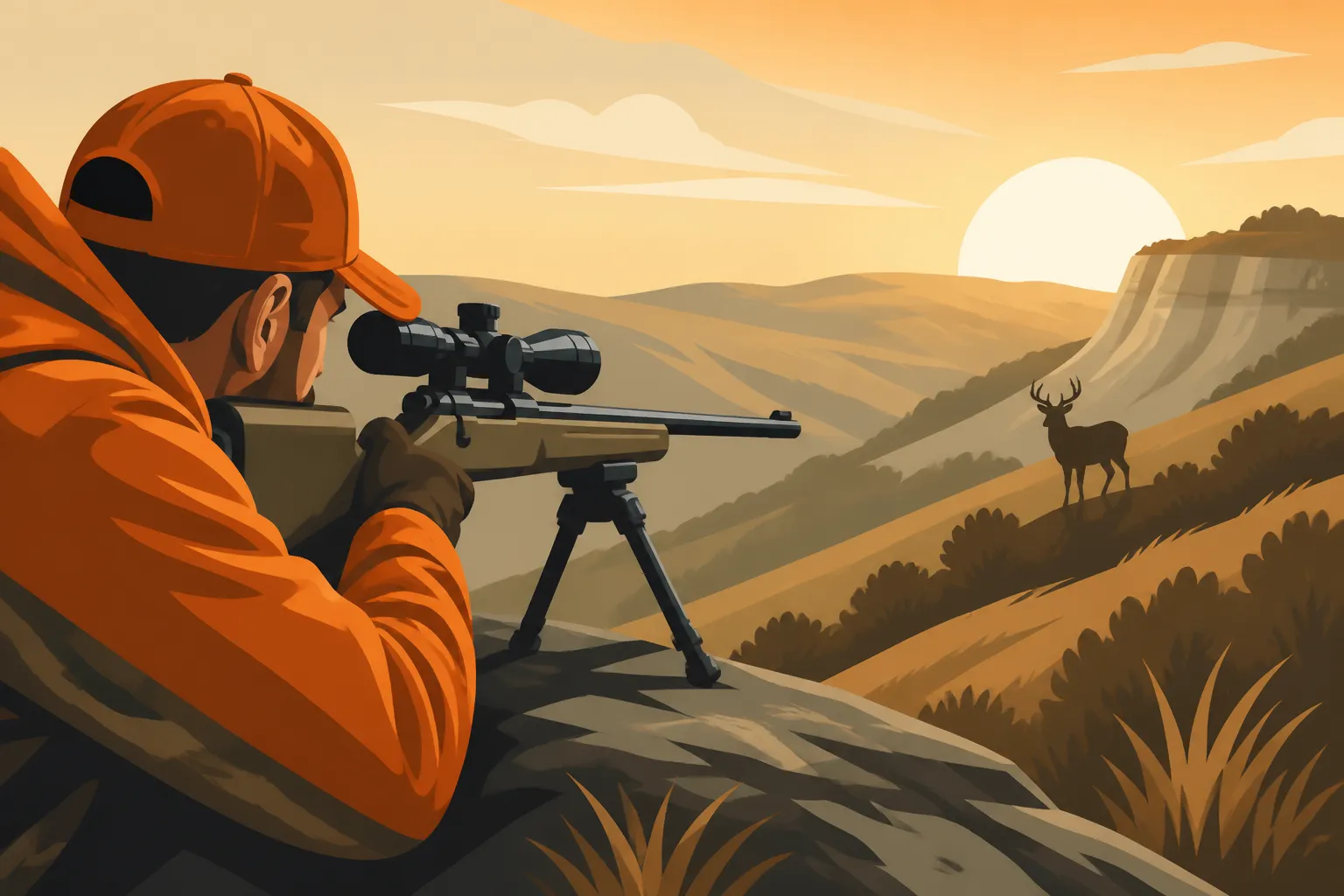
Imagine this scenario: you've climbed to a prominent finger ridge, carefully picked your stand location, and watched the sun come up. Below you, a brushy draw cuts through the hillside, offering a potential bedding area. Across the main valley, you see an old logging road that deer might use to travel between feeding and bedding. A deer suddenly steps out on that logging road, maybe 200 yards away, presenting a broadside shot. The next evening, you might be still-hunting a timbered slope and have a buck explode from a thicket at 60 yards. Your rifle needs to perform consistently in all these varied conditions. For more on navigating this landscape, check out Hunting Wisconsin Coulees and Ridge Tops.
Why the 6.5 Creedmoor Shines in Variable Terrain
Now that we've set the stage, let's talk about why the 6.5 Creedmoor has gained such a loyal following among hunters, particularly those who frequent terrains like Wisconsin's coulee country. It's not just hype; there's real substance behind its popularity.
Flat Trajectory and Reduced Bullet Drop
One of the biggest advantages of the 6.5 Creedmoor is its incredibly flat trajectory. This means less bullet drop over distance compared to many traditional deer calibers. Why is this so crucial in the coulees? When you're looking at a deer on a steep hillside or across a deep valley, accurately judging range and angle can be difficult. A flatter shooting cartridge helps to mitigate errors in range estimation.
For instance, if you misjudge a 250-yard shot by 25 yards either way, with a flatter-shooting cartridge like the 6.5 Creedmoor, your point of impact will be much closer to your aim point than with a rainbow-like trajectory of a slower, heavier bullet. This gives you a larger "vital zone" where small errors in range estimation or holdover won't result in a missed shot or, worse, a wounded animal. This consistency across varied distances provides a huge confidence boost, especially when every shot opportunity feels hard-earned.
Low Recoil for Accuracy and Spotting Shots
Let's be honest, recoil can be a factor for anyone, regardless of experience. Heavy recoil can lead to flinching, poor shooting habits, and reduced accuracy, especially when you're tired from climbing hills all day. The 6.5 Creedmoor offers a relatively mild recoil impulse, making it very comfortable to shoot.
This comfortable shooting experience translates directly to better accuracy in the field. Hunters are less likely to anticipate the shot, resulting in a smoother trigger pull and better shot placement. Furthermore, the lighter recoil allows you to stay on target better through the shot, often enabling you to spot your bullet's impact or watch the deer's reaction. This is incredibly valuable in situations where a follow-up shot might be necessary, or simply for confirmation that your shot was true. When you're dealing with Recovering a Deer From a Coulee Bottom, knowing exactly where your deer went down can save you a lot of time and effort.
Inherent Accuracy and Wind Resistance
The 6.5 Creedmoor was designed from the ground up to be an inherently accurate cartridge, and it lives up to that reputation. The cartridge's efficient case design and bullet selection contribute to excellent ballistic coefficients, meaning the bullets are more aerodynamic and resist wind drift better.
In coulee country, where winds can swirl and gust unpredictably, this wind resistance is a significant benefit. A bullet that holds its line better in the wind provides a more forgiving margin of error. Couple this with the cartridge's excellent precision, and you have a recipe for ethical, confident shooting at those potentially longer distances that are common from ridge points or across open fields. Many hunters using GoHunt maps to scout their hunting areas find themselves plotting potential long-range shot scenarios, and having a caliber that can handle them brings peace of mind.
Terminal Performance on Wisconsin Whitetails
While the 6.5 Creedmoor is often praised for its long-range capabilities, it's also highly effective on deer at typical hunting distances. With proper bullet selection, it delivers ample energy and reliable expansion for quick, humane kills on Wisconsin whitetails.
Modern 6.5mm hunting bullets are designed to expand reliably, creating a wide wound channel. Whether you choose a bonded bullet for deeper penetration on quartering shots or a rapid-expansion bullet for broadside presentations, the 6.5 Creedmoor, when paired with the right projectile, is more than capable of taking down even the largest bucks in the Driftless Area. The key is to match your bullet to your hunting conditions and practice consistently.
Practical Considerations for Hunting with a 6.5 Creedmoor
Choosing the right caliber is only part of the equation. To truly maximize the potential of your 6.5 Creedmoor in Wisconsin's coulee country, you need to consider how you set up your rifle and how you approach your hunt.
Bullet Selection for Deer
As mentioned, bullet choice is critical. While most reputable hunting ammunition in 6.5 Creedmoor will perform well on deer, consider the following:
- Weight: Common bullet weights range from 120-147 grains. Lighter bullets often fly flatter, while heavier bullets can offer better wind resistance and deeper penetration, especially if you anticipate quartering shots or shooting through light brush. For deer, a 129-grain to 143-grain bullet is usually an excellent all-around choice.
- Construction: Look for bullets designed for controlled expansion. Examples include Hornady ELD-X, Barnes TSX/TTSX, Nosler AccuBond, and Winchester Deer Season XP. These bullets are engineered to retain weight and penetrate deeply while expanding reliably within the animal. Avoid varmint-specific bullets that might fragment too quickly.
Always test several brands and bullet weights in your specific rifle to see what it shoots most accurately. What performs well in one rifle might not in another.
Optics and Zeroing Strategy
A quality rifle scope is non-negotiable for coulee hunting with a 6.5 Creedmoor. You need clarity, light-gathering capability for those crucial dawn and dusk hours, and a reliable aiming system.
- Magnification: A scope with a variable magnification from 3-9x, 4-12x, or even 3-15x is ideal. This allows you to dial down for close, fast shots in thick timber and crank up the power for precise aiming across longer distances. Consider Rifle Scopes for Low-Light Timber as many shots will happen during these prime times.
- Reticle: A simple duplex reticle works well, but a reticle with BDC (Bullet Drop Compensator) hashes or a Christmas tree-style reticle can be extremely useful for quick holdovers at varying ranges without having to dial adjustments.
- Zeroing: For a 6.5 Creedmoor in coulee country, a 200-yard zero is a popular choice. This will keep your bullet relatively flat out to around 250-275 yards, often within a couple of inches of your aim point. You'll then have predictable holdover points for longer shots. Always verify your rifle's performance at various distances (e.g., 50, 100, 200, 300 yards) at the range, and practice shooting at angled targets if possible. For a deeper dive into optimizing your zero, explore Zeroing a Rifle for Mixed Distances.
Carrying and Handling in Steep Terrain
While the 6.5 Creedmoor itself is a cartridge, the rifle you chamber it in plays a huge role in its practicality.
- Rifle Weight: You'll be doing a lot of walking and climbing in coulee country. A lightweight rifle (7-8 lbs scoped) is a real blessing by the end of a long day. Heavy barreled "long-range" specific rifles might be incredibly accurate, but they can become a burden quickly on those steep climbs.
- Sling: Invest in a comfortable, non-slip sling. A good sling will keep your rifle secure on your shoulder while navigating tough terrain, allowing your hands to be free for balance or climbing.
- Protection: Consider a scope cover or a scope cap to protect your optics from rain, snow, and bumps as you move through thick brush. Your rifle is a tool, but it's an important one that needs to be protected to ensure performance.
For comprehensive scouting and planning your routes through the challenging terrain, using a mapping application like GoHunt can provide invaluable satellite imagery and topographic data, helping you identify potential shooting lanes and optimal stand locations before you even step foot in the woods.
Alternative Calibers for Wisconsin's Driftless
While the 6.5 Creedmoor excels, it's important to acknowledge that it's not the only option, and other calibers have proven their worth in Wisconsin's coulees for generations. Hunters often debate the merits of different cartridges, and personal preference, familiarity, and available equipment often weigh heavily in the decision.
Traditional Deer Cartridges
Many classic calibers remain highly effective, particularly for those who prioritize timber hunting or have less frequent long-range shot opportunities.
- .308 Winchester: The .308 is a perennial favorite across Wisconsin. It's compact, accurate, and delivers plenty of punch for deer. While its trajectory isn't quite as flat as the 6.5 Creedmoor, it's more than sufficient for the vast majority of shots in coulee country, especially under 200 yards. It also often comes in lighter, handier rifle platforms. Check out .308 Versus .270 for Whitetails for a detailed comparison.
- .270 Winchester: Another classic, the .270 has a reputation for being a flat-shooting cartridge with excellent terminal performance on deer. It generally has slightly more recoil than the 6.5 Creedmoor but offers similar ballistic advantages for longer shots. It’s a workhorse caliber that has taken countless deer in Wisconsin.
- .30-06 Springfield: The versatile .30-06 is arguably the most popular big game cartridge in North America for good reason. It can handle a wide range of bullet weights, making it adaptable to both close-range timber hunting and longer shots across valleys. However, it does come with more noticeable recoil than both the 6.5 Creedmoor and .308.
These cartridges are all excellent choices and can be just as effective as the 6.5 Creedmoor with good bullet selection and diligent practice. The key is understanding their ballistic properties and limitations in the varied coulee environment.
Shotguns and Straight-Wall Cartridges
In some parts of Wisconsin, particularly those with higher population densities or specific safety concerns, rifle hunting might be restricted to shotguns or straight-wall cartridges. While the heart of the Driftless Area is generally open to centerfire rifles, it's always critical to know the local regulations for your specific hunting area.
- Shotgun Slugs: Modern slug guns, especially those with rifled barrels and sabot slugs, are incredibly accurate out to 150-200 yards. They deliver massive energy to the target but come with a much more pronounced bullet drop and heavier recoil than centerfire rifles. If you hunt in areas requiring slugs, practice extensively at varying distances to understand your gun's capabilities.
- Straight-Wall Cartridges: Cartridges like the .450 Bushmaster or .350 Legend have gained popularity in states with straight-wall only regulations, and while not typically needed for deer in most of Wisconsin's coulees, they could be an option for some. They offer good performance at shorter ranges (typically under 200 yards) but will have a much more arcing trajectory than the 6.5 Creedmoor.
Ultimately, the best caliber is the one you shoot most accurately and confidently. For those looking for a modern cartridge that offers a blend of flat trajectory, manageable recoil, and excellent accuracy for the diverse demands of Wisconsin's coulee country, the 6.5 Creedmoor is undeniably a top contender. Before you head out, make sure your Wisconsin Hunting Licences and What They Cost are up to date!
| Caliber | Typical Bullet Weight (gr) | Approx. Drop at 300yds (w/ 200yd zero) | Recoil (Relative) | Strengths in Coulee Country | Weaknesses in Coulee Country |
|---|---|---|---|---|---|
| 6.5 Creedmoor | 120-147 | ~9-11 inches | Low | Flat trajectory, low recoil, accurate, good wind resistance | Ammunition can be more expensive than traditional calibers |
| .308 Win | 150-180 | ~12-15 inches | Medium | Versatile, common, good energy, widely available ammunition | Slightly more bullet drop and recoil than 6.5 Creedmoor |
| .270 Win | 130-150 | ~10-13 inches | Medium-High | Flat trajectory, excellent deer cartridge, good energy | Higher recoil than 6.5 Creedmoor, can be harder to find rifles in lighter packages |
| .30-06 Sprg | 150-180 | ~14-18 inches | High | Powerful, extremely versatile, widely available ammunition | Highest recoil of the group, not necessary for most deer shots |
This article is for general informational purposes only and does not constitute professional advice. Laws, prices and regulations vary by location and change over time. Consult a qualified professional for guidance on your specific situation.