Recovering a Deer From a Coulee Bottom
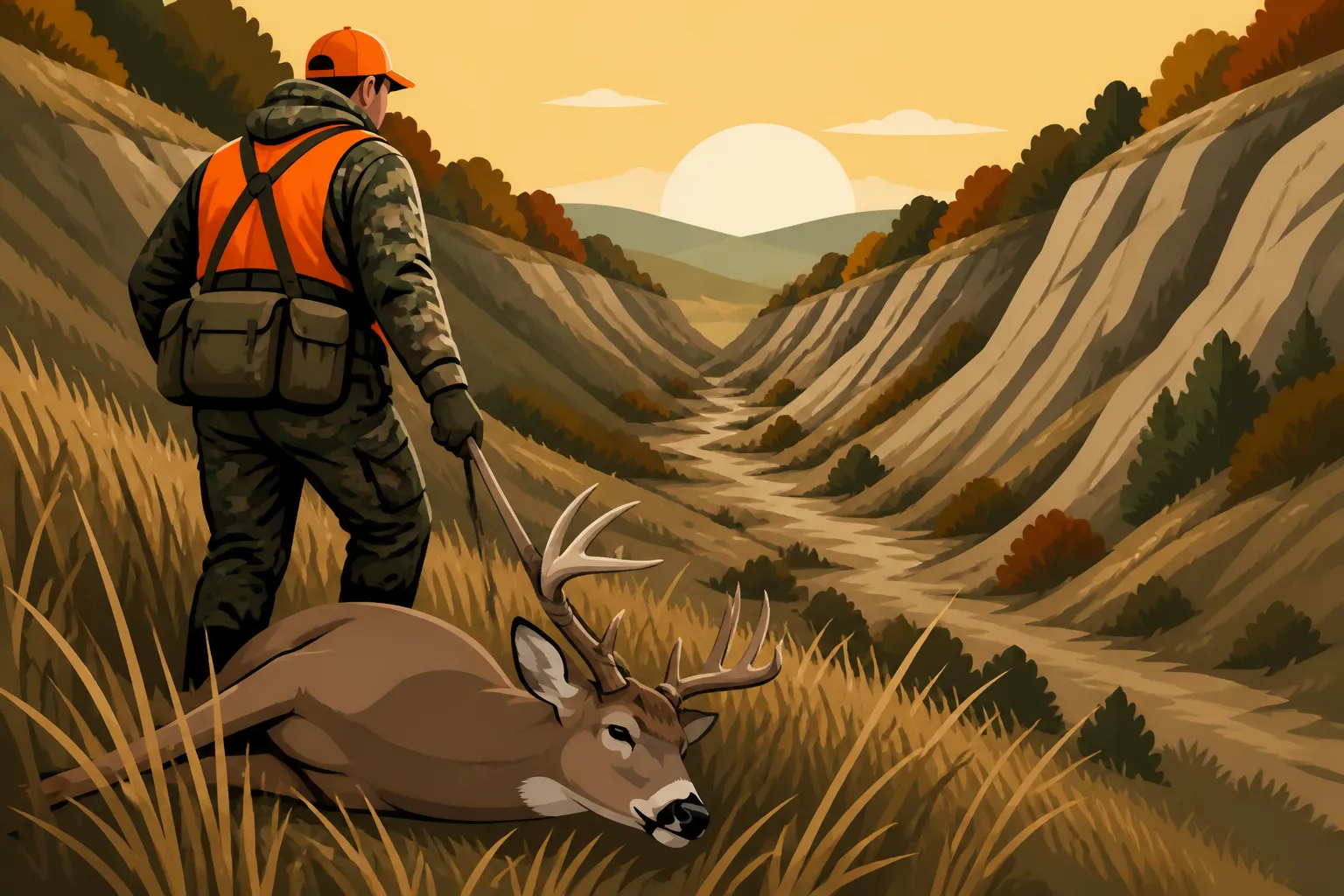
There's nothing quite like the rush of adrenaline when you make a good shot on a Wisconsin whitetail, only to have that high quickly morph into a sinking feeling as you watch your deer disappear into the abyss of a steep coulee bottom. That heart-stopping moment, knowing your trophy—and all that precious venison—is now in one of the most physically demanding places imaginable, can turn excitement into dread. This guide is here to help you navigate that exact scenario, offering practical, empathetic advice for safely and successfully recovering a deer from the challenging terrain of a coulee bottom.
The Initial Assessment and Safety First
When a deer takes a tumble into a coulee, your first instinct is often to charge after it. We've all been there, that intense desire to get hands on your animal. But pausing, taking a deep breath, and making a rational assessment of the situation is absolutely crucial. A hasty decision could lead to injury or even losing the deer entirely.
Assessing the Situation
Did you see your deer go down, or did it just vanish? This detail is incredibly important. If you saw it fall, mentally mark that spot as precisely as possible. Note landmarks, specific trees, or rock formations. If it just vanished, the last place you saw it alive is your starting point for the trail. Think about the angle of the shot, the deer's reaction, and the direction it ran. Was it a clear trail or did it weave through thick brush and over rocky ledges?
The terrain itself is your biggest challenge here. Coulees in Wisconsin's Driftless Area are notorious for their steep, often slippery slopes, loose rock, and dense undergrowth. A perfectly good blood trail can seemingly disappear into a leaf litter or a pile of fallen timber. Consider the time of day: approaching dusk means limited visibility, which complicates trailing significantly. Weather conditions also play a huge role; rain can wash away blood, while snow can offer a clear track but also make the footing treacherous. Always think about your own physical limits before you even begin to descend. Sometimes, the wisest move is to back out, give the deer time (if the shot wasn't immediately fatal), and return with help and better light. This is especially true if you suspect a gut shot or a marginal hit where the deer might still be alive but bedded down. Rushing in could bump the deer, sending it even further into the depths.
Personal Safety and Equipment Check
Before you even think about scrambling down into that steep, unforgiving coulee, you must prioritize your personal safety. The terrain itself presents numerous hazards: loose rocks, slippery leaves, exposed roots, and sudden drop-offs. A twisted ankle or a nasty fall down a steep incline is the last thing you need when trying to recover a deer. Always wear sturdy, ankle-supporting boots with good traction. Even in dry conditions, these slopes can be treacherous.
Beyond footing, consider what you'll need once you reach the deer. A reliable headlamp is non-negotiable, even if you start your search in daylight, because you never know how long the recovery might take, especially if you have to follow a faint trail or if you're recovering a deer after dark in Wisconsin. Pack extra batteries. Bring plenty of water, some snacks for energy, and additional layers of clothing. Temperatures in a deep coulee can feel significantly different than on the ridge top, and exertion can lead to sweating, which quickly turns to chilling when you stop. A compact first-aid kit is also a wise addition for any hunting trip, particularly when you're venturing into remote, rugged areas. You never know when you might need to patch up a scrape or a deeper cut, or tend to a sprain. Make sure someone knows where you are and your estimated return time, especially if you're hunting alone. Cell service can be spotty in deep coulees, so don't rely solely on your phone for emergencies.
Navigating the Coulee and Locating Your Deer
Once you've assessed the situation and geared up, the real work begins: descending into the coulee and finding your deer. This often requires a blend of technology, woodsmanship, and a whole lot of patience.
Utilizing Technology and Sign
Modern hunting apps can be an absolute lifesaver in this kind of challenging terrain. Before you even move from your stand or the point of the shot, mark your exact location and the last known position of the deer using an app like OnX Hunt or the GoHunt app. These apps often provide detailed topographic maps and aerial imagery, which are invaluable for understanding the contours of the coulee and planning your descent. You can drop pins for blood sightings, disturbed vegetation, or even just points of interest. This creates a digital breadcrumb trail that can guide you back out and help you re-orient if you get disoriented in the thick cover.
When it comes to blood trailing, be prepared for disappointment. Deer hit in steep, rocky, or heavily vegetated areas often don't leave a copious blood trail. The blood might be absorbed by leaves, smeared on rocks, or simply not reach the ground if the deer is low to the ground. Don't solely rely on blood. Look for other signs: disturbed leaves, broken twigs, scuff marks in soft soil, and even deer hair. If the deer was heavily hit, there might be bits of internal tissue. Pay attention to the deer's travel patterns; injured deer often head downhill, seek thick cover, or try to cross water. Learning to read a ridge point for deer movement can also give you clues about where it might have gone before it even disappeared. Move slowly and deliberately, stopping frequently to scan ahead and around you. It's often easier to spot a faint sign when you're still than when you're moving.
Methodical Grid Search and Patience
When the blood trail becomes intermittent or vanishes entirely, which is a common frustration in coulee country, it's time to switch to a systematic grid search. Don't just wander aimlessly. Pick a point where you last saw definite sign and expand your search pattern in ever-widening circles or a grid pattern. If you have a hunting partner, this is the time to work together, spreading out a safe distance apart and communicating constantly. One person might focus on the uphill side, another on the downhill, covering ground more efficiently.
Patience is perhaps the most critical virtue here. It's incredibly disheartening when the trail disappears, especially when you're facing a long, steep climb back out. Resist the urge to give up too soon. Many deer are recovered hours after the shot, sometimes even the next morning, if the weather is cool enough and you're confident the shot was lethal. If it's getting dark and you haven't found your deer, and you're sure it's dead, it might be best to carefully mark your last sign with flagging tape (removed once the deer is found) and return at first light with fresh eyes and possibly more help. Attempting to follow a blood trail after dark in Wisconsin, especially in a coulee, can be frustrating and even dangerous. A good headlamp helps, but it still can't replicate daylight.
The Extraction Challenge: Getting Your Deer Out
Finding your deer in a coulee bottom is only half the battle. The true test of will and strategy often comes with the extraction. Dragging a deer up a near-vertical slope can feel like an impossible task.
Field Dressing and Prep in Tough Terrain
Once you locate your deer, the immediate next step is field dressing. This is usually straightforward on flat ground, but on a steep coulee side, it presents its own set of challenges. Gravity, which normally assists, can become your adversary, causing entrails to roll down or making it awkward to maintain position. If you can, try to position the deer sideways on the slope or against a log to prevent it from sliding further downhill while you work.
For truly steep and difficult terrain, or if you're alone, consider the "gutless method" of field dressing. This involves quartering the deer and removing the meat without opening the body cavity. While it takes a bit more time and knowledge, it can significantly reduce the weight you need to move and allows you to carry the deer out in smaller, more manageable pieces in a frame pack designed for boning out a deer. This method also keeps the meat cleaner from dirt and debris encountered during a difficult haul. Regardless of the method, work quickly and cleanly to preserve the meat, especially if temperatures are mild, following best practices for field dressing a deer in cold weather or any conditions.
Strategies for Moving the Deer Uphill
Now, for the main event: getting that deer up and out. Dragging a deer up a coulee wall is easily one of the most physically demanding aspects of hunting. If you have a partner or two, this becomes significantly easier. One person can pull from the front, another can push from the back, or you can alternate pulling and resting. Communication is key to avoid injuries.
Without snow, a standard deer sled for snow country can still be useful, even on bare ground, as it helps the deer slide over roots and rocks more easily and protects the hide and meat from abrasion. If the slope is incredibly steep and long, you might need to break the haul into shorter segments, taking frequent breaks. A sturdy rope is indispensable. You can loop it around the deer's neck and front legs, creating a harness, or even use it with a basic block and tackle system if you have suitable trees and the foresight to bring one. For those truly challenging spots, especially if you hunt this type of terrain regularly, investing in a portable winch or even a small, battery-powered capstan winch might be a game-changer. These can dramatically reduce the manual effort required. Remember, it's not a race; slow and steady wins, protecting your body and your valuable venison.
Using Gear to Your Advantage
Don't underestimate the power of the right gear. Beyond the aforementioned deer sleds and ropes, consider what else can make this arduous task more manageable. If the coulee bottom eventually flattens out enough to allow for it, a game cart can be invaluable for the final stretch to your vehicle, though they are usually useless on the truly steep stuff.
For situations where quartering is the only viable option, investing in high-quality game bags for warm September days is crucial. These breathable bags protect your meat from flies, dirt, and debris, allowing it to cool while you shuttle it out in pieces. Brands like Argali, Kifaru, or even some of the more durable brands available through retailers like GoHunt, offer excellent options designed for backcountry hunters who frequently bone out animals. A good, sharp field dressing knife and a bone saw (or the gutless method to avoid sawing) are also essential for efficient processing in the field. Remember, the goal isn't just to get the deer out, but to get it out in a way that preserves the quality of the meat.
Post-Recovery: Care and Considerations
You've done it. After hours of sweat, grit, and maybe a few choice words, your deer is finally out of the coulee. But the work isn't quite over. Proper post-recovery care is essential to honor your harvest and ensure that delicious venison makes it to your freezer in prime condition.
Meat Care After a Difficult Haul
After exerting so much energy to recover your deer, the last thing you want is to compromise the meat quality. Even if you field dressed the deer in the coulee, the process of dragging it out can introduce dirt, leaves, and other debris. Take a few minutes at your vehicle or at home to meticulously clean the carcass. Wipe down any soiled areas with clean cloths or paper towels. If possible, rinse the cavity with cool water, ensuring you dry it thoroughly afterward to prevent bacterial growth.
Air circulation is vital for cooling. Hang your deer in a cool, shaded, well-ventilated area as quickly as possible. If the weather is warm, consider placing bags of ice inside the body cavity. For those who enjoy the nuances of flavor, learning about aging venison in cold weather can elevate your table fare. While not always practical immediately after a tough recovery, keeping these principles in mind for future hunts will serve you well. Protecting the meat from flies and other insects with breathable game bags is also a must, especially in milder temperatures. All your hard work in that coulee should result in delicious, clean venison, so don't skimp on this final, important step.
Registering Your Harvest and Reporting Success
With your deer finally secured and properly cared for, there's one more crucial step: registering your harvest. In Wisconsin, this is a straightforward process that can often be done online or via phone. You'll need your customer ID, your deer carcass tag number, and basic information about your harvest, such as the deer's sex, if it was antlered or antlerless, and the county and deer management unit where it was harvested. The Wisconsin DNR website makes registering a Wisconsin deer online quick and easy, ensuring you comply with all regulations.
Beyond the official requirements, take a moment to savor your accomplishment. Recovering a deer from a coulee bottom is a significant feat, one that tests your physical endurance, mental fortitude, and woodsmanship. It's a story you'll be telling around the campfire for years to come, perhaps even adding to your family's Wisconsin deer camp traditions. Share your experience with friends and fellow hunters; they'll appreciate the grit and determination it took. And, of course, enjoy the venison – it will taste all the sweeter knowing the effort that went into bringing it home.
Comparison of Deer Extraction Methods
| Method | Description | Pros | Cons | Best for Coulee Bottoms? |
|---|---|---|---|---|
| Dragging (Whole Deer) | Pulling the entire deer by rope or drag harness. | Simple, requires minimal gear; keeps carcass intact for transport. | Extremely physically demanding on steep, uneven terrain; high risk of injury; can soil meat. | Poor – Only for short, less steep sections or with multiple helpers. |
| Quartering / Pack-Out | Breaking the deer down into manageable sections (quarters, backstraps, etc.) and carrying them out in a pack. | Reduces weight per trip; allows access to very remote areas; cleaner meat. | Requires skill/knowledge of gutless method; multiple trips often needed; requires specialized pack and game bags. | Excellent – Best for very steep, rough, or distant retrievals. |
| Sled / Game Cart | Using a plastic sled or wheeled cart to transport the deer. | Reduces friction and effort (sled); ideal for flatter, less rugged terrain (cart). | Sleds struggle with very steep, rocky slopes; carts are useless on most coulee terrain. | Moderate (Sled) – Good for gradual slopes or snow; Poor (Cart) – Not for steep coulees. |
| Mechanical Winch (Portable) | Battery-powered or manual winch to pull deer or quarters up steep inclines. | Significantly reduces physical exertion; allows single-person recovery in tough spots. | Requires significant investment; adds weight to carry in; needs strong anchor points (trees). | Excellent – If budget and gear allowance permit, makes recovery far easier. |
Disclaimer
Please note that hunting regulations and land access rules can change. Always consult the latest Wisconsin Department of Natural Resources (DNR) regulations and local ordinances before engaging in any hunting activity. Safety should always be your top priority.