Wind and Thermals in a Coulee
If you've spent any time hunting the steep, winding terrain of Wisconsin's Driftless Area, you know the soul-crushing frustration of a coulee's wind. One minute you're sure your scent is blowing perfectly into the valley, the next you catch a whiff of yourself swirling back up the ridge, putting every deer within a quarter-mile on high alert. It feels like the wind has a mind of its own out there, and frankly, it often does. This guide is all about demystifying those unpredictable air currents, helping you understand how wind and thermals work in a coulee so you can finally put them to work for you, instead of against you.
Understanding the Basics of Thermals and Wind in Coulees
The unique topography of coulees creates a microclimate where air movement isn't just about the prevailing wind, but a complex dance of rising and falling air influenced by temperature, sunlight, and the very shape of the land. Ignoring these thermal shifts is like trying to navigate a ship without knowing how tides work; you'll eventually run aground. For Wisconsin hunters, especially those chasing big bucks in the dramatic bluffs and valleys, a deep understanding of these forces is absolutely critical to success.
Defining Thermals: Updrafts and Downdrafts
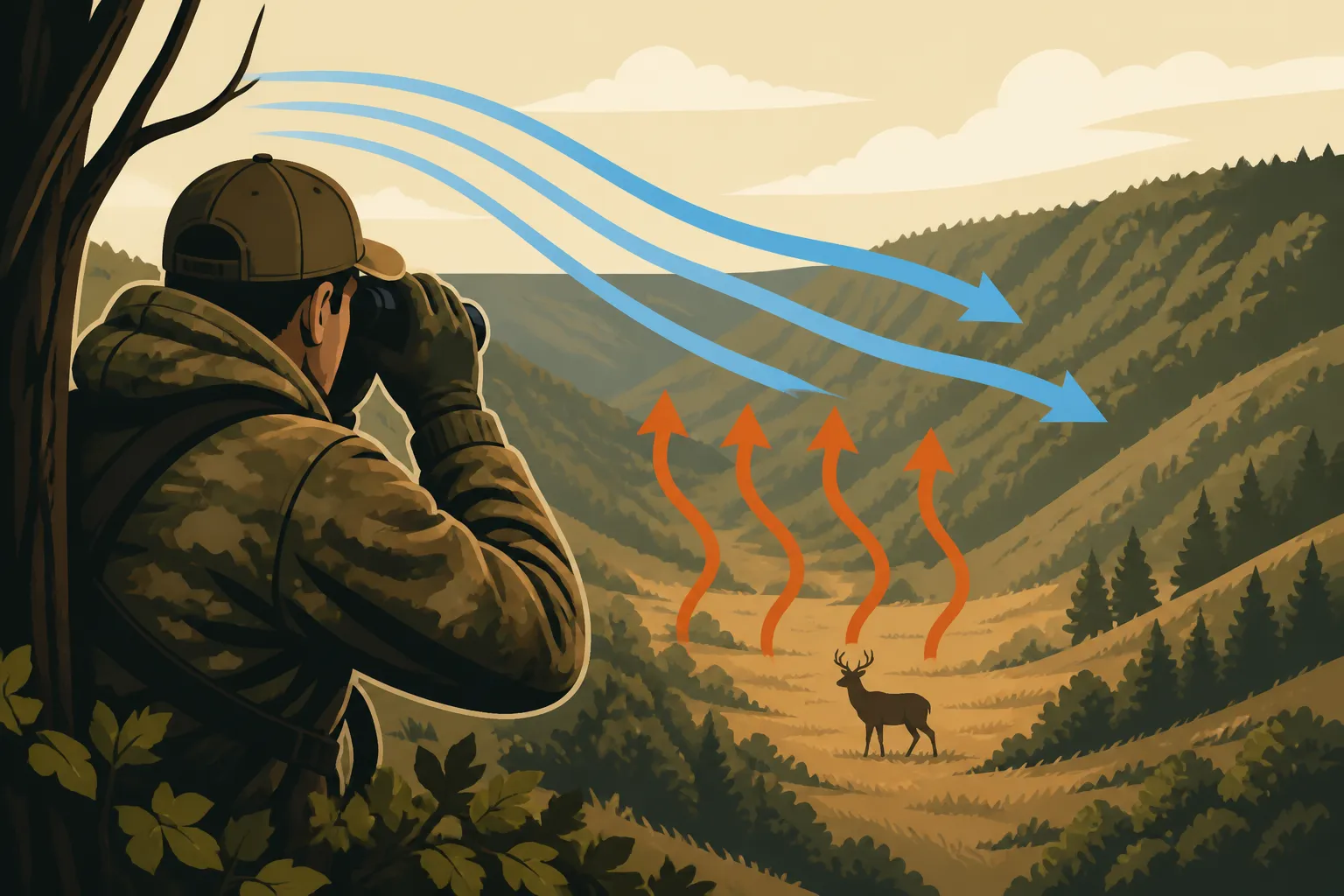
At its core, a thermal is simply air moving vertically due to temperature differences. Warm air rises (updraft), and cool air sinks (downdraft). This isn't groundbreaking science, but its application in a coulee setting is where it gets interesting and often overlooked. Think about the sun hitting the east-facing slope of a coulee in the morning. As that slope warms up, the air directly above it begins to heat and rise, creating an updraft. This rising air pulls cooler, heavier air from the valley bottom or the shaded west-facing slope upwards to replace it.
Conversely, as the sun begins to set or hides behind a ridge, those same slopes cool down. The air above them cools too, becoming denser and heavier. This cool, heavy air then begins to sink down the coulee walls and into the valley bottom, creating a downdraft. These thermal movements are most pronounced at dawn and dusk, acting like a natural conveyor belt for your scent, as well as the deer's. Many hunters focus solely on the prevailing wind direction, but in a coulee, understanding these vertical air movements is often far more important for staying undetected.
The Influence of Sun and Shade
The sun is the engine driving thermal activity. Where the sun shines, the ground warms, and thermals rise. Where there's shade, the ground cools, and thermals fall. This dynamic can be incredibly localized and shift throughout the day. Imagine a coulee with a deep, shaded draw on one side and a sun-drenched slope on the other. Even if the prevailing wind is light, you could have an updraft on the sunny side and a downdraft in the shaded draw, creating a swirling nightmare of scent distribution. This is why a simple wind checker powder becomes your best friend in coulee country, letting you actually see these localized air currents in real time.
Consider hunting on a crisp, clear morning in early October. As the sun creeps over the eastern ridge, it starts warming the slope it hits first. You might be set up on the west-facing slope, still in shadow. The thermal will be pulling down on your side, but up on the other. Then, as the sun gets higher, both slopes might warm, causing various localized updrafts. It's a continuous, shifting puzzle, and deer are masters at using these shifts to their advantage, often bedding in locations that give them a thermal advantage for detecting danger.
How Coulees Amplify Wind Swirls
Beyond simple thermals, the funneling effect of coulees can turn even a gentle breeze into a chaotic swirl. The topography acts like a giant wind tunnel, but one with many twists and turns. As wind pushes over a ridge and drops into a coulee, it doesn't just flow in a straight line. It bounces off walls, tumbles into pockets, and gets redirected by side draws, creating eddies and unpredictable currents. This is particularly true in the deeper, more complex coulees of the Driftless Area.
You might be sitting in a stand, thinking the northwest wind is holding steady, only to have a sudden gust from the south blow right up from the valley floor because of how the main wind current interacted with a specific bend or a small side spur. This is one of the most common frustrations for hunters: feeling like the wind is constantly betraying them. Learning to anticipate these swirls and plan for them by observing terrain features is key. It's not about finding a place with no wind, but finding a place where the wind is predictably swirling in a way that benefits your hunt.
Reading the Landscape for Thermal Movement
Successfully hunting coulees means becoming a student of the landscape. You need to look at the terrain not just as features for deer movement, but as conduits and controllers of air flow. This skill develops over time, but there are specific elements you can learn to read and utilize right away. Tools like aerial maps on your phone, such as those offered by GoHunt, can be incredibly valuable for visualizing these terrain features before you even step foot in the woods.
Identifying Thermal Channels
Just as deer have their travel corridors, thermals have their channels. These are often the same features that funnel deer movement. Deep draws, narrow ravines, and the steepest parts of a coulee wall tend to be where thermals are most concentrated. In the morning, watch for where the sun hits first and longest in a valley. Those will be your primary updraft channels. In the evening, look for the shaded, cooler spots; these will typically be your downdraft funnels. Deer understand these channels intrinsically. They often use the rising thermals in the morning to travel up out of valley bottoms, or the falling evening thermals to slip back down into feeding areas, knowing their scent is carried away from potential predators.
Walking these areas during scouting can reveal subtle clues. You might notice leaves rustling more in one draw than another on a calm day, or feel a distinct cool breeze flowing downhill even when the ridge top is still. These are often indicators of thermal activity. A good mapping app, like GoHunt, can help you visualize these thermal corridors and plan your approach, identifying potential bottlenecks where deer might move with the prevailing thermal advantage.
Monitoring Wind and Microclimates
Effective coulee hunting requires constant vigilance of the wind, not just at your stand, but how it's behaving in the entire microclimate around you. This means using a wind checker frequently – not just once an hour, but every few minutes, especially during prime movement times. Throw a puff of powder out at different heights and angles to see how the air is truly moving. You might find that at chest height, the wind is one direction, but at eye level, it's completely different, or that a thermal is pulling your scent straight up even with a crosswind.
Beyond a simple wind checker, pay attention to the subtle cues around you. The way leaves flutter on different trees, the direction of smoke from a distant chimney (if visible), or even just how the hair on your arms reacts can give you clues. If you're near a creek, watch how the mist moves. If you're hunting during a light rain, observe how the drops are falling; are they going straight down, or are they being pulled in a distinct direction by a thermal? These microclimates are what make coulee hunting so challenging and rewarding.
Using Terrain Features to Your Advantage
Every hump, dip, and bench in a coulee can affect wind flow. Instead of fighting it, learn to use these features. A small point or a subtle finger ridge sticking out into a coulee can act as a natural deflector, creating a more stable pocket of air behind it. Setting up your stand just on the downwind side of such a feature can shield your scent from swirling winds. Conversely, a deep, narrow draw that opens directly into a main coulee can become a strong thermal highway, pulling air straight up or down.
When you're trying to figure out your approach, tools like GoHunt can be invaluable for pinpointing terrain features that might offer a thermal advantage. For example, a small saddle along a ridge might be a consistent thermal hotspot, drawing deer using rising morning air. Or a steep, rocky face on a south-facing slope will heat up fast, creating a strong morning updraft that you can position yourself above to keep your scent from drifting into the valley below. Understanding how to use these nuances of the land is a cornerstone of Hunting Wisconsin Coulees and Ridge Tops.
Tactical Considerations for Hunting Coulees
Once you grasp the dynamics of coulee winds and thermals, you can start building a tactical hunting plan that leverages them. This isn't about finding a spot where the wind is perfect all day, which rarely happens, but about minimizing your risk and maximizing your chances by understanding how deer will move in response to these same air currents. This often means adjusting your entry, exit, and stand placement strategies.
Strategic Entry and Exit Routes
Perhaps the most critical aspect of coulee hunting is planning your entry and exit. On flat ground, you might just walk in on a straight line. In a coulee, that's a recipe for blowing out every deer in the area. Your entry route needs to utilize thermals to keep your scent out of known bedding or travel areas. In the morning, as thermals are rising, consider an entry route that parallels a ridge line, staying above where deer are likely to be bedded in the draws below. Your scent will rise and dissipate, or be carried over their heads.
For your exit, especially in the evening when thermals are falling, you'll want to use the opposite strategy. You might exit by dropping into the valley bottom and moving out, allowing your scent to fall and drift behind you, away from bedding areas on the slopes. Alternatively, an exit route along the bottom of a coulee, while carefully playing the downdraft, can keep your scent lower than deer moving up the slopes. This careful consideration of Entry Routes on Steep Driftless Ground is paramount. It’s also important to minimize noise and visual disturbance, but scent control is often the primary factor when deer are using those thermals to detect you.
Stand Placement for Prevailing and Thermal Winds
Choosing where to hang your stand or set up a ground blind becomes a chess match with the wind and thermals. Instead of simply putting your back to the wind, you need to consider how the prevailing wind will interact with the local thermal. A common strategy is to set up on a crosswind slope, where your scent is carried across the coulee rather than directly down into it, and then rely on the thermal to lift it. For instance, if the prevailing wind is from the west and you're hunting an east-facing slope, your scent will blow across the coulee. If the morning thermal is rising, your scent will be carried up and across, hopefully over the heads of deer.
Consider the time of day you intend to hunt a specific spot. For morning hunts, often the best approach is to get high on a ridge or saddle, above where deer are likely to be, and let the rising thermals carry your scent upwards and away. For evening hunts, as thermals fall, you might want to be lower, catching deer moving up from feeding areas, with your scent flowing safely behind them down into the valley. Flexibility is key; sometimes, having a couple of different stand options for various wind and thermal conditions in the same general area, as discussed in Hanging a Stand in a Wisconsin Coulee, is the best approach.
Calling and Scent Control in Dynamic Air
Calling and scent control take on new dimensions in coulees. When you grunt or rattle, especially during the rut, that sound is going to travel differently depending on the thermals. Sound carries well in calm, cool air, but can be diffused quickly by rising, turbulent thermals. Practice listening to how sound carries in different parts of a coulee; it's a skill that can inform your calling strategy. For example, if you're trying to draw a buck up from a bedding area in a valley bottom, your calls will be carried more effectively by a rising morning thermal.
Scent control becomes even more crucial and complex. No matter how meticulously you wash your clothes or use sprays, the dynamic air currents in a coulee will test you. Beyond traditional scent elimination, consider using natural cover scents that blend with the environment, and always, always use a wind checker. It's not about being scent-free; it's about making sure the air carrying your scent isn't moving towards a deer. This is particularly vital when you're targeting mature bucks that are hyper-sensitive to foreign odors, especially during phases like Hunting the Pre-Rut in Late October.
Dealing with Shifting Conditions
The one constant in coulee hunting is change. The wind never truly stays the same, and thermals are always shifting. Becoming proficient means not just understanding these phenomena, but learning to adapt your strategy on the fly. This requires patience, keen observation, and sometimes, a willingness to move.
Adapting to Mid-Day Thermal Changes
The period between morning and evening, often called "mid-day," sees significant thermal shifts. As the sun climbs high, it can warm both sides of a coulee, causing less defined updrafts and more turbulent, unpredictable air currents. This is when the prevailing wind can sometimes take over, but often in an unpredictable, swirling fashion. During these hours, deer are typically bedded, but knowing how the air moves is still vital for their safety and yours.
If you're still-hunting or trying to sneak through a coulee during mid-day, be extremely cautious. Your scent is likely to swirl more, making it harder to predict. This is a time when sitting tight in a well-placed stand that accounts for all potential wind directions might be safer than trying to move. Or, if the terrain allows, move to a higher, more open ridge point where the prevailing wind has less interference from the coulee walls. A common mistake is assuming the wind will stabilize; instead, prepare for it to do anything but.
Hunting in Different Weather Patterns
Weather patterns dramatically influence thermals and wind. A cloudy, overcast day will have less intense thermal activity because the sun isn't directly heating the slopes. In these conditions, the prevailing wind will have a much stronger and more predictable influence. A rainy day can also dampen thermals, as the moisture equalizes ground temperatures, making scent control challenging as wet air tends to carry scent more effectively.
Conversely, a cold, clear day after a front can mean very strong, defined thermals. The cold, dense air will sink powerfully into the valleys in the evening and rush up the sun-warmed slopes in the morning. Hunting in these conditions means doubling down on your thermal strategy. For hunters who spend long hours on stand, especially in the late season, understanding how to manage the cold while staying scent-conscious is covered in Cold Weather Sitting Strategy. Snow cover, too, changes the game. Snow reflects sunlight, reducing ground heating, which can diminish thermal strength. However, the contrast between bare ground (like south-facing slopes) and snow-covered ground can create even more localized and intense thermals.
Using Technology to Predict and Observe
Modern technology can be a game-changer for predicting and observing coulee wind and thermals. Weather apps on your smartphone can provide detailed hourly wind forecasts, including speed and direction, which you can then cross-reference with your knowledge of the local topography. Some advanced hunting apps, like GoHunt, offer features that visualize wind direction over specific terrain, though these are still models and require on-the-ground verification. Using these tools to plan your hunt routes and stand locations before you even leave home is a smart strategy.
However, remember that these are predictions. There's no substitute for real-time observation using a wind checker. Consider carrying a small thermometer to gauge temperature differences between shaded and sunny slopes. Trail cameras with time-lapse features can also reveal how deer are moving in specific thermals at different times of day, providing invaluable scouting data. Being able to visualize and plan your approach with detailed maps, then verifying with on-the-ground observation, is the most effective method for Scouting Wisconsin Public Land Before Season.
Here's a quick reference for typical thermal patterns in coulees:
| Time of Day | Sun Exposure | Thermal Direction | Impact on Scent | Recommended Stand/Approach |
|---|---|---|---|---|
| Early Morning | East-facing slopes warm | Updraft (valley to ridge) | Scent rises | High, above expected deer |
| Late Morning | Both slopes warming | Mixed/Turbulent, rising | Unpredictable | High, or static position |
| Mid-Day | Peak sun, warmer air | Variable, weaker thermals | Prevailing wind dominant, but swirling | Stay put or high on ridge |
| Late Afternoon | West-facing slopes cool | Downdraft (ridge to valley) | Scent falls | Low, catching deer moving up |
| Evening/Dusk | All slopes cooling | Strong downdraft (ridge to valley) | Scent falls | Low, catching deer moving down |
| Cloudy/Overcast | Minimal sun | Weaker thermals | Prevailing wind more stable | Adjust for true prevailing wind |
Hunting coulees is not for the faint of heart, but by mastering the invisible forces of wind and thermals, you'll unlock a new level of confidence and success in some of Wisconsin's most challenging and rewarding deer country. This knowledge also applies when you're thinking about Using a Ground Blind on Wisconsin Public Land, where your scent cone will be very close to the ground and highly susceptible to falling thermals. It takes time, practice, and a lot of patience to truly become proficient, but the reward of outsmarting a wise old coulee buck is absolutely worth it.
Disclaimer
The information provided in this guide is for general informational purposes only and does not constitute professional advice. Hunting regulations and conditions can change rapidly. Always consult the Wisconsin Department of Natural Resources (DNR) for the most current rules, regulations, and safety guidelines before engaging in any hunting activities. Adherence to all local, state, and federal laws is the responsibility of the hunter.