Long Shots Across a Wisconsin Coulee
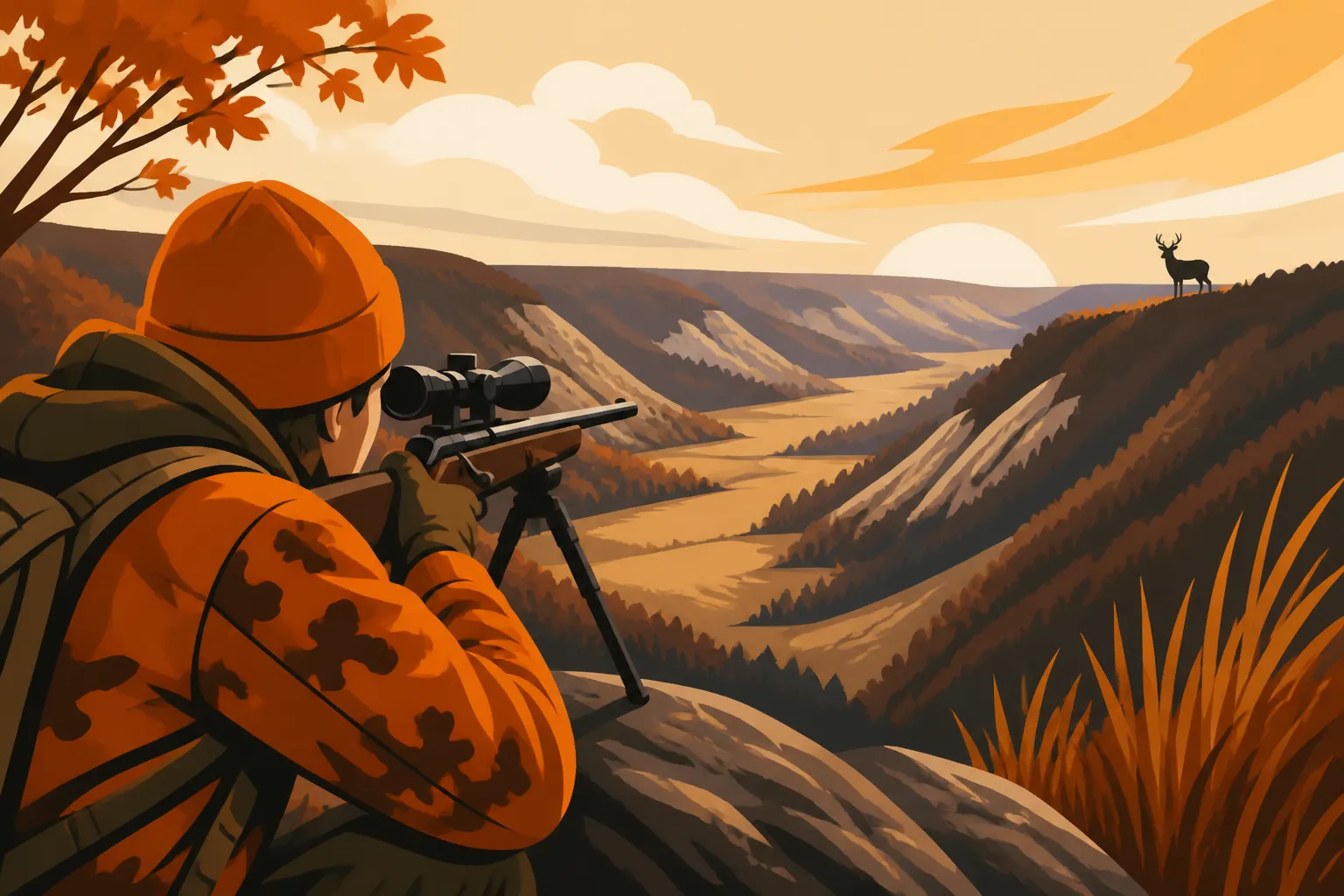
There's nothing quite like standing on a coulee rim in Wisconsin's Driftless Area, looking out over those incredible folds of land, hoping to spot a mature whitetail buck. But those long, sweeping views often mean one thing: a potential for a longer shot than many hunters are accustomed to. It's a unique challenge, navigating the steep terrain, swirling winds, and dense pockets of timber, all while trying to make a precise shot. This guide is all about equipping you with the knowledge, gear, and tactics to confidently and ethically make those crucial long shots across a Wisconsin coulee when the opportunity presents itself.
The Unique Challenges of Wisconsin's Coulee Country Terrain
Hunting the Driftless Area of Wisconsin is an experience unlike almost anywhere else in the state. It's a place of breathtaking beauty, but it demands a specific kind of strategy and preparation from hunters. Those rolling hills and deep valleys, carved by ancient glaciers that skirted this region, create a hunting environment that's as rewarding as it is demanding.
Decoding the Driftless Landscape
Imagine stepping out onto a ridge in Buffalo County or Crawford County. Below you, a patchwork of timbered hillsides, hidden spring creeks, and small, irregular crop fields sprawls out. These are the coulees: narrow, steep-sided valleys with flat bottoms, often cut by streams, flanked by razor-back ridges. The deer here don't just walk; they flow with the land, using every fold, every brushy draw, and every change in elevation to their advantage. They'll bed on south-facing slopes in thick thermal cover, or tuck into deep draws to escape the wind. Their travel corridors often follow old logging roads or faint trails along benches halfway up a hillside.
This diverse landscape means that shot opportunities can present themselves in a dizzying array of scenarios. You might spot a buck feeding in a small alfalfa field hundreds of yards away at the bottom of a valley, or catch one skirting a distant ridgetop far across the way. The challenge isn't just the distance, but the angle, the background, and the ever-present cover. It's a constant game of hide-and-seek, where seeing a deer doesn't necessarily mean getting a clear shot, and a clear shot might be significantly further than you'd prefer. This terrain is precisely why many hunters find Driftless Area Deer Hunting in Wisconsin to be such a compelling pursuit.
The Realities of Longer Shots in This Environment
When we talk about "long shots" in Wisconsin coulees, we're not always talking about extreme, western-style distances of 500+ yards. Often, it's a shot that might be 200, 250, or even 300 yards. What makes these distances challenging in coulee country is the context. You're rarely shooting from a perfectly flat, stable bench rest. Instead, you might be kneeling, leaning against a tree, or trying to find a solid rest on uneven ground. The shot could be sharply downhill, or a steep climb uphill, both of which play tricks on trajectory.
Then there's the environmental factor. The wind, which can be fickle and swirling in these valleys, might be hitting you differently than it's hitting the deer a quarter-mile away. Thermals, those invisible currents of air that rise and fall with the sun, can carry scent or distort sound, but they can also play a role in how a bullet drifts, especially across a deep, sun-warmed valley. You might finally get a clear view of that buck you've been chasing, only to realize he's standing on an opposing hillside at an awkward angle, with a strong crosswind. It's a frustrating dance, but with the right preparation, you can turn those frustrations into confident opportunities.
Essential Rifle Setups for Coulee Success
When you're facing the possibility of a longer shot across a coulee, your rifle setup becomes paramount. It's not just about having a gun; it's about having a system that's accurate, reliable, and capable of delivering ethical energy on target at extended ranges. The right rifle, paired with the correct ammunition, is the foundation of confidence when those longer opportunities arise.
Caliber Choices for Variable Distances
Selecting the right caliber for hunting Wisconsin's coulees is a balance between trajectory, energy, and recoil. You need something that shoots flat enough to minimize holdover guesswork at ranges out to 300 yards, while still carrying enough punch to ensure a quick, clean kill.
For many coulee hunters, popular choices include the .308 Winchester, the .270 Winchester, and the 6.5 Creedmoor. The .308 is a classic for a reason: it's incredibly versatile, has manageable recoil, and there's a huge variety of accurate ammunition available. It’s also often chambered in lighter, more compact rifles which can be a blessing when you’re climbing those steep hillsides. The .270 Winchester offers a slightly flatter trajectory, making those mid-range shots a little easier to estimate, and it carries excellent energy. The 6.5 Creedmoor has surged in popularity due to its inherently accurate design and mild recoil, which allows for easier shot follow-through and faster recovery for a second shot if needed. Its ballistic coefficient is excellent, meaning it bucks the wind well, a definite advantage in swirling coulee winds. For more details on what makes these calibers stand out, check out Choosing a Rifle Caliber for Wisconsin Deer.
Ultimately, the best caliber is one you shoot accurately and confidently. While a .30-06 or even a 7mm Rem Mag would certainly do the job, their added recoil might hinder precision for some hunters, especially when practicing for those longer shots. Focus on a cartridge that you can consistently place shots with, rather than simply chasing raw power.
Rifle Features That Make a Difference
Beyond caliber, several rifle features can significantly impact your performance in the coulees. Weight is a big one. You'll be doing a lot of hiking up and down hills, so a rifle that's reasonably light (say, 7-8 pounds with scope) will be appreciated by the end of the day. However, don't go too light, as an extremely lightweight rifle can be harder to hold steady for a precise long shot.
Barrel length also plays a role. While longer barrels can provide slightly higher velocities, a 20-22 inch barrel is often a good compromise for maneuverability in thicker timber and while climbing, without sacrificing too much velocity for practical hunting ranges. Synthetic stocks are often preferred over wood for their durability and weather resistance, especially during a damp Wisconsin fall. You don't want your stock warping or getting dinged up after a slip on a muddy incline.
Lastly, consider the rifle's action. A smooth, reliable bolt action is often preferred for its accuracy and simplicity. Whatever your choice, ensure your rifle is well-maintained and thoroughly cleaned before the season, especially after any wet or muddy outings. A reliable rifle is one less thing to worry about when you're perched on a ridge, heart pounding, trying to make a crucial shot.
Optimizing Optics for Clarity and Precision
Having a capable rifle is only half the equation when it comes to long shots across a coulee. Without clear, precise optics, even the best rifle in the world is just a fancy stick. Good glass allows you to not only spot your target but also to accurately judge distance, assess shot placement, and make precise adjustments, all critical in the varied light and distances of coulee hunting.
Scopes for the Diverse Coulee Environment
Your rifle scope is your window to success on those longer shots. For Wisconsin coulees, a variable power scope is almost a necessity. You might need 3x or 4x magnification for a quick shot through thick brush, but you'll definitely want the ability to dial up to 9x, 12x, or even 15x for a precise shot at 200+ yards across a valley. A popular configuration is a 3-9×40, 3.5-10×44, or for those desiring more reach, a 4-16x or 4.5-14x.
Beyond magnification, focus on glass quality. High-quality objective lenses and coatings will transmit more light, giving you a brighter, clearer image, especially in the low-light conditions often found in deep coulees at dawn and dusk. Look for scopes with good eye relief and a forgiving eye box, which will make it easier to acquire a target quickly and consistently, even when you're not in a perfect shooting position. As detailed in Rifle Scopes for Low-Light Timber, superior light transmission is a game-changer when deer are most active.
Reticle choice is also important. A simple duplex reticle is effective, but many hunters appreciate BDC (Bullet Drop Compensating) reticles or those with hash marks (MIL or MOA) for making quick holdover adjustments. Knowing your reticle and how it corresponds to your bullet's trajectory at various distances is key. You can practice this extensively at the range, ensuring you know exactly where to hold for different ranges.
Rangefinders and Binoculars: Your Distance Duo
A top-tier rifle and scope are only as good as your ability to accurately determine distance. This is where a quality rangefinder becomes an indispensable tool. In the steep, broken terrain of the coulees, estimating distance by eye is notoriously difficult. What looks like 150 yards can easily be 225, and that difference is significant for bullet drop.
Look for a rangefinder that offers angle compensation. This feature is crucial when shooting uphill or downhill, as the effective horizontal distance (the "rifleman's distance") is shorter than the line-of-sight distance. Many modern rangefinders, like those from prominent outdoor brands, excel at this. Practice ranging various objects and features in the coulees during scouting trips, so you can quickly get a reading when a deer appears. The better you know your terrain and its typical ranges, the faster you can act.
Alongside your rangefinder, a good pair of binoculars is essential for effective glassing. Whether you're scanning a distant ridge for movement or picking apart a hillside for a bedded buck, quality binoculars (8x or 10x magnification are common choices) will save your eyes and reveal details you'd otherwise miss. They help you scout, identify deer, and verify antlers without constantly raising your rifle.
When combining these tools, consider how a service like GoHunt can enhance your scouting. Their mapping features allow you to mark potential shot distances and identify key terrain features long before you ever step foot in the woods. By pre-ranging areas and understanding the topography through GoHunt's satellite imagery, you can significantly reduce the guesswork on those crucial shots. Having detailed maps, especially when using a tool like GoHunt, gives you an edge in understanding the lay of the land, which helps you anticipate longer shot opportunities and mentally prepare for them. Binocular Choice for Wisconsin Whitetails is a great resource for selecting the right pair to complement your rangefinder.
| Optic Type | Primary Function | Key Features for Coulee Hunting | Considerations |
|---|---|---|---|
| Rifle Scope | Target acquisition, aiming, trajectory | Variable magnification, clear glass, BDC/MOA reticle, low-light performance | Eye relief, ruggedness, ease of adjustment. |
| Binoculars | Glassing, scouting, target identification | 8x-10x magnification, wide field of view, ergonomic, durable | Weight, fog-proofing, good light transmission. |
| Rangefinder | Accurate distance measurement | Angle compensation, fast readings, ease of use, compact | Battery life, maximum range, ability to range through light cover. |
Ballistics and Shot Placement: Making the Long Shot Count
You've got the terrain understood, a capable rifle, and clear optics. Now comes the moment of truth: understanding how your bullet flies and putting it exactly where it needs to go. Long shots are less about luck and more about a deep understanding of ballistics and precise execution.
Understanding Your Bullet's Trajectory
Every bullet, once it leaves the barrel, immediately begins to fall due to gravity. Its path is a curve, not a straight line. This "bullet drop" becomes increasingly significant as distance increases. Your rifle's zero (the distance at which your bullet crosses the line of sight for the second time, usually 100 or 200 yards) is your starting point. Knowing your specific ammunition's ballistic data—how much it drops at 100, 200, 300, and even 400 yards—is absolutely critical. Many ammunition manufacturers provide this data on their websites or packaging.
For example, a typical deer hunting round zeroed at 200 yards might be an inch or two high at 100 yards, dead on at 200, but then drop 6-8 inches at 250 yards, and 15-20 inches at 300 yards. Without knowing these figures, you're guessing, and guessing on a live animal is unethical. This is why consistent practice is so important; you need to see what your bullet actually does at those longer ranges. Learning to "dope" your rifle, which means knowing its precise trajectory, is fundamental for any hunter contemplating a long shot. More on this crucial skill can be found in Zeroing a Rifle for Mixed Distances.
| Distance (yards) | Bullet Drop (inches, example) | Wind Drift (inches, 10 mph crosswind, example) |
|---|---|---|
| 100 | 0 (zero) | 1.5 |
| 150 | -1 | 2.5 |
| 200 | -4 | 4 |
| 250 | -8 | 6 |
| 300 | -15 | 9 |
Note: These are illustrative examples only. Your specific rifle and ammunition will have unique ballistic data.
Accounting for Wind, Angle, and Holdover
Once you understand bullet drop, you need to factor in other environmental variables.
Wind: This is often the trickiest factor in the coulees. Wind can shift direction and speed rapidly in valleys and across open fields. A 10 mph crosswind can push a bullet several inches off target at 250-300 yards, easily enough to cause a missed shot or a poor hit. You need to learn to "read" the wind: watch grass, tree branches, flags, or even throw a pinch of dust. If you can't feel it, assume it's there. Hold into the wind slightly, based on your ballistic data and practice.
Angle: Shooting uphill or downhill at steep angles dramatically changes the effective distance to the target. Gravity acts perpendicular to the ground, so when you shoot at an angle, less of gravity is pulling the bullet straight down relative to its flight path. The general rule is to "shoot flat"—that is, aim for the horizontal distance, not the line-of-sight distance. This is why angle-compensating rangefinders are so valuable. If your rangefinder says 250 yards line-of-sight but 210 yards "shoot-to" distance, you aim for 210 yards. Ignoring this can lead to a shot going high. The nuances of Wind and Thermals in a Coulee can significantly impact shot placement.
Holdover: This refers to aiming above your target to compensate for bullet drop. If your scope has a BDC reticle or hash marks, you'll use those. If not, you'll need to know how many inches your bullet drops at a given distance and hold that many inches high on the animal's body. This requires precise knowledge of your bullet's path and a steady hand. Again, extensive practice at varying distances is the only way to become proficient.
Strategic Positioning and Ethical Considerations
Making a long shot across a coulee isn't just about pointing and shooting. It's a culmination of smart scouting, strategic positioning, and a deep ethical commitment to a clean kill. In Wisconsin's rugged terrain, where deer can disappear in an instant, these elements are particularly crucial.
Scouting and Setup for Optimal Shooting Lanes
Before you even step foot in the woods with your rifle, the real work begins with scouting. Using digital mapping tools (like the ones from GoHunt) or traditional topographical maps, study the coulee landscape. Identify ridge tops, pinch points, benches, and field edges that offer long, clear lines of sight. Look for natural funnels where deer movement might be concentrated, providing opportunities for those longer shots. Reading Aerial Photos for Coulee Deer can give you an invaluable head start here.
Once you've identified potential shooting positions, physically visit them during your scouting trips. Walk the ground. Range various landmarks and potential deer crossings. Understand the prevailing wind patterns and how thermals might affect your position throughout the day. Where will the sun be? Will there be glare? Where is your backstop? Having a clear understanding of potential shot angles and distances from your chosen stand or ground position will build confidence and help you react quickly and effectively when a deer appears. Many hunters find great success by focusing on Hunting Wisconsin Coulees and Ridge Tops, as these elevated positions naturally lend themselves to longer sight lines.
Consider your entry and exit routes. For a long shot to be viable, you need to be able to get into your position quietly and undetected, and just as importantly, have a plan for recovery should you make a successful shot. Hauling a deer out of a deep coulee bottom is no small feat.
Ethical Ranges and Shot Execution
This is perhaps the most important aspect of taking long shots. What is an "ethical range" for you? It's not necessarily the maximum distance your rifle can send a bullet, but rather the maximum distance at which you can consistently place a bullet precisely into the vital zone of a deer under hunting conditions. For some, this might be 150 yards. For others, with extensive practice and a finely tuned system, it might be 300 yards or even a bit more.
Never push your limits. If you're not 100% confident in your ability to make a clean kill at a given distance, do not take the shot. Wait for a closer opportunity, or pass on the animal. The animal's life is in your hands, and a responsible hunter prioritizes a clean, quick kill above all else.
When the moment arrives for a longer shot:
- Get Stable: This is non-negotiable. Use a bipod, shooting sticks, a sturdy tree, or a backpack for a rock-solid rest. The slightest wobble at 50 yards becomes a huge error at 250.
- Range Immediately: Confirm the exact distance with your rangefinder.
- Account for Variables: Adjust for wind and angle compensation based on your practice and current conditions.
- Focus on Breathing and Trigger Control: Squeeze the trigger slowly and deliberately, allowing the shot to break cleanly without anticipating recoil.
- Follow Through: Maintain your sight picture after the shot, watching for the animal's reaction. This can provide crucial information for tracking.
Remember, even with all the right gear and knowledge, the buck might move, the wind might shift, or the angle might change. Be patient. Sometimes the best shot is the one you don't take, waiting for a more favorable opportunity.
Practice, Preparation, and Confidence Building
Making consistent long shots is a perishable skill. It requires constant reinforcement, both at the range and in your mind. You can't just buy a long-range setup and expect success without putting in the time and effort. True confidence in the coulees comes from knowing you've done everything to prepare.
Range Practice Beyond 100 Yards
For many hunters, range sessions consist of a few shots at 100 yards to confirm zero. For coulee hunting and the potential for longer shots, you need to expand that dramatically. Find a range where you can safely shoot at 200, 300, and ideally, even 400 yards. This is where you truly learn your rifle's capabilities and, more importantly, your own.
Don't just shoot from a bench rest. Practice from field positions: prone, kneeling, and using shooting sticks or a bipod. Simulating real hunting conditions is vital. How quickly can you get stable and make a shot? How does your breathing affect your hold? What happens when your heart rate is elevated from a quick climb up a ridge?
Spend time practicing holdovers with your chosen reticle or by dialing your scope's elevation turret (if your scope and skill level allow). Consistency is key. Every bullet is an expensive lesson, but every one teaches you something invaluable about your setup. Consider documenting your results: temperature, wind, distance, point of impact. This data is gold for building your personal ballistic chart.
Mental Fortitude and Field Adaptability
Beyond the physical mechanics of shooting, mental preparation plays a huge role in making a successful long shot. The pressure of a live animal, the excitement, and the fleeting nature of the opportunity can make even experienced hunters rush or make mistakes.
This is where visualization and pre-planning come in. Before hunting, mentally walk through scenarios. Imagine spotting a buck at 250 yards across a coulee. What's your immediate reaction? How do you range him? How do you get stable? How do you account for wind and angle? The more you mentally rehearse, the more prepared you'll be when it actually happens.
Adaptability is also crucial. The coulee environment is dynamic. The wind might shift, a thermal might rise, or the deer might take a step that obstructs its vitals. You need to be ready to adjust your plan or, if necessary, pass on the shot. Using a robust mapping tool, such as GoHunt, not only helps you plan your hunt but also builds a deeper understanding of the specific terrain you'll be covering. This familiarity fosters a sense of preparedness that reduces stress and helps you make clearer decisions in the heat of the moment. With GoHunt, you can mark various landmarks and their pre-ranged distances, giving you immediate reference points should a deer step into view. This preparation, combined with range time, is the ultimate confidence builder for long shots in Wisconsin's coulees.
The rugged beauty of Wisconsin's coulee country offers some of the most challenging and rewarding hunting opportunities in the state. Mastering the art of the long shot in this unique landscape requires more than just a powerful rifle; it demands a deep understanding of the terrain, precise optics, a solid grasp of ballistics, and unwavering ethical judgment. By investing in quality gear, committing to rigorous practice, and continuously honing your fieldcraft, you can transform what once seemed like an impossible shot into a confident, ethical opportunity.
Disclaimer
This article is for general informational purposes only and does not constitute professional advice. Laws, prices and regulations vary by location and change over time. Consult a qualified professional for guidance on your specific situation.