Northern Forest Versus Farmland Deer
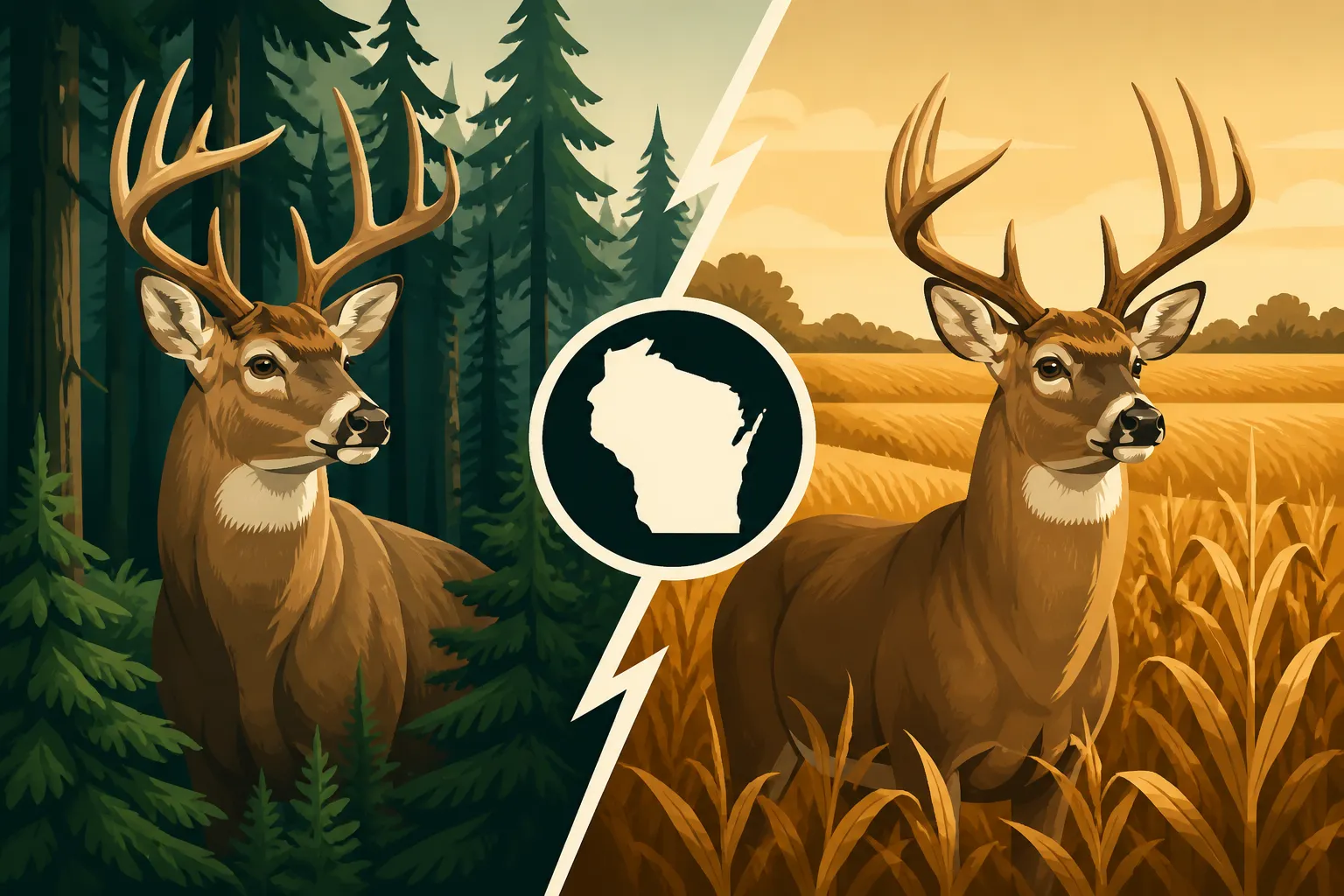
Choosing where to hunt deer in Wisconsin can feel like deciding between two entirely different worlds: the sprawling, rugged beauty of the Northern Forest or the productive, patchwork fields of the Farmland Zone. Many hunters grapple with this choice, often feeling frustrated by the sheer contrast in conditions and deer behavior. This guide will meticulously break down the unique characteristics, challenges, and rewards of pursuing whitetails in both these distinct Wisconsin landscapes, helping you understand which environment might best suit your hunting style and goals.
Understanding the Core Differences in Habitat
Wisconsin’s diverse geography means that deer hunting isn’t a one-size-fits-all endeavor. The terrain, vegetation, and human impact vary dramatically between the northern reaches and the agricultural south, fundamentally shaping the deer that live there and how we pursue them.
The Dense, Wild Northern Forest Environment
Picture this: endless acres of towering pines, thick cedar swamps, aspens in various stages of regrowth, and vast hardwood ridges. This is the heart of Wisconsin’s Northern Forest, encompassing much of the state's upper half. It’s a landscape defined by its wildness, where deer often seem like ghosts, moving silently through dense cover. This habitat is challenging, demanding, and incredibly rewarding for those who embrace its unique character.
The cover here is exceptional, offering deer boundless places to hide, bed, and travel unseen. Think about the impenetrable thickets of young conifers, the almost mythical feeling of a mature stand of hemlocks, or the crisscrossing blowdowns that create natural fortresses. These areas are not only difficult for hunters to navigate but also provide crucial thermal cover and protection from predators. Deer here rely heavily on natural browse — anything from hardwood saplings to conifer tips — for sustenance, especially when deep snow blankets the forest floor. While these forests are beautiful, they can be unforgiving, with deep snowfalls often dictating deer movement and survival. As we’ve seen in past years, severe winters can dramatically impact the herd, highlighting just how tough these deer are.
The Open, Agricultural Farmland Landscape
Now, shift your mental image to rolling hills covered in golden cornfields, neat rows of soybeans stretching to the horizon, interspersed with woodlots, creek bottoms, and hedgerows. This is Wisconsin’s Farmland Zone, predominantly found in the southern and western parts of the state, including the famous Driftless Area. It’s a landscape that screams "food source," and deer here thrive on the abundance provided by agriculture.
The open nature of farmland, while seemingly simpler, presents its own set of challenges. Deer densities are generally higher in these areas, and deer often grow larger due to the rich, year-round food supply. But don't let the "open" fool you; deer are masters of using every piece of available cover, no matter how small. A narrow woodlot, a brushy fence line, or even a standing cornfield becomes prime bedding or travel corridor. The pressure from hunters can also be more intense, especially on smaller, accessible public parcels or along the edges of private land. Hunters often find themselves navigating a complex mosaic of land ownership, making gaining access to private land a critical component of successful hunting.
Deer Behavior and Biology in Each Setting
The environment profoundly molds the deer that inhabit it. Deer in the Northern Forest behave differently than their farmland cousins, largely due to variations in food availability, population density, and predator pressure. Understanding these adaptations is key to formulating effective hunting strategies.
Northern Forest Deer: Survival and Adaptation
Deer in Wisconsin’s Northern Forest are truly creatures of resilience. Their lives are a constant testament to survival against harsh elements and predatory threats. Due to the generally lower nutritional value of natural browse compared to agricultural crops, northern bucks rarely reach the enormous body and antler sizes seen in prime farmland areas. However, what they lack in raw size, they make up for in cunning and toughness. Their home ranges tend to be smaller, particularly in winter, as they conserve energy. They become incredibly adept at using the terrain and dense cover to avoid detection. You might find them holed up in a thick cedar swamp during a blizzard, or subtly skirting a logging road through a maze of tag alders.
The rut in the north can feel a bit different, too. While still governed by light cycles, its intensity can sometimes be masked by the sheer difficulty of finding deer in the vast, dense timber. Bucks might not be as eager to chase does across wide-open spaces simply because those spaces don't exist, and energy conservation is paramount. You'll often find more sign in transition areas between bedding and feeding, or along subtle ridges that offer easier travel. It's a game of patience and deep woods tracking, rather than watching over a large alfalfa field. The persistent threat of wolves, coyotes, and even bears further sharpens their senses and reinforces their reclusive nature. Hunters often describe these deer as "wilder" and harder-earned.
Farmland Deer: Abundance and Opportunism
In contrast, farmland deer are a picture of abundance. With a year-round buffet of corn, soybeans, alfalfa, and food plots, these deer have access to high-energy, protein-rich diets that fuel impressive antler growth and body mass. It's no secret that many of the state's record-book bucks, and certainly the heaviest animals, come from these rich agricultural areas. Counties like Buffalo County have legendary status for a reason, thanks to this combination of food, terrain, and deer genetics. These deer often have larger home ranges, moving between various food sources and bedding cover, sometimes traveling significant distances overnight to feed.
The rut in farmland is often a highly visible spectacle, with bucks actively cruising field edges, pushing does, and engaging in more open sparring. This is where rattling and grunting can be particularly effective, drawing out curious or territorial bucks from the edges of cover. However, this abundance comes with a trade-off: increased human presence. Farmland deer are highly educated. They learn to avoid roads, become largely nocturnal, and use every ditch, hedgerow, and woodlot as a sanctuary. You'll often see them pouring into a cornfield at dusk, only to disappear back into heavy cover before legal shooting light the next morning. Hunting here requires a keen understanding of their movements in relation to agricultural cycles and property boundaries, as well as exceptional patience for those brief windows of daylight activity.
Hunting Strategies and Tactics for Each Zone
The distinct behaviors and habitats demand entirely different approaches from hunters. What works brilliantly in a vast northern wilderness might be completely useless, or even detrimental, in a smaller, high-pressure farmland woodlot.
Navigating the Challenges of Northern Forest Hunting
Hunting in the Northern Forest is a commitment to the wild. It often means covering significant ground on foot, being comfortable in solitude, and embracing a more traditional, "hunter-gatherer" mindset. Still-hunting is a revered tactic here, moving slowly, deliberately, and always scanning ahead, trying to pick apart the dense cover for a glimpse of hide or antler. The forest floor can be crunchy with fallen leaves, making silent movement a true art form. Many successful hunters also rely on tracking, especially after a fresh snowfall, to follow a buck's trail. This is a skill passed down through generations, requiring patience, careful observation, and the ability to interpret subtle signs.
Treestand setups tend to be in areas that funnel deer movement through thick cover, perhaps between a bedding swamp and a hardwood ridge, or along a subtle bench on a steep slope. Unlike farmland, you're often not looking over a massive expanse but rather a narrow shooting lane. Understanding how to still-hunt Wisconsin cedar swamps or identify pinch points in the vast wilderness is crucial. Cold weather sitting strategies are also paramount, as temperatures can plummet quickly, making proper layering and durable gear a necessity for a full day on stand. Long walks are the norm, so being physically prepared to hike miles into remote areas is essential. This is where a robust GPS like the GoHunt app really shines, helping you navigate and track your movements in areas with limited landmarks.
Capitalizing on Farmland Opportunities
Farmland hunting, while offering the allure of larger deer, demands a strategic, often more calculated approach. Stand placement is everything, focusing on connecting food sources (like standing cornfields or alfalfa plots) to bedding areas (thick woodlots, creek bottoms, or brushy CRP fields). Hunters spend countless hours scouting, using trail cameras to pattern individual deer movements, and carefully planning entry and exit routes to minimize disturbance. Hunting a standing cornfield in farm country requires understanding how deer use the cover it provides and anticipating their travel once it's harvested.
Due to higher hunting pressure, deer quickly become nocturnal. Therefore, targeting the first and last hours of daylight, or hunting during the peak rut when bucks are more susceptible to daylight movement, is critical. Ground blinds are very popular, offering excellent concealment along field edges or within small patches of cover, especially when combined with good brushing in. Scent control is also paramount; in these smaller, more confined hunting areas, a deer's nose can be your undoing. Successfully hunting Wisconsin farmland deer often involves adapting to the specific patterns of local deer, which can vary wildly from one farm to the next. This is where platforms like GoHunt can help by providing detailed aerial imagery and land ownership information, allowing you to identify those crucial funnels and overlooked pockets of cover on both private and public parcels.
Gear and Equipment Considerations
Your choice of hunting ground will heavily influence the gear you need to bring. What’s considered a luxury in one area might be an absolute necessity in another. Preparing for the specific conditions is key to a comfortable and successful hunt.
Essential Gear for the Northern Forest Hunter
When heading into the Northern Forest, durability, reliability, and practicality are your watchwords. You'll be walking more, likely in more rugged terrain, and facing colder, snowier conditions.
- Layered Clothing: Forget the bulky, single-layer parka. Think a robust base layer, insulating mid-layers, and a waterproof, windproof outer shell. Wool or high-quality synthetics are preferred for their ability to insulate even when wet. This is critical when you might be sitting for hours in freezing temperatures, then hiking hard, then sitting again.
- Footwear: Insulated, waterproof boots with excellent traction are non-negotiable. You'll be slogging through snow, mud, and possibly icy terrain. Consider boots with removable liners for easy drying.
- Navigation: While your phone's GPS is great, a dedicated handheld GPS unit or a fully charged phone with an app like GoHunt, downloaded maps, and a portable charger are essential. Cell service can be spotty or nonexistent in remote northern areas. Knowing how to read a compass and map is also a valuable backup skill.
- Game Retrieval: A sturdy deer sled is a lifesaver once you've made a kill. Dragging a deer through deep snow and thick brush for miles is an exhausting endeavor, and a sled makes it significantly easier.
- Optics: While long-range glass isn't as critical, a good pair of 8x or 10x binoculars with excellent low-light performance will help you pick apart dense cover.
- Weapon: Reliability in cold, wet conditions is key. Rifles, especially those chambered in common calibers like .30-06 or .308, are popular choices for their range and knockdown power, though muzzleloaders are also common during their specific season. Ensuring your rifle is zeroed for realistic timber ranges, perhaps 100-150 yards, is more important than worrying about extreme long shots.
Key Equipment for the Farmland Hunter
Farmland hunting often requires a different set of specialized tools, focused on stealth, observation, and maximizing brief opportunities.
- High-Quality Optics: With more open spaces, good binoculars (10×42 or even 12×50) are crucial for scanning distant fields and woodlot edges. A reliable rangefinder is also vital for accurately judging distances across varied terrain.
- Scent Control: Deer here are masters of avoiding human scent. Scent-control clothing, sprays, and strategic wind-checking are non-negotiable. Playing the wind correctly is paramount when setting up on a field edge.
- Calls and Decoys: Rattling antlers, grunt tubes, and doe bleat calls can be highly effective during the rut in farmland areas. Decoys, particularly a lone buck or doe, can sometimes draw in a dominant buck or curious young deer, especially if used strategically in open fields during the pre-rut or peak rut.
- Ground Blinds: As mentioned, ground blinds offer excellent concealment along field edges or within sparse cover, allowing for more movement and comfort during long sits. They need to be brushed in effectively to blend with the surroundings.
- Trail Cameras: For patterning deer movement around agricultural fields and specific bottlenecks, trail cameras are invaluable. They help identify nocturnal habits and pinpoint exactly when and where deer are moving.
- Portable Stands: Lightweight climbing sticks and hang-on stands are popular for their versatility, allowing hunters to adapt to changing deer patterns or crop rotations. Tree saddles are also gaining popularity for their portability and minimal impact.
The Social and Ethical Considerations
Beyond the practicalities of habitat and gear, hunting in Wisconsin involves a deep responsibility to the land, wildlife, and fellow outdoor enthusiasts. The social dynamics and ethical considerations shift subtly depending on whether you're in the remote north or the more populated farmland.
Respecting the Land and Other Hunters in the North
Hunting in the Northern Forest often means immersing yourself in vast tracts of public land, such as the Chequamegon-Nicolet National Forest or numerous county forests. This comes with a particular set of unwritten rules and expectations.
- Public Land Etiquette: The sheer size of these areas usually means less direct competition with other hunters, but respecting personal space is still vital. If you find a vehicle parked at your intended starting point, consider moving to another spot. The north has enough room for everyone.
- Minimal Impact: Practice Leave No Trace principles. Pack out everything you pack in, and perhaps a little extra. Avoid leaving trash, spent casings, or any signs of your presence. This remote wilderness demands our respect.
- Sustainable Harvest: While deer densities might be lower, ethical harvesting means being selective when appropriate and always prioritizing a clean, humane kill. Understanding the challenges and realities of the deer population helps manage expectations.
- Sharing the Resource: Be mindful that many others use these forests for hiking, camping, birdwatching, and other activities. Be visible, be courteous, and represent hunters in a positive light. The "Hunting Pressure on Wisconsin Public Land" is a real factor, and being respectful helps everyone.
Navigating Private Land and Community in Farmland
Farmland hunting, while often associated with higher deer numbers, carries a heavier social load, primarily due to the prevalence of private property and denser human populations.
- Gaining Permission: This is perhaps the biggest hurdle for farmland hunters. Building relationships with landowners, asking permission well in advance, and offering to help with chores are all essential. Remember, you are a guest on their land, and their rules must be respected implicitly. Never trespass.
- Property Boundaries: With smaller parcels and more clear-cut boundaries, knowing exactly where you can and cannot hunt is crucial. Use land ownership maps (like those offered by GoHunt) and be absolutely certain of your location at all times. Mistakes can lead to serious consequences and damage your reputation, and that of hunters in general.
- Community Relations: Farmland areas are communities. Be polite, considerate, and visible. Don't block farm access roads, drive too fast on rural roads, or leave gates open. A positive relationship with the local community is invaluable.
- Chronic Wasting Disease (CWD): Many of Wisconsin's farmland counties are within the CWD endemic area. Hunters here have a critical role to play in monitoring the disease by participating in CWD sampling efforts. Understanding which Wisconsin counties have CWD and following carcass transport rules is not just a legal obligation, but an ethical one for the health of the herd. This includes being responsible about baiting and feeding restrictions, which are often tied directly to CWD prevalence.
Making Your Choice: Which Zone is Right for You?
So, after diving deep into the nuances, how do you decide between the vastness of the Northern Forest and the bounty of the Farmland Zone? It really boils down to your personal hunting philosophy, desired experience, and what you’re willing to put into the hunt.
Weighing the Pros and Cons of Each Experience
Let’s lay it out clearly to help you make an informed decision:
| Feature | Northern Forest Hunting | Farmland Zone Hunting |
|---|---|---|
| Deer Density | Generally lower, harder to find | Higher, often concentrated around food sources |
| Deer Size | Typically smaller body/antlers, but exceptionally wild | Often larger body/antlers due to rich diet, but highly pressured |
| Habitat | Vast, dense woods, swamps, rugged terrain | Mix of agriculture, woodlots, hedgerows, creek bottoms |
| Hunting Style | Still-hunting, tracking, long walks, patience, solitude | Stand hunting, patterning, scent control, strategic movement, access focus |
| Physical Demand | Higher, covering more ground, tougher terrain | Moderate, often shorter walks, but requires more stealth |
| Pressure | Lower overall, but can find pockets of activity | Higher, deer more nocturnal and wary |
| Access | Abundant public land, relatively easy access | Predominantly private land, requires landowner permission |
| Challenge | Finding deer in vastness, harsh weather, endurance | Outsmarting wary deer, managing pressure, securing access |
| Gear Focus | Durability, navigation, cold weather, game retrieval | Optics, scent control, trail cameras, specialized calls, stealth |
| Reward | Sense of accomplishment, true wilderness experience | Potential for larger deer, consistent sightings, understanding agriculture |
If you relish solitude, physical challenge, and the satisfaction of earning a deer through skill and perseverance in an untamed environment, then the Northern Forest might be your ideal. If you're drawn to the prospect of bigger bucks, enjoy the strategic game of patterning deer movements, and are willing to put in the effort to gain private land access or meticulously scout public fringes, then the Farmland Zone could be your preferred playground.
Blending Strategies for a Well-Rounded Season
The beauty of hunting in Wisconsin is that you don't necessarily have to choose just one. Many seasoned hunters combine strategies, taking advantage of both environments throughout the season. Perhaps you start your Wisconsin's long archery season in the farmland, hoping to catch an early-season buck moving to and from agricultural fields. Then, as the weather turns colder and the rut kicks in, you might shift your focus to a remote northern block during Wisconsin's nine-day gun deer season, embracing the challenge of a true wilderness hunt.
Consider scouting both types of land before the season even begins. Use tools like the GoHunt app to explore potential public lands in both zones, identifying pinch points in the north or overlooked woodlots in the farmland. This way, you can remain flexible and adapt your plans based on weather conditions, deer activity, and hunting pressure. A well-rounded Wisconsin hunter understands that each landscape offers unique lessons and rewards, contributing to a richer, more diverse hunting experience throughout the year.
Ultimately, whether you choose the quiet depths of the northern woods or the rich bounty of the southern farms, Wisconsin offers incredible opportunities for deer hunters. It’s about understanding the land, respecting the animals, and finding your own rhythm in the wild.
Disclaimer
Hunting is an inherently risky activity. Always prioritize safety, follow all Wisconsin Department of Natural Resources (DNR) regulations, and ensure you have the appropriate licenses and tags. Conditions can change rapidly, especially in wild environments, so always be prepared for the unexpected.