Hanging a Stand in a Wisconsin Coulee
Hunting the steep, broken terrain of a Wisconsin coulee can be both incredibly rewarding and intensely frustrating. The challenge isn't just the physical exertion of climbing those hills; it's the bewildering dance of wind, thermals, and deer movement that makes finding the perfect stand location feel like solving a complex puzzle. This guide will meticulously break down the art and science of hanging a deer stand in Wisconsin's coulee country, helping you unlock the secrets to consistent success in these unique landscapes.
Understanding the Coulee's Unique Challenges
Before you even think about hoisting a stand into a tree, you need to deeply understand the environment you're stepping into. Coulees aren't just hills; they're a dynamic system where every fold and feature plays a role in how deer live and move.
Reading the Topography and Deer Movement
Deer in coulees operate on a different set of rules than their flatland cousins. They exploit every contour, every bench, and every subtle change in elevation to their advantage. Imagine a buck traversing a steep hillside; he’s not going straight up and down unless he has to. Instead, he's likely following a bench, a subtle flat area that wraps around the side of the hill, making travel easier and offering an elevated vantage point. These benches often serve as highways, especially during the rut when bucks are cruising for does.
Understanding where deer bed in a coulee is also paramount. Often, mature bucks will bed just below a ridge top on a leeward slope (sheltered from the wind), giving them the ability to scent check above them while having a visual of anything approaching from below. They might also utilize thick cedar swamps or brushy pockets lower in the coulee, particularly during periods of high pressure or extreme weather. Travel corridors, those invisible deer trails that are worn paths on the forest floor, frequently run along the bottoms of coulees, offering cover and ease of travel. Don't overlook the significance of crossings, where deer habitually move from one side of a coulee to another, often at the narrowest points or where the slopes are less severe. These specific details are critical for effective stand placement.
Wind and Thermals: Your Biggest Obstacle
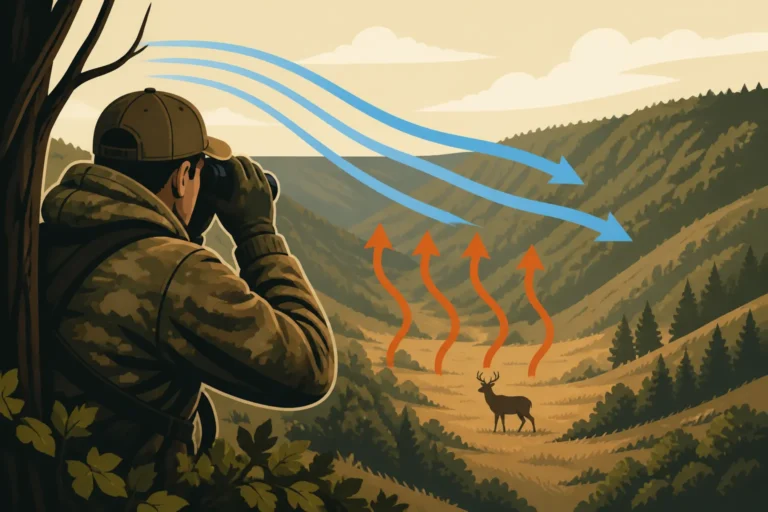
If there’s one thing that will humble a coulee hunter, it’s the wind and thermals. Unlike relatively flat ground where wind direction might be fairly consistent, a coulee creates a dynamic air current that can swirl and eddy like water in a rapid. In the mornings, as the sun warms the valley floor, thermals begin to rise, carrying your scent uphill. Conversely, in the evenings, as the air cools, thermals reverse and start to fall, pulling your scent down into the coulee bottom. This constant shift means that a stand location that's perfect in the morning might be a disaster by afternoon.
The challenge is further compounded by the "canyon effect," where wind can be funneled directly up or down the coulee, or even crossways in unpredictable gusts. You might feel a steady breeze at your stand, but a few hundred yards away, your scent could be swirling in every direction. This makes it crucial to not only know the forecasted wind direction but to understand how that wind interacts with the specific topography of your chosen coulee. It often means having multiple stand options for different wind conditions or employing a strategy that mitigates scent as much as possible. Really digging into the science of Wind and Thermals in a Coulee can be a game-changer for your hunting strategy.
Access and Stealth on Steep Terrain
Getting to your stand in a coulee undetected is half the battle. These steep hillsides are often covered in noisy leaves, dry sticks, and loose rocks, making a quiet approach difficult. The last thing you want is to crunch your way up a ridge, silhouetted against the sky, announcing your presence to every deer within a quarter-mile. This is where meticulous planning for your entry and exit routes becomes non-negotiable.
Think about using natural depressions, creek beds, or the very bottoms of coulees for your approach, as these often provide natural cover and absorb sound better. Always try to approach with the wind and thermals in your favor, so any noise or lingering scent is carried away from bedding areas or travel corridors. Avoiding "skylining," or walking along a ridge top where your silhouette is easily visible, is paramount. If you must cross a ridge, do so quickly and efficiently, preferably during low light when your profile is less obvious. The effort you put into a stealthy approach directly impacts your success, and nowhere is this more true than in the demanding terrain of a coulee.
Strategic Stand Placement Within the Coulee
Once you’ve got a handle on the coulee's unique dynamics, it's time to translate that knowledge into smart stand placement. This isn't just about finding any tree; it's about finding the right tree that capitalizes on deer behavior and mitigates the environmental challenges.
Targeting Travel Corridors and Funnels
Deer are creatures of habit, and in coulee country, those habits are often dictated by the easiest path of travel. Look for natural funnels – places where the topography forces deer into a narrow strip of land. This could be a saddle connecting two ridges, a pinch point where a steep bluff pushes deer towards a specific crossing, or even a logging road that creates an easy path through otherwise rugged terrain. Creek bottoms, especially those with some cover, often act as deer highways, particularly at night or during the rut when bucks are on the move.
The key is to identify these high-traffic areas and place your stand where you can intercept deer movement without being detected. Sometimes, a subtle bench on a steep slope can be a major travel route. Learning to spot these subtle trails, often indicated by worn earth or tracks, takes practice. Consider where deer might move between bedding and feeding areas. During scouting, I often use mapping tools like GoHunt to analyze contours and identify potential funnels before I even step foot in the woods. This initial digital reconnaissance can save you countless hours of hiking. A deep dive into Reading a Ridge Point for Deer Movement will further refine your understanding of these critical travel paths.
Elevated vs. Ground-Level: When to Choose Which
The choice between a treestand and a ground blind in a coulee depends heavily on the specific situation. Treestands offer a significant advantage by getting your scent off the ground and providing a wider field of view over the undulating terrain. They are often the preferred choice when you can find a suitable tree along a travel corridor or overlooking a feeding area on a bench. Elevated positions also allow you to see down into the coulee or across a valley, giving you more time to react to approaching deer. However, hanging a treestand can be more labor-intensive and might require significant tree trimming for shooting lanes, which can leave a lasting impact. When considering Treestand Setups in Wisconsin Hardwoods, you'll find that coulees often present some challenging tree choices due to the terrain.
Ground blinds, on the other hand, offer unparalleled concealment and comfort, especially in areas where suitable trees are scarce or too small to hang a stand safely. They are excellent for quick, temporary setups or when hunting with a crossbow or shotgun in areas with dense cover. They also allow for more forgiving shot angles if deer pass close. However, ground blinds keep your scent closer to the ground, making careful wind management even more critical. You also lose the elevation advantage for spotting deer from a distance. For some situations, especially on public land where permanent stands aren't allowed or if you need to adapt to a specific scenario, a well-placed and brushed-in ground blind can be incredibly effective. Consider the article on Using a Ground Blind on Wisconsin Public Land for more insights into this tactic.
Playing the Wind and Thermals for Your Advantage
Since wind and thermals are such dominant factors in coulee hunting, your stand placement must directly account for them. This often means having a primary stand location for a particular wind and a backup or two for different conditions. For morning hunts, consider setting up high on a ridge or just below the crest, with an approach that keeps you above the rising thermals. As the sun comes up, your scent will be carried upward and over the coulee, away from deer still in the bottoms.
Conversely, for evening hunts, a stand positioned lower in the coulee, perhaps along a creek bottom or a feeding bench, can be highly effective. The falling thermals will pull your scent downhill, over your position, and into the valley floor, keeping it away from deer moving along the mid-slopes or benches above you. Always check the prevailing wind, but then add the "thermal factor" to your decision. A good rule of thumb is to allow your scent to blow into an area you don't expect deer to be using at that time, or into open ground where deer are less likely to travel. Learning to combine topography with weather forecasts is essential for mastering hunting in Hunting Wisconsin Coulees and Ridge Tops.
The Practicalities of Hanging Your Stand
Once you've identified your ideal stand locations based on deer movement, wind, and thermals, it's time for the physical work of getting that stand up there. This isn't just brute force; it's about smart choices and meticulous execution.
Choosing the Right Tree and Stand Type
Selecting the right tree for your stand is crucial for both safety and effectiveness. Look for a sturdy, healthy tree with a straight trunk that offers good cover from the deer's line of sight. Oaks, maples, and even some pines can work well, depending on the area. Avoid dead or diseased trees at all costs. The tree's diameter should be appropriate for your stand's attachment system. If you're using a hang-on, ensure there are branches or other trees nearby to break up your outline. For climbers, a completely straight trunk free of large limbs is paramount.
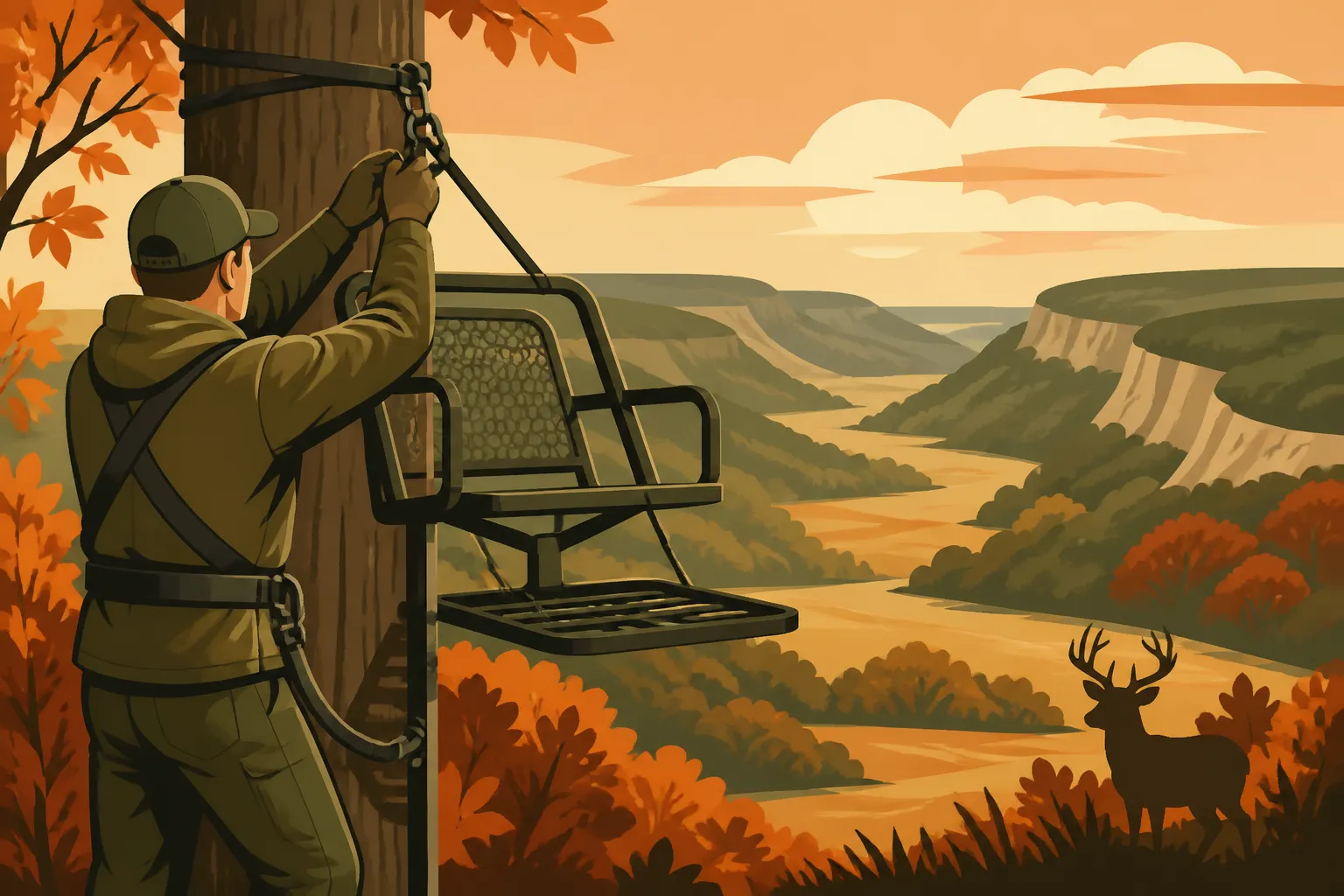
When it comes to stand types, hang-on stands are incredibly versatile for coulee hunting, as they can be used in a wider variety of trees than climbers. They're often paired with climbing sticks or a climbing aid like a Treehopper for quiet, efficient ascent. Saddle hunting, while having a steeper learning curve, is gaining popularity for its ultimate mobility and the ability to hunt nearly any tree safely and quietly, allowing hunters to adapt quickly to changing conditions. Before you commit to a purchase, research different brands and read reviews—GoHunt is a great resource for comparing gear and finding what fits your hunting style and budget best. Don't forget to factor in how easy the stand is to carry up and down those steep coulee hills.
Safety First: Gear and Best Practices
I cannot stress this enough: your life depends on proper safety practices when hanging and hunting from a stand. Always, and I mean always, wear a full-body safety harness. It should be worn from the moment your feet leave the ground until they are firmly back on solid earth. A lineman's belt is indispensable for safely securing yourself to the tree while you're actually putting up climbing sticks and the stand itself. A quality lifeline that runs from the base of the tree up to your stand platform allows you to remain tethered at all times while ascending and descending.
Before each season, thoroughly inspect all your climbing sticks, stand, and harness for any signs of wear, cracks, or damage. Check straps, buckles, and ropes meticulously. If anything looks questionable, replace it. When hanging a stand, it's always best to have a buddy with you, especially in rugged coulee terrain where a fall could mean a long, difficult rescue. Clear shooting lanes before the season, if possible, to minimize disturbance closer to opening day. Remember, no deer is worth a broken bone or worse.
Minimizing Your Impact and Scent
Deer are incredibly sensitive, and disturbing their environment, even slightly, can make them wary of your stand location. When hanging your stand, aim to be as quiet and efficient as possible. Plan your trim cuts carefully, only removing branches that absolutely interfere with your shot or access. Use hand saws or pruners instead of noisy battery-powered tools when possible. Collect and carry out all trimmed branches; don't leave a pile of fresh cuttings at the base of your tree.
Scent control is also paramount. Wear clean clothes, preferably those dedicated only to hunting, and use scent-eliminating sprays on yourself and your gear. Avoid walking through areas where you know deer frequent on your way to and from your stand site. Consider bringing in your stand a few days or even weeks before you plan to hunt it, allowing any lingering human scent to dissipate. Regularly checking weather patterns and deer movement on GoHunt's detailed maps can help you plan your excursions to minimize disturbances. Every little detail matters when you're trying to outsmart a mature buck.
Post-Setup and Ongoing Management
Hanging the stand is just the beginning. Effective coulee hunting requires ongoing management, adaptation, and a keen eye for how deer use the landscape throughout the season.
Access Routes and Entry/Exit Strategies
A beautifully hung stand is useless if your approach scares away every deer in the county. Your entry and exit routes are just as important as the stand's location itself. In coulees, this often means using topography to your advantage. Try to identify deep ditches, creek beds, or even thick fencelines that offer concealed pathways to your stand. Plan your route so that the wind and thermals are carrying your scent away from bedding areas and active travel corridors during your approach. For example, if you're hunting an evening thermal drop, approach from the ridge top, staying high and letting the rising morning thermals carry your scent away. Then, as evening sets in and thermals fall, your scent will be pulled into the valley below your stand, which deer have likely already vacated for feeding.
Always consider the easiest and quietest path, even if it means walking a little further. Utilizing old logging roads or field edges for part of your journey can reduce noise. When you get close to your stand, slow down and be hyper-vigilant. After your hunt, use a different exit route if it helps keep you out of prime deer areas. Understanding Entry Routes on Steep Driftless Ground offers specific tactics that apply perfectly to coulee country.
Seasonal Adjustments and Adaptations
Deer behavior in coulees isn't static; it shifts dramatically throughout the season, driven by food availability, breeding cycles, and hunting pressure. In the early archery season, deer are often predictable, moving between bedding areas and green food sources like alfalfa or acorns if they're dropping. Your stands should reflect this, focusing on hidden pockets of preferred forage or travel routes between them. As the season progresses into late October and November, the rut kicks in, and deer patterns change entirely. Bucks become more transient, cruising saddles, ridge tops, and benches, searching for does. This is when your strategically placed funnels and travel corridor stands truly shine. Understanding Hunting the Wisconsin Rut in November is crucial for adapting your strategy.
During the late season, after the rut, deer revert to prioritizing food and cover, especially with colder temperatures and snow. Focus on remaining food sources, like standing cornfields near coulees, brassicas, or even cut bean fields where deer might be pawing for leftovers. Sometimes, a subtle south-facing slope that gets more sun can hold deer seeking warmth. Having flexible stand setups or the willingness to move can greatly improve your odds during these shifting phases. Consulting GoHunt for current conditions and deer reports can help inform these seasonal shifts.
Hunting Pressure and Stand Relocation
Wisconsin's coulee country, especially public land, can see significant hunting pressure, particularly during the gun deer season. Deer are highly adaptive, and they quickly learn to avoid areas where they've been pressured. If your stand spot stops producing, or if you notice fresh boot tracks near your setup, it might be time to move. Don't be afraid to pull a stand and relocate it to a fresh area, especially if you’ve scouted out multiple potential spots. Sometimes, simply moving a stand 100 yards can make all the difference, putting you in a new line of sight and scent cone.
Consider hunting during the week or later in the season when pressure tends to drop. Be prepared to hike deeper into the coulees than most other hunters are willing to go. Often, the biggest bucks will find sanctuary in the thickest, nastiest, most difficult-to-access areas. A good strategy includes thorough Scouting Wisconsin Public Land Before Season to identify these overlooked havens. Having a mobile setup, whether it's a lightweight hang-on or a saddle system, allows you to be nimble and react to pressure. The ability to adapt and relocate is often the hallmark of a consistently successful coulee hunter.
| Coulee Hunting Phase | Primary Deer Focus | Ideal Stand Location | Wind/Thermal Strategy |
|---|---|---|---|
| Early Season | Food (Acorns, Alfalfa, Browse) & Bedding | Near active food sources, subtle benches leading to food, creek bottoms | Prioritize morning rising thermals (stand high), evening falling thermals (stand lower) |
| Pre-Rut/Rut | Breeding, cruising for does, scrapes, rubs | Saddles, pinch points, ridge points, travel corridors between bedding/feeding | Crosswinds along travel routes, consider multiple stands for varying conditions |
| Late Season | Calorie-rich food, thermal cover, warmth | Standing corn, brassicas, south-facing slopes, thick cedar swamps | Focus on evening falling thermals near food, morning thermals rising from cover |
Disclaimer
Please ensure you are familiar with and adhere to all current Wisconsin hunting regulations, safety guidelines, and land access rules before embarking on any hunting activity. Hunting is an inherently risky activity, and personal safety should always be your top priority.