Layout Blinds for Wisconsin Cut Corn
There's nothing quite as frustrating as meticulously setting up a spread of decoys in a promising cut cornfield, only to have a flock of wary geese or ducks flare at the last moment, their keen eyesight picking out the unnatural lump of your traditional blind. It’s a common scenario for many Wisconsin waterfowl hunters, leaving you wondering how to truly disappear into the landscape. This guide will walk you through the essential role of layout blinds in field hunting, helping you understand their advantages, how to choose the right one, and how to effectively deploy them to become virtually invisible in those wide-open spaces.
The Frustration of Field Hunting Without Cover
We’ve all been there. You scouted the perfect cut cornfield, watched the birds fly into it like clockwork, and felt that surge of excitement. Then, on hunt day, you tried to make do with a few cornstalk bundles or a makeshift panel blind. The result? Birds circling high, maybe dipping a wing in curiosity, but ultimately veering off well outside of range. It’s disheartening, and it makes you question if field hunting is even worth the effort in some of Wisconsin’s more pressured areas. The simple truth is, waterfowl are incredibly smart, and they've learned to spot anything out of place.
Why Birds Flare to Traditional Blinds
Imagine you're a Canada goose, soaring hundreds of feet above a patchwork of Wisconsin farmland. From that vantage point, everything looks flat and uniform. Then, suddenly, a dark blob or an upright structure appears, sticking out like a sore thumb against the stubble. That's what a traditional A-frame blind or even a poorly concealed panel blind looks like to them. It creates a stark, unnatural silhouette against the horizon, especially in the low light of dawn or dusk when birds are most active. They see the shape, they recognize the threat, and they flare, often letting out a warning honk for good measure. This isn't just a hunch; it's a behavior honed by generations of evading predators and hunters. They learn quickly.
Even if you go to great lengths to brush in a standing blind, the sheer height and bulk of it can be a giveaway. In a flat, open field, there's no natural feature that offers that kind of vertical concealment, except maybe a distant treeline or a silo. When you attempt to replicate that in the middle of a cut cornfield, it just doesn't look right. The shadows it casts, the way the light hits it differently than the surrounding ground – these are all signals to wary birds that something is amiss. They've seen it before, they've been shot at from similar setups, and their survival instincts kick in instantly.
The Deceptive Nature of "Good" Natural Cover
Sometimes, you find a patch of slightly taller stubble, a ditch bank, or a leftover round bale in a field and think, "This is perfect! I can hide here." While these spots might offer some initial visual break-up, they often fall short in practice. The problem is that while you might feel hidden at eye level, the birds are approaching from above, scanning the entire field from a completely different perspective. What looks like great cover to you on the ground might still present an elevated, human-shaped mass to a flock of incoming birds.
Furthermore, relying on existing natural cover can severely limit your setup options. You might be forced to set up in a location that isn't ideal for wind direction, decoy spread visibility, or sun position, just because that's where the best "natural" cover happened to be. This compromises your entire hunt before it even begins. You want to be where the birds want to be, and where you can present the most convincing decoy spread, not just where you can find a few scraps of concealment. This is especially true when hunting pressured birds in areas like the southern Wisconsin farmland, where waterfowl have countless options and quickly learn to avoid anything suspicious.
Understanding Layout Blinds: Your Ultimate Low-Profile Advantage
This is where the magic of a layout blind truly shines. Instead of trying to blend an upright structure into a flat landscape, you become part of the landscape itself. Layout blinds allow you to lie down, nearly invisible, until the precise moment you need to spring into action. It's a game-changer for field hunting, and once you try it, you'll wonder how you ever hunted cut corn without one.
What Exactly is a Layout Blind?
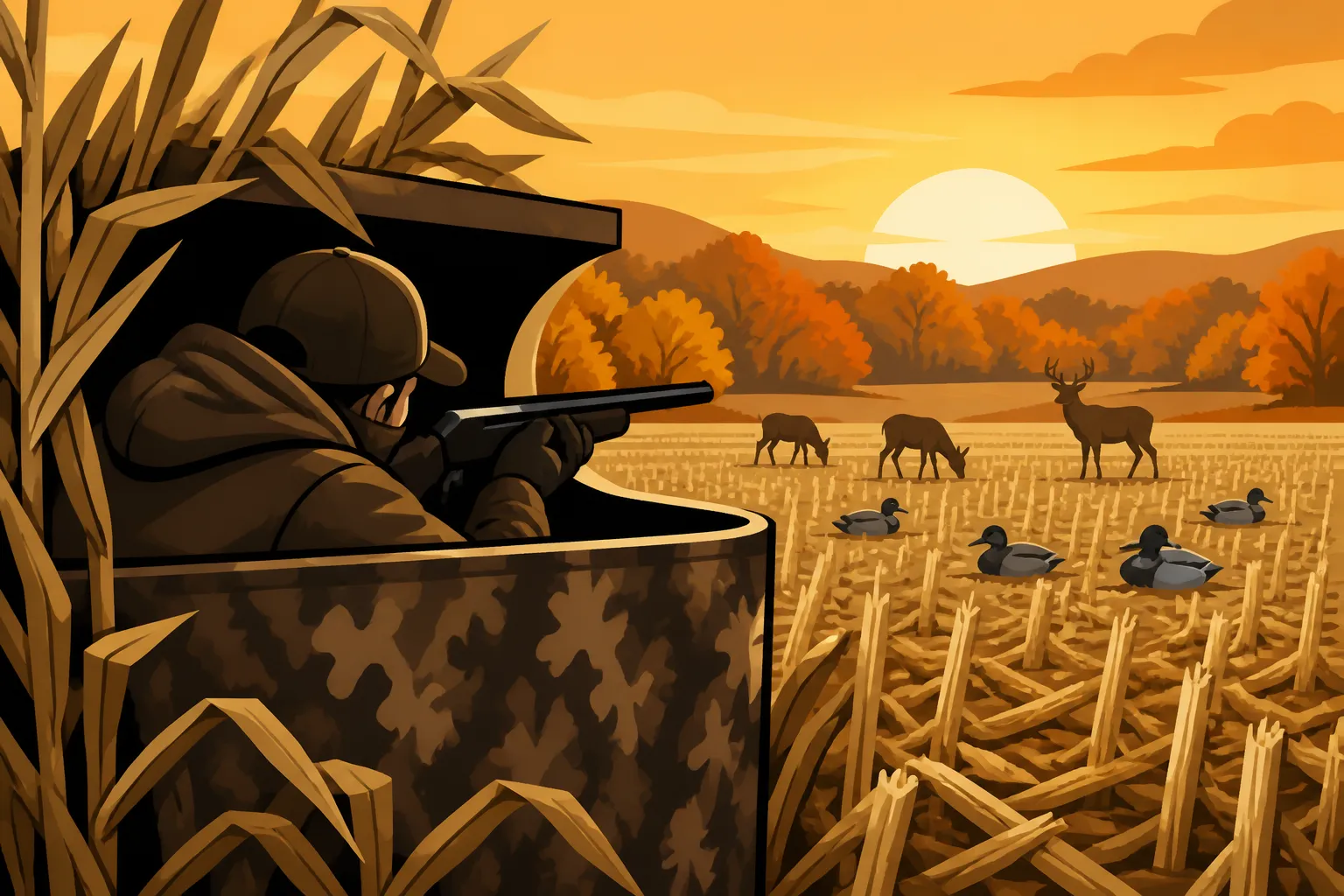
At its core, a layout blind is a low-profile, coffin-like structure designed for a hunter to lie down in, completely concealed from overhead observation. It typically consists of a lightweight frame, often aluminum or fiberglass, covered with a durable, weather-resistant fabric shell. The hunter enters through a rear opening, lies on their back, and then pulls a front flap or lid down, effectively closing themselves inside. When birds are in range and the shot opportunity arises, the hunter pushes up on the lid, which usually springs open, allowing them to sit up quickly and shoot.
These blinds are engineered for stealth and comfort in harsh environments. Most modern layout blinds incorporate stubble straps or loops on the exterior, allowing hunters to easily attach local vegetation like cornstalks, grass, or weeds. This "brushing in" process is critical, as it breaks up the blind's outline and helps it truly disappear into the field. Think of it as wearing camouflage, but for your entire hunting position. You become a part of the field, not an anomaly on it.
Many models also feature comfortable padded seats or backrests, which is a huge bonus when you're lying flat for hours in a cold Wisconsin field. They're designed to be highly portable, often folding flat or rolling up to be carried on your back or pulled on a sled. This portability means you aren't tied to a single location and can adapt to changing bird movements or wind conditions, which is essential for success in diverse regions, from the fields near Horicon Marsh Waterfowl Hunting Rules to the more expansive agricultural areas.
Key Features to Look for in a Wisconsin Layout Blind
Choosing the right layout blind for Wisconsin conditions involves considering several factors beyond just color. You need a blind that can withstand the cold, mud, and sometimes wet snow, while still offering superior concealment and comfort.
- Durability and Weather Resistance: Look for heavy-duty, waterproof or water-resistant fabric like 600D polyester. Wisconsin weather can turn on a dime, especially during the waterfowl seasons. You don't want to be soaking wet after an hour in a damp field. Reinforced stitching and a robust frame are also critical for longevity. Imagine pulling your blind through muddy stubble – it needs to hold up.
- Comfort and Insulation: Since you'll be lying flat for extended periods, comfort is paramount. A thick padded bottom or an integrated seat is a huge plus. Some blinds even have a padded headrest. Consider blinds with an insulated floor or a layer designed to keep the cold ground from sapping your body heat. Staying warm means staying focused.
- Concealment Features: Stubble straps are non-negotiable. The more, the better, allowing you to attach ample natural vegetation. Some blinds also have mesh face screens for observation, letting you see out without birds seeing your face, and flagging ports to work your calls or flags without revealing yourself prematurely. When you’re hunting Field Hunting Geese in Southern Wisconsin, being truly hidden can be the difference between limits and empty bags.
- Portability: While most layout blinds are designed to be portable, some are lighter or fold more compactly than others. If you frequently hike into fields or navigate tricky terrain, a lighter blind with comfortable backpack straps will be a lifesaver. Look for easy setup and takedown mechanisms too.
- Size and Profile: Consider the space inside and out. Do you have enough room to comfortably operate your gun, calls, and retrieve shells? How low is its profile once brushed in? A lower profile generally means better concealment. However, it should still offer enough head and shoulder room to sit up and shoot safely and comfortably.
| Feature | Description | Benefit for Wisconsin Hunter |
|---|---|---|
| Durable Fabric | Heavy-duty, water-resistant material (e.g., 600D polyester) | Withstands mud, stubble, snow, and rain; longer lifespan in tough conditions. |
| Stubble Straps | Loops or elastic bands on the exterior for attaching natural vegetation | Essential for breaking up silhouette and blending seamlessly with cut corn or grass. |
| Padded Seat/Floor | Integrated cushioning or insulation in the bottom of the blind | Increased comfort for long waits; helps insulate from cold, damp ground. |
| Flagging Ports | Small, accessible openings on the sides for using flags | Allows for realistic flagging motion to attract birds without revealing the hunter's position. |
| Mesh Face Screen | See-through mesh panel in the lid for observation | Provides clear view of approaching birds while keeping the hunter's face fully concealed. |
| Low Profile Design | Minimal height when deployed | Maximizes concealment against the flat horizon of open fields; less likely to spook wary birds. |
| Portability | Lightweight frame, backpack straps, or compact folding design | Easy to transport to remote fields; allows for quick adjustments to changing bird patterns. |
Strategies for Effective Layout Blind Deployment in Cut Corn
Having the best layout blind won't do you any good if you don't know how to use it effectively. It's not just about lying down; it's about becoming part of the field, understanding bird behavior, and integrating your blind into a convincing setup. The whole point is to lure those birds close, and that requires careful planning and execution.
Scouting is Non-Negotiable
Just like with any successful hunt, scouting is absolutely paramount for layout blind success in cut corn. You need to know exactly where the birds want to be. This means observing their flight paths, feeding patterns, and entry/exit points from roosts to feeding areas. Pay attention to the specific fields they're hitting, and often, the exact corner or section of that field. You can use mapping apps, like what you find on GoHunt, to mark these locations precisely and note access points. The more information you gather, the better your chances of intercepting them.
When scouting, look for natural depressions or slight rises in the field that can further aid in hiding your blind. A small swale might only be a few inches deep, but those few inches can make a huge difference in breaking up your profile. Note the prevailing wind direction on the days the birds are using the field. This will influence your decoy spread and where you position your blinds relative to the landing zone. Also, consider the sun's position – you want the sun at your back, if possible, to put glare in the birds' eyes and make it harder for them to see into your spread. This kind of detailed reconnaissance is crucial for Reading Roost-to-Field Flight Lines.
Don't just scout from your truck; get out and walk the field, preferably at the same time of day you plan to hunt. See the field from a goose's perspective, or at least from the ground level where your blind will sit. Are there power lines, fence rows, or distant structures that might look suspicious from above? Take mental notes, or even photos, to plan your concealment and decoy placement. Understanding these nuances is what separates a good hunt from a great one.
Camouflage, Decoys, and Spacing
Once you’ve identified your ideal spot, the real work begins: brushing in your layout blind. This isn't just tossing a few stalks on top; it's about meticulously covering every bit of the blind's fabric so it vanishes into the surrounding field. Gather cornstalks, stubble, weeds, and anything else native to that specific field. Pay close attention to the edges of the blind where it meets the ground, ensuring there's no harsh line or shadow. The goal is to make it look like a natural, random clump of field debris. Some hunters even throw a handful of dirt on top to dull the fabric's sheen.
Your decoy spread is the other half of the equation. Layout blinds allow you to place your decoys much closer to your actual hunting position, creating a more convincing kill hole right in front of you. Consider using a mix of full-body and shell decoys, depending on what the birds are reacting to. Create a natural-looking "J" or "U" pattern with an open landing zone directly in front of your blinds, downwind. The specific type and number of decoys will vary depending on the target species – whether you're after Canada geese or ducks. Referencing guides on Decoy Spreads for Wisconsin Divers can provide excellent strategies, even if you’re primarily targeting geese in a field.
If hunting with multiple people, proper spacing of layout blinds is important. Keep them close enough for communication and safety, but far enough apart to maximize the spread of your shot and reduce the chance of multiple hunters flaring birds at once. Generally, 10-15 yards between blinds is a good starting point, allowing for individual hunter movement and ample shooting lanes. Make sure all blinds are brushed in equally well; one poorly concealed blind can ruin the hunt for everyone.
Weather Considerations and Comfort
Wisconsin's waterfowl season can bring everything from mild, sunny autumn days to biting cold, driving snow, and freezing rain. Your layout blind needs to perform in all of it. On cold days, an insulated blind combined with proper layering is crucial. Use a good quality base layer, a warm mid-layer, and a waterproof, windproof outer shell. Bring hand warmers and a hot thermos of coffee or soup. Remember, you're lying on the ground, so cold can penetrate quickly.
On wet days, ensure your blind's fabric is truly waterproof. A leaking blind will quickly turn a miserable hunt. You might even consider placing a tarp or ground cloth under your blind for an extra layer of protection against ground moisture. Mud is also a factor, so having a blind that's easy to clean is a huge benefit. Many hunters use their GoHunt app to check detailed weather forecasts, including wind speed and direction, which can dictate blind placement and brushing material.
Wind can also affect how you brush in your blind. Strong gusts can blow off loose vegetation, so make sure your stubble is securely woven into the straps. On particularly windy days, consider setting up with a slight crosswind rather than a direct headwind to help cushion the blind from gusts and make it easier for birds to cup their wings and land. Comfort might seem like a luxury, but being warm and dry means you can stay out longer and remain focused, which directly translates to more opportunities.
Maximizing Your Success with Layout Blinds
While the blind itself provides the physical concealment, maximizing your success truly comes down to understanding the nuances of the hunt and practicing your technique. It’s about becoming one with the environment and anticipating the birds’ moves.
Hunting Safety and Communication
Safety is always paramount in any hunting scenario, and layout blind hunting is no exception. With multiple hunters lying low, communication is vital. Establish clear shooting zones and verbal commands beforehand. Who calls the shot? What's the signal to sit up? Typically, one person acts as the caller and shotgunner, signaling when to rise and shoot. Always be aware of where other hunters are located and never swing your gun in their direction. Knowing the legal shooting hours in Wisconsin is also crucial for safe and ethical hunting.
When it's time to rise, do so smoothly and efficiently. A sudden, jerky movement can still spook birds, even if they're committed. Practice getting into and out of your blind with your loaded gun, ensuring there's no snagging or fumbling. This practice also helps you identify any potential hazards or uncomfortable positions before you're in the heat of the moment. Many hunters attach a small lanyard to their blind door so they can quickly grab it and open the lid, minimizing any hesitation.
Furthermore, always wear appropriate blaze orange or fluorescent pink when walking to and from your blind in areas where it's required, especially during Wisconsin's Nine-Day Gun Deer Season or other concurrent firearms seasons. Once you're in your blind and concealed, it's generally not required for waterfowl, but consider having a piece handy to throw over your blind if someone approaches or if you need to stand up quickly outside of shooting hours. Always verify current regulations specific to your hunting method and location.
Practice Makes Perfect
Just like calling a gobbler off the roost or making the perfect shot with a muzzleloader in December, becoming proficient with a layout blind takes practice. Before you head to the field for your first hunt, set up your blind in your backyard or an open area. Practice brushing it in with whatever natural materials you have available. Get in and out of it multiple times, simulating the motion of rising to shoot. Practice shouldering your shotgun from the prone position. This will help you identify any awkward angles or movements that might compromise your shot or reveal your position.
Pay attention to how quickly you can sit up and get your gun mounted. Some blinds have spring-loaded doors that assist this motion, but it still requires coordination. Practice with your hunting gear on – your waders, heavy coat, and gloves – as these can affect your movement and comfort. The more you practice, the more fluid and natural your movements will become, leading to quicker shots and fewer fumbled opportunities. This pre-season drill is invaluable and will build your confidence when those big flocks of geese are circling.
Another aspect of practice is understanding bird behavior. Spend time simply watching birds interact with fields, even if you’re not hunting. Observe how they approach, how they react to different wind conditions, and what makes them comfortable versus wary. The more you understand their habits, the better you can set up your blinds and decoys to exploit those patterns. This deep knowledge of your quarry is a hallmark of successful hunters, whether you’re Still-Hunting Wisconsin Cedar Swamps for deer or lying low for geese. Your layout blind is a tool, and like any tool, its effectiveness depends on the skill of the person wielding it.
Disclaimer
This article is for general informational purposes only and does not constitute professional advice. Laws, prices and regulations vary by location and change over time. Consult a qualified professional for guidance on your specific situation.